Health · Book club
Complications book club questions
Here are 12 book club questions for Complications by Atul Gawande, ordered to open easily and end somewhere worth arguing about. Copy them, print them, or bring them up one at a time.
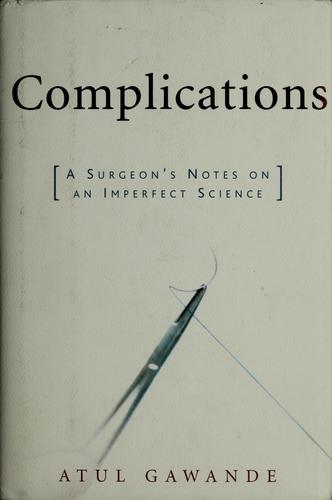
Complications is Atul Gawande's first collection of essays, drawn from his New Yorker writing and his early years as a surgical resident at Brigham and Women's Hospital.
Atul Gawande · 2002 · 4h 45m
Full summary and key takeaways →The 12 questions
- 1.
Gawande describes surgeons learning on patients without fully disclosing that fact. What is your reaction to that system — does it seem unavoidable, or is there a more honest approach?
- 2.
The book argues that medical error is structural, not just individual. What does that imply about how hospitals, regulators, and patients should respond to harm in medical settings?
- 3.
Gawande writes about his own early errors during training. Does a surgeon's willingness to be honest about mistakes change how you'd feel about being operated on by them?
- 4.
The heuristics that make diagnosis efficient also make it systematically biased. Where else do you see expert pattern-matching fail in ways that look obvious only afterward?
- 5.
The mystery section covers conditions that medicine can describe but not reliably treat. What would it mean to tell a patient honestly that the medical system doesn't have an answer for them?
- 6.
Gawande describes the culture of surgical training as one where admitting difficulty or uncertainty is professionally dangerous. How does that culture get changed, and who has to change it first?
- 7.
The uncertainty section raises the question of when to stop treating. How do you think about that decision for yourself or for family members — and what information would you want?
- 8.
Complications was published in 2002. Which of the problems Gawande identifies seem better addressed now, and which seem unchanged or worse?
- 9.
The book is written by a physician about medicine. How would the same stories read from the patients' perspectives, and what would be lost or gained in that shift?
- 10.
Gawande notes that some hospitals have better outcomes than others for the same procedures, and that neither patients nor referring doctors typically know which those are. What should follow from that?
- 11.
Which essay in Complications did you find most unsettling, and why? What assumption did it challenge?
- 12.
Gawande's tone is reflective rather than outraged. Is measured equanimity the right response to the problems he describes, or does it risk letting medicine off too easily?
How to run the discussion
- Pick six to eight, not all of them. An hour of real discussion covers fewer questions than anyone expects, and racing the list is what makes a book club feel like homework.
- Open with what people noticed, not what they concluded. Asking for a verdict first hardens opinions before anyone has heard each other.
- Let the disagreement run. The questions below that split a room are the ones worth the time; the ones everyone answers the same way can be skipped.
- Ask the quiet person a specific question. A direct, narrow question is far easier to answer than an open invitation to contribute.
Themes worth steering toward
If the conversation stalls, these are the threads that usually restart it.
Common questions
What are good book club questions for Complications?
Here are 12 book club questions for Complications by Atul Gawande, ordered to open easily and end somewhere worth arguing about. The strongest openers ask what each reader noticed rather than what they concluded, and the discussion usually turns on medicine, uncertainty, fallibility.
How long should a book club discussion of Complications last?
Most groups run 60 to 90 minutes of actual discussion. That is roughly six to eight questions, not all of them, so pick the ones that suit your group rather than working down the list in order.
What are the main themes in Complications?
Medicine, Uncertainty, Fallibility, Surgery, Medical culture. Those are the threads most likely to divide a room, which makes them the useful places to steer a discussion that has gone quiet.
Picking the next one? See books like Complications or questions for other book club picks.
