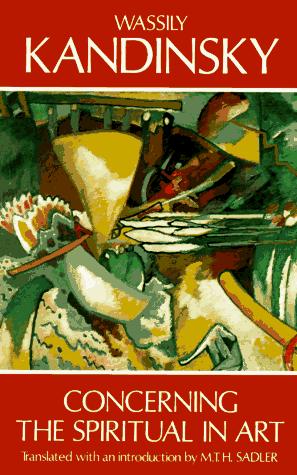
Talk to Concerning the Spiritual in Art like its author wrote you back.
Get the ideas that fit your life — not generic summaries.
- Chat with the book
- Audiobook-style main ideas
- Adapts to your life and goals
- Helps you take action
What it argues
Wassily Kandinsky's 1911 manifesto is the founding document of abstract art. Written as Kandinsky was abandoning representational painting entirely, it attempts something unusual: a theory of why art affects us, rooted in the idea that colors and forms carry intrinsic psychological and spiritual weight independent of any depicted subject. The argument is not mysticism for its own sake. Kandinsky was trying to solve a practical problem — how to make paintings that communicate directly, the way music does, without the detour of depicting recognizable objects.
The book opens with a diagnosis of the age. Kandinsky believed Western culture was in a period of materialist crisis — obsessed with measurable things, deaf to inner life. He saw certain painters, musicians, and poets as the vanguard of a coming "epoch of great spirituality" that would reassert immaterial values. The tone is messianic at points, but the underlying observation — that modern industrial society had flattened attention to the visible and material — has aged better than the more occult-inflected passages.
What it gets right
- 1.
Kandinsky argues that color and form carry intrinsic psychological effects — yellow agitates, blue deepens, acute angles energize — independent of any depicted subject.
- 2.
Abstract art is not empty decoration but an attempt to achieve the direct emotional communication that music achieves, without the mediation of recognizable objects.
- 3.
The concept of 'inner necessity' is Kandinsky's primary criterion for art: a work is valid when it expresses the artist's genuine inner impulse rather than imitating external appearance or following convention.
What it covers
Who wrote it
Wassily Kandinsky (1866–1944) was a Russian painter and art theorist widely credited as one of the first artists to produce purely abstract works. Born in Moscow, he studied law before moving to Munich to pursue painting in his thirties. He co-founded the Blue Rider group in 1911 with Franz Marc and taught at the Bauhaus from 1922 to 1933. His theoretical writings, including Point and Line to Plane (1926), complement his paintings in developing a systematic language of visual composition. He died in Neuilly-sur-Seine in 1944.
