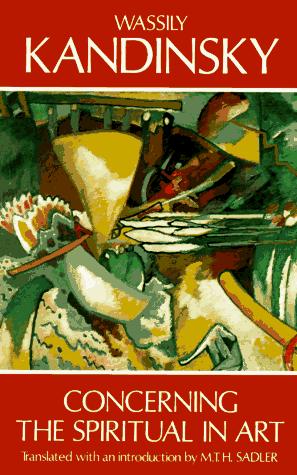
Concerning the Spiritual in Art by Wassily Kandinsky is a 1911 philosophy book about abstract art, color theory, spiritual experience. Kandinsky argues that color and form carry intrinsic psychological effects — yellow agitates, blue deepens, acute angles energize — independent of any depicted subject.
Summary
Wassily Kandinsky's 1911 manifesto is the founding document of abstract art. Written as Kandinsky was abandoning representational painting entirely, it attempts something unusual: a theory of why art affects us, rooted in the idea that colors and forms carry intrinsic psychological and spiritual weight independent of any depicted subject. The argument is not mysticism for its own sake. Kandinsky was trying to solve a practical problem — how to make paintings that communicate directly, the way music does, without the detour of depicting recognizable objects.
The book opens with a diagnosis of the age. Kandinsky believed Western culture was in a period of materialist crisis — obsessed with measurable things, deaf to inner life. He saw certain painters, musicians, and poets as the vanguard of a coming "epoch of great spirituality" that would reassert immaterial values. The tone is messianic at points, but the underlying observation — that modern industrial society had flattened attention to the visible and material — has aged better than the more occult-inflected passages.
The core chapters are about color and form as expressive instruments. Yellow advances and agitates; blue recedes and deepens. Warm colors carry different charge than cool ones. Acute angles feel different from obtuse ones. Kandinsky maps these effects with the earnestness of a researcher, drawing on his own synesthetic experience (he heard colors) and on parallels to music and literature. The paired discussion of color and sound runs through the book — he describes yellow as similar to a high trumpet, violet to an English horn. These analogies are not decoration. They are the mechanism by which Kandinsky argues that abstract art can achieve what he called "inner sound."
Kandinsky's case for abstraction is not that representation is bad but that it is limiting. When a painting is recognizable, the viewer reacts to the subject — "that's a horse," "that's a church." The formal properties (the specific yellow, the angle of a line) barely register. Abstraction removes the subject so those properties can speak. Whether you find this persuasive depends on how much you already believe art is about sensation rather than depiction, but the argument is more rigorous than its reputation suggests. Even readers skeptical of Kandinsky's spiritual framework will find the color chapters practically useful as a guide to why certain compositions work.
Talk to Concerning the Spiritual in Art like its author wrote you back.
Get the ideas that fit your life — not generic summaries.
- Chat with the book
- Audiobook-style main ideas
- Adapts to your life and goals
- Helps you take action
Key takeaways
- 1.
Kandinsky argues that color and form carry intrinsic psychological effects — yellow agitates, blue deepens, acute angles energize — independent of any depicted subject.
- 2.
Abstract art is not empty decoration but an attempt to achieve the direct emotional communication that music achieves, without the mediation of recognizable objects.
- 3.
The concept of 'inner necessity' is Kandinsky's primary criterion for art: a work is valid when it expresses the artist's genuine inner impulse rather than imitating external appearance or following convention.
- 4.
Kandinsky draws systematic parallels between colors and musical timbres, treating painting as a visual form of composition. Yellow is a high trumpet; violet is a low English horn.
- 5.
He distinguishes between three sources of inspiration: impressions from nature, improvisations (spontaneous expressions of inner life), and compositions (carefully constructed expressions of inner life).
- 6.
The spiritual crisis Kandinsky diagnoses — a culture so materialist it has lost access to inner experience — motivates the entire project. Abstract art is, in part, a response to that crisis.
- 7.
Form without color has meaning; color without form has meaning. But the two interact, and that interaction is the fundamental material of painting.
Discussion questions
Use these on your own, with a book club, or as chat starters in Superbook. Book club version, ready to copy or print →
- 1.
Kandinsky wrote this at the moment he was abandoning representational painting. How does knowing the historical stakes change how you read the arguments?
- 2.
Do his color associations — yellow as aggressive, blue as spiritual — match your own experience, or do they feel culturally specific?
- 3.
What does 'inner necessity' mean in practice? Can you think of art that obviously has it and art that obviously doesn't?
- 4.
Kandinsky draws extensive parallels to music. Does music work on you the way he describes, bypassing intellect and hitting directly? Does visual art do the same?
- 5.
He believed Western culture was in a materialist crisis that art could help correct. Does that diagnosis feel relevant now?
- 6.
The book's spiritualism draws on theosophy and Steiner. How much does the philosophical scaffolding matter if the color observations are accurate?
- 7.
Is abstract art actually more emotionally direct than representational art, or does it just require a different kind of learned perception?
- 8.
Kandinsky was synesthetic — he heard colors. How much of his theory depends on that unusual sensory equipment?
- 9.
Which of his color analyses has most changed how you see a specific painting or composition?
- 10.
The book was published in 1911, a year before his first purely abstract works. Does it feel like a manifesto building toward a decision, or a retrospective justification?
- 11.
What would it mean to apply 'inner necessity' as a standard to work outside art — writing, design, or music you make yourself?
Themes
Frequently asked questions
-
What is Concerning the Spiritual in Art about?
It is Kandinsky's argument that colors and abstract forms carry direct psychological and spiritual meaning, and that painting can communicate inner experience without depicting recognizable subjects — the theoretical foundation for abstract art.
-
Is Concerning the Spiritual in Art hard to read?
It is short (around 80 pages in most editions) and generally accessible, though some sections on theosophy and occultism require patience. The color theory chapters are the most practically useful and read clearly. Plan about two hours for a careful reading.
-
Who should read this book?
Painters, designers, and anyone interested in how color functions psychologically. It's also essential reading for understanding twentieth-century art history. Readers skeptical of mysticism should not be put off — the formal observations stand independently of the spiritual framework.
-
Is the color theory in this book still valid?
The associative observations (colors have consistent psychological tendencies) are broadly supported by subsequent research, though cross-cultural variation complicates some of Kandinsky's more universal claims. The core insight — that color choices have affective consequences beyond personal preference — is well established.
-
What is 'inner necessity' in Kandinsky's theory?
The principle that an artist's formal choices should be driven by genuine inner compulsion rather than imitation, trend-following, or mere decoration. It is his primary criterion for distinguishing meaningful art from empty technical exercise.