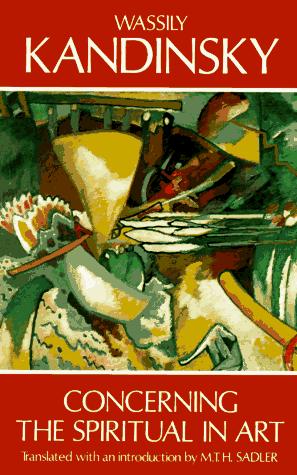
Talk to Concerning the Spiritual in Art like its author wrote you back.
Get the ideas that fit your life — not generic summaries.
- Chat with the book
- Audiobook-style main ideas
- Adapts to your life and goals
- Helps you take action
Concerning the Spiritual in Art, in detail
Wassily Kandinsky's 1911 manifesto is the founding document of abstract art. Written as Kandinsky was abandoning representational painting entirely, it attempts something unusual: a theory of why art affects us, rooted in the idea that colors and forms carry intrinsic psychological and spiritual weight independent of any depicted subject. The argument is not mysticism for its own sake. Kandinsky was trying to solve a practical problem — how to make paintings that communicate directly, the way music does, without the detour of depicting recognizable objects.
The book opens with a diagnosis of the age. Kandinsky believed Western culture was in a period of materialist crisis — obsessed with measurable things, deaf to inner life. He saw certain painters, musicians, and poets as the vanguard of a coming "epoch of great spirituality" that would reassert immaterial values. The tone is messianic at points, but the underlying observation — that modern industrial society had flattened attention to the visible and material — has aged better than the more occult-inflected passages.
The core chapters are about color and form as expressive instruments. Yellow advances and agitates; blue recedes and deepens. Warm colors carry different charge than cool ones. Acute angles feel different from obtuse ones. Kandinsky maps these effects with the earnestness of a researcher, drawing on his own synesthetic experience (he heard colors) and on parallels to music and literature. The paired discussion of color and sound runs through the book — he describes yellow as similar to a high trumpet, violet to an English horn. These analogies are not decoration. They are the mechanism by which Kandinsky argues that abstract art can achieve what he called "inner sound."
Kandinsky's case for abstraction is not that representation is bad but that it is limiting. When a painting is recognizable, the viewer reacts to the subject — "that's a horse," "that's a church." The formal properties (the specific yellow, the angle of a line) barely register. Abstraction removes the subject so those properties can speak. Whether you find this persuasive depends on how much you already believe art is about sensation rather than depiction, but the argument is more rigorous than its reputation suggests. Even readers skeptical of Kandinsky's spiritual framework will find the color chapters practically useful as a guide to why certain compositions work.
The big ideas
- 1.
Kandinsky argues that color and form carry intrinsic psychological effects — yellow agitates, blue deepens, acute angles energize — independent of any depicted subject.
- 2.
Abstract art is not empty decoration but an attempt to achieve the direct emotional communication that music achieves, without the mediation of recognizable objects.
- 3.
The concept of 'inner necessity' is Kandinsky's primary criterion for art: a work is valid when it expresses the artist's genuine inner impulse rather than imitating external appearance or following convention.
