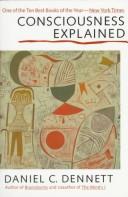
Consciousness Explained by Daniel C. Dennett is a 1991 philosophy book about consciousness, philosophy of mind, neuroscience. The Cartesian Theater — the idea of a central neural location where conscious experience is 'presented' — is a myth. No such location exists in the brain.
Summary
Consciousness Explained is Daniel Dennett's attempt to replace what he calls the Cartesian Theater — the intuitive picture of consciousness as a single unified stream of experience observed by a self — with a model he calls Multiple Drafts. The book is ambitious in scope and deliberately provocative in title. Dennett does not claim to have solved the hard problem of consciousness; he claims to dissolve it by arguing that the hard problem is built on a mistaken picture of what consciousness is.
The Cartesian Theater model assumes there is a central place in the brain where sensory information arrives, gets processed, and is "presented" to the conscious subject. Dennett argues that no such place exists and no such presentation happens. Instead, the brain runs multiple parallel processes that revise and compete with one another. What we experience as a unified, moment-by-moment conscious stream is actually a kind of retroactive narrative the brain constructs. Experiments on visual perception, temporal ordering, and change blindness are used to show that our introspective reports of our own experience are not reliable. We often report experiencing things we could not have experienced at the moment we claim.
Dennett also attacks the idea of qualia — the supposed intrinsic, ineffable character of subjective experience (the "redness" of red, the "painfulness" of pain). He argues qualia are philosophically incoherent: the properties philosophers attribute to them are mutually contradictory, and their apparent explanatory force dissolves once you think carefully about what they would need to be. This is the most contested part of the book. Many philosophers argue that in explaining qualia away, Dennett simply changes the subject — that he explains everything except what he promised to explain.
Consciousness Explained is demanding and long, and Dennett's prose requires sustained attention. It rewards readers willing to engage seriously with philosophy of mind, cognitive science, and the specific experiments Dennett marshals. Critics argue it is more accurately titled Consciousness Explained Away. Supporters contend it is the most honest account available of what neuroscience and evolution actually suggest about mind. Both camps agree the book is important and that the argument is serious enough to require a genuine rebuttal rather than dismissal.
Talk to Consciousness Explained like its author wrote you back.
Get the ideas that fit your life — not generic summaries.
- Chat with the book
- Audiobook-style main ideas
- Adapts to your life and goals
- Helps you take action
Key takeaways
- 1.
The Cartesian Theater — the idea of a central neural location where conscious experience is 'presented' — is a myth. No such location exists in the brain.
- 2.
Consciousness is better understood as Multiple Drafts: parallel processes that revise and compete until a narrative is retroactively settled on.
- 3.
Introspection is not reliable. Experiments show we routinely misreport the timing, sequence, and content of our own perceptual experiences.
- 4.
Qualia — the supposed intrinsic, private, ineffable qualities of experience — are philosophically incoherent. Their apparent mystery dissolves under careful analysis.
- 5.
The self is not a homunculus or a central controller. It is a narrative center of gravity: a useful fiction the brain generates to organize behavior.
- 6.
Free will, on Dennett's account, is compatible with determinism. The kind of freedom that matters is about the ability to respond to reasons, not about breaking causal chains.
- 7.
Evolution shaped the architecture of mind, and understanding consciousness requires understanding the adaptive functions that shaped it.
- 8.
Color, pain, and other seemingly obvious features of experience turn out to be relational and context-dependent rather than intrinsic properties of sensations.
Discussion questions
Use these on your own, with a book club, or as chat starters in Superbook. Book club version, ready to copy or print →
- 1.
Dennett argues the Cartesian Theater is a myth but admits it feels real. What does that gap between how mind feels from the inside and what neuroscience suggests tell us?
- 2.
The Multiple Drafts model says there is no single moment of consciousness. Does that match your own experience, or does it feel wrong in a way that seems significant?
- 3.
Dennett claims introspection is unreliable. Which of the experiments he describes do you find most convincing on this point?
- 4.
His critics say he explains qualia away rather than explains them. What would count as genuinely explaining subjective experience rather than explaining it away?
- 5.
If the self is a narrative fiction the brain generates, does that change anything about how you think about personal identity or moral responsibility?
- 6.
Dennett is a physicalist: he believes consciousness is entirely a product of physical processes. What would persuade you that he's wrong?
- 7.
The book was published in 1991. Which parts feel most outdated given developments in neuroscience since then, and which still hold up?
- 8.
Why do you think the intuition that there must be 'something it is like' to be conscious persists even among people who accept Dennett's framework intellectually?
- 9.
Dennett dismisses the 'hard problem' of consciousness as a pseudo-problem. Is that a satisfying philosophical move or an evasion?
- 10.
How does reading this book change, if at all, how you think about the consciousness of animals, infants, or AI systems?
- 11.
Dennett's tone is confident and sometimes dismissive of his opponents. Does that rhetorical style make the argument stronger or weaker?
- 12.
If everything Dennett claims is true, is there still a meaningful distinction between being awake and dreaming?
Themes
Frequently asked questions
-
What is Consciousness Explained about?
It's Dennett's argument that the common-sense picture of consciousness — a unified stream of experience observed by a self — is a useful fiction rather than a biological reality. He proposes the Multiple Drafts model as an alternative and argues that qualia and the Cartesian Theater are philosophical mistakes.
-
Is Consciousness Explained actually worth reading?
Yes, but be prepared for a demanding book. At over 500 pages and written in dense philosophical prose, it requires commitment. The reward is a serious, sustained encounter with the hardest questions about mind. Don't expect an easy resolution — the debate Dennett enters is still live.
-
How long does it take to read Consciousness Explained?
Ten to twelve hours for most readers. It's the longest and most technical of Dennett's popular books. Some sections require re-reading, particularly the chapters on qualia and introspection.
-
What is Dennett's main argument in Consciousness Explained?
That the brain has no central theater where consciousness happens. Instead, parallel processes run simultaneously and revise each other. The subjective sense of a unified, continuous stream of experience is a narrative the brain constructs after the fact, not a direct reflection of neural events.
-
Who should read Consciousness Explained?
Philosophy students, cognitive scientists, and anyone seriously interested in questions about mind and experience. General readers who want an accessible introduction to the topic may find it overwhelming. Start with his shorter book Kinds of Minds first if you're new to the territory.