Science fiction · Book club
Contact book club questions
Here are 12 book club questions for Contact by Carl Sagan, ordered to open easily and end somewhere worth arguing about. Copy them, print them, or bring them up one at a time.
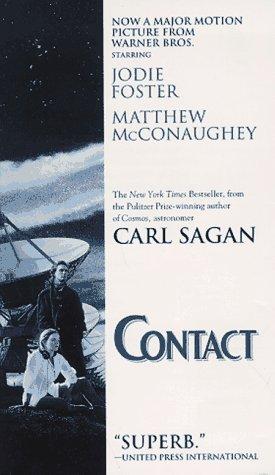
Contact follows Ellie Arroway, an astronomer and SETI researcher who has spent her career scanning the skies for evidence of extraterrestrial intelligence.
Carl Sagan · 1985 · 10h 0m
Full summary and key takeaways →The 12 questions
- 1.
Ellie ends the novel in the position of the religious believer — holding an unverifiable experience. Does Sagan seem to think this is ironic, a vindication of religious epistemology, or something else entirely?
- 2.
The political maneuvering around the machine — who gets on it, what it means geopolitically — is as detailed as the science. Does that feel like Sagan's natural concern, or a digression from the main story?
- 3.
The Vegans built the machine to test whether humanity could cooperate at a planetary level. Does humanity pass? Does Sagan think we do?
- 4.
The conversations between Ellie and Rankin (the evangelical) are the novel's most interesting philosophical exchanges. Which character does the novel seem to favor — or is it genuinely agnostic?
- 5.
Sagan's Ellie is a self-portrait: rational, lonely, committed to evidence. Is she a fully realized character to you, or a philosophical position with a name?
- 6.
Contact treats interstellar communication as primarily a mathematical and linguistic problem. Is that assumption still plausible to you, or has our thinking about intelligence changed enough to question it?
- 7.
The ending's ambiguity is famous. Do you read it as Ellie having genuinely made contact with something, as a simulation or illusion she experienced, or as deliberately unresolvable?
- 8.
Compared to Blindsight's hostile and incomprehensible aliens, Contact's Vegans are relatively benevolent and communicative. What does each novel's alien design say about its author's assumptions about intelligence?
- 9.
Science funding, institutional politics, and government interference are constant features of Ellie's career. How much does the novel's depiction of scientific work feel like Sagan's experience rather than fiction?
- 10.
The signal contains what turns out to be Hitler's face — the first television broadcast powerful enough to reflect back. How does Sagan use that detail, and what does it say about what we broadcast into the universe?
- 11.
Ellie's relationship with her dead father shapes her quest. Is the novel ultimately about the cosmos, or is the cosmos a way of talking about something more intimate?
- 12.
If a real SETI signal arrived tomorrow, do you think humanity would handle it anything like the novel suggests? What does your answer reveal about your assumptions about human nature?
How to run the discussion
- Pick six to eight, not all of them. An hour of real discussion covers fewer questions than anyone expects, and racing the list is what makes a book club feel like homework.
- Open with what people noticed, not what they concluded. Asking for a verdict first hardens opinions before anyone has heard each other.
- Let the disagreement run. The questions below that split a room are the ones worth the time; the ones everyone answers the same way can be skipped.
- Ask the quiet person a specific question. A direct, narrow question is far easier to answer than an open invitation to contribute.
Themes worth steering toward
If the conversation stalls, these are the threads that usually restart it.
Common questions
What are good book club questions for Contact?
Here are 12 book club questions for Contact by Carl Sagan, ordered to open easily and end somewhere worth arguing about. The strongest openers ask what each reader noticed rather than what they concluded, and the discussion usually turns on science and faith, first contact, political power.
How long should a book club discussion of Contact last?
Most groups run 60 to 90 minutes of actual discussion. That is roughly six to eight questions, not all of them, so pick the ones that suit your group rather than working down the list in order.
What are the main themes in Contact?
Science and faith, First contact, Political power, Search for meaning, Human unity. Those are the threads most likely to divide a room, which makes them the useful places to steer a discussion that has gone quiet.
Picking the next one? See books like Contact or questions for other book club picks.
