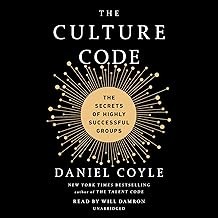
The Culture Code by Daniel Coyle is a 2018 business book about organizational culture, team dynamics, psychological safety. Culture is built through repeated micro-signals that answer the question 'is it safe to be here?' — not through values statements, town halls, or motivational programs.
Summary
The Culture Code is Daniel Coyle's investigation into what separates exceptional team cultures from average ones. After years studying organizations as different as the San Antonio Spurs, the Navy SEALs, the Pixar creative team, and a kindergarten class in Harlem, Coyle concluded that great cultures aren't built on vision statements or motivational speeches. They're built through tiny, repeated signals that answer the most basic human question in a social environment: is it safe to be here?
The book is organized around three skills. The first is building safety — creating the conditions where people feel secure enough to take risks, offer dissenting opinions, and admit mistakes. Coyle draws on Amy Edmondson's psychological safety research but makes it concrete through stories, showing exactly what language and behavior signals safety versus danger. The second skill is sharing vulnerability — specifically the way leaders who admit uncertainty, ask for help, and acknowledge failure create permission structures for everyone else to do the same. The third is establishing purpose through vivid, repeated narrative rather than through corporate values documents.
One of the book's most striking findings is about the role of small, non-verbal signals in culture. Groups that feel cohesive send constant low-level "belonging cues" — brief moments of eye contact, attention, proximity, humor — that tell members their presence matters. Coyle studied a group dynamics researcher who could predict whether a team would succeed or fail in twenty minutes by measuring these cues rather than by listening to what was being said.
The writing is clear and the case studies are well-chosen. Coyle avoids the over-systematizing that makes some culture books feel like PowerPoint decks. The result is a readable, well-evidenced case for why culture is a skill, not an accident — and why the specific behaviors of leaders matter more than the policies and values those leaders profess.
Talk to The Culture Code like its author wrote you back.
Get the ideas that fit your life — not generic summaries.
- Chat with the book
- Audiobook-style main ideas
- Adapts to your life and goals
- Helps you take action
Key takeaways
- 1.
Culture is built through repeated micro-signals that answer the question 'is it safe to be here?' — not through values statements, town halls, or motivational programs.
- 2.
Belonging cues are the small non-verbal signals — attention, proximity, eye contact, humor — that constantly communicate whether a person's presence matters. High-cohesion teams send far more of them.
- 3.
Psychological safety is not about eliminating conflict or criticism. It's about creating the conditions where honest input, risk-taking, and mistakes can occur without social punishment.
- 4.
Vulnerability loops work as follows: one person takes the risk of admitting uncertainty or asking for help; the other responds with vulnerability in kind; trust increases. Leaders who go first determine whether this loop starts.
- 5.
Purpose isn't built through mission statements — it's built through vivid, repeated narrative. The stories that teams tell about themselves define the behaviors that feel natural.
- 6.
The best teams have someone whose job is to watch for and amplify the moments when people behave consistently with the culture. Culture maintenance is active, not passive.
- 7.
Overcommunicating priorities works. Teams that constantly and redundantly articulate what matters most aren't being repetitive — they're preventing drift.
- 8.
High-performance teams talk more, not less. They ask more questions, use more humor, and interrupt each other more often than mediocre teams. Connection and information flow together.
Discussion questions
Use these on your own, with a book club, or as chat starters in Superbook. Book club version, ready to copy or print →
- 1.
Think about a team you've been on that had strong culture. What were the repeated small signals — not the big programs — that created that feeling?
- 2.
Coyle says belonging cues work through eye contact, attention, and small moments of connection. What do those cues look like in your current team's virtual or in-person interactions?
- 3.
Where in your organization is it genuinely unsafe to admit a mistake or voice a dissenting opinion? What's the cost of that?
- 4.
When was the last time a leader you respected made a genuine public admission of uncertainty or failure? What did that do to the culture around them?
- 5.
Coyle found that you could predict team success or failure in twenty minutes by measuring belonging cues. If a researcher watched your team for twenty minutes, what would they observe?
- 6.
What's the most important story your team tells about itself — the founding myth, the big win, the near-disaster? Does that story reinforce the culture you want?
- 7.
The book distinguishes between teams that read from the same script and teams that co-create their understanding of what matters. Which more accurately describes your team?
- 8.
Have you ever been on a team where psychological safety was present? What would you have to do differently to create that in your current team?
- 9.
Coyle describes leaders going first in vulnerability. What's something true about your current professional situation that you could share with your team that you haven't yet?
- 10.
What does your organization do when someone makes a significant mistake? Does the response build or erode psychological safety?
- 11.
What's a priority that your organization says it has but that its actual behavior consistently contradicts? How does that contradiction affect the culture?
- 12.
The book covers very different organizations — Navy SEALs, Pixar, a kindergarten class. What's the core cultural practice that shows up across all of them?
Themes
Frequently asked questions
-
Is The Culture Code worth reading?
Yes. It makes the abstract concept of organizational culture concrete and evidence-based without oversimplifying it. The case studies are vivid and well-selected, and the three-skill framework — safety, vulnerability, purpose — is simple enough to apply without being simplistic.
-
How long does it take to read The Culture Code?
Around four to five hours for the 288-page book. Coyle writes in a journalistic style that reads quickly, with stories carrying most of the argument.
-
What is a 'belonging cue' and why does it matter?
A belonging cue is any small signal — a moment of eye contact, a brief acknowledgment, a laugh, a leaning-in — that tells someone their presence is noticed and valued. Coyle found that high-cohesion teams send these constantly, and that they're measurable predictors of team performance. They're easy to miss and easy to improve.
-
Who should read The Culture Code?
Leaders at any level who want to build stronger teams. Particularly useful for managers who have tried culture initiatives that didn't stick and want to understand why — and what the alternative looks like.
-
What's the most actionable idea in The Culture Code?
The vulnerability loop: going first in admitting uncertainty or asking for help creates permission for everyone else to do the same. Coyle offers specific phrases and behaviors that activate this loop. The cost is low; the effect on trust is disproportionate.