Literary fiction · Book club
Crossroads book club questions
Here are 12 book club questions for Crossroads by Jonathan Franzen, ordered to open easily and end somewhere worth arguing about. Copy them, print them, or bring them up one at a time.
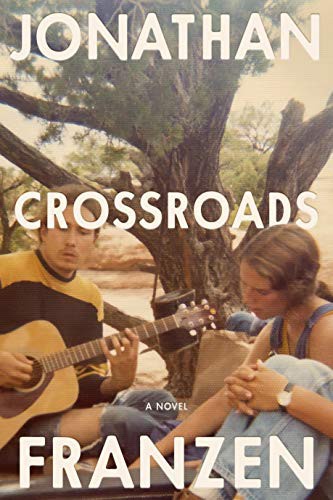
It is Christmas Eve 1971 in the Chicago suburb of New Prospect, Illinois, and the Hildebrandt family is in various states of crisis.
Jonathan Franzen · 2021 · 14h 15m
Full summary and key takeaways →The 12 questions
- 1.
Russ feels entitled to the influence and admiration that Rick Ambrose now holds at Crossroads. Is his resentment understandable, petty, or both — and how does the novel want you to read it?
- 2.
Marion's hidden history reframes everything you thought you understood about the family's dynamic. Did that reframing feel fair, or like a trick the novel held back too long?
- 3.
Clem decides to return his student deferment and enlist during the Vietnam War as a moral act. Is his reasoning coherent? Is it admirable, self-righteous, or naive?
- 4.
Perry is the novel's most intellectually agile character and the one most visibly destroying himself. What does the novel say about intelligence as both gift and liability?
- 5.
Crossroads the youth group is built around a version of countercultural Christianity that is simultaneously genuine and manipulable. How does Franzen navigate that ambiguity?
- 6.
The novel is set in 1971 but published in 2021. Does the period setting feel like creative freedom to you, or does it feel like nostalgia or avoidance?
- 7.
Becky's social calculation and her genuine awakening are running in parallel for most of the novel. Where does one end and the other begin?
- 8.
Franzen has been accused of writing female characters less fully than male ones. Does Marion's characterization change your view of that critique?
- 9.
This is the first volume of a trilogy. Does reading a novel that is explicitly incomplete feel satisfying or frustrating? How does Crossroads work as a standalone?
- 10.
Which family member did you find most sympathetic? Did that change over the course of the novel?
- 11.
Faith in the novel is sometimes a genuine resource and sometimes a performance or a tool for avoiding hard things. Can you tell which is which, and does the novel ask you to?
- 12.
If you've read Freedom or The Corrections, how does Crossroads compare as a family novel? What does the religious dimension add or complicate?
How to run the discussion
- Pick six to eight, not all of them. An hour of real discussion covers fewer questions than anyone expects, and racing the list is what makes a book club feel like homework.
- Open with what people noticed, not what they concluded. Asking for a verdict first hardens opinions before anyone has heard each other.
- Let the disagreement run. The questions below that split a room are the ones worth the time; the ones everyone answers the same way can be skipped.
- Ask the quiet person a specific question. A direct, narrow question is far easier to answer than an open invitation to contribute.
Themes worth steering toward
If the conversation stalls, these are the threads that usually restart it.
Common questions
What are good book club questions for Crossroads?
Here are 12 book club questions for Crossroads by Jonathan Franzen, ordered to open easily and end somewhere worth arguing about. The strongest openers ask what each reader noticed rather than what they concluded, and the discussion usually turns on faith and hypocrisy, family and betrayal, 1970s america.
How long should a book club discussion of Crossroads last?
Most groups run 60 to 90 minutes of actual discussion. That is roughly six to eight questions, not all of them, so pick the ones that suit your group rather than working down the list in order.
What are the main themes in Crossroads?
Faith and hypocrisy, Family and betrayal, 1970s America, Guilt and redemption, Adolescence and idealism. Those are the threads most likely to divide a room, which makes them the useful places to steer a discussion that has gone quiet.
Picking the next one? See books like Crossroads or questions for other book club picks.
