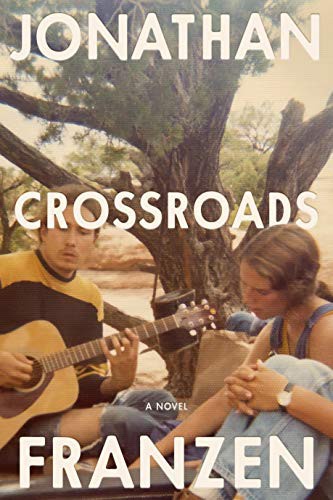
Crossroads by Jonathan Franzen is a 2021 literary fiction book about faith and hypocrisy, family and betrayal, 1970s america. Franzen takes religious belief seriously rather than ironically — Russ and Marion are not hypocrites in the simple satirical sense but people whose faith and failures coexist without canceling each other.
Summary
It is Christmas Eve 1971 in the Chicago suburb of New Prospect, Illinois, and the Hildebrandt family is in various states of crisis. The father, Russ, is an associate pastor at a Protestant church whose youth group, Crossroads, has been taken over by a charismatic rival who now holds all the influence and affection Russ believes he deserves. The mother, Marion, has a secret history that she has managed with extraordinary care for decades and is now watching that management fail. Their eldest son, Clem, is at home from college with a new moral conviction about Vietnam. Their daughter, Becky, is navigating the social politics of Crossroads with the social intelligence of someone who has always gotten what she wanted and is beginning to want things she can't quite name. Their youngest son, Perry, is the most intellectually gifted of the family and also the most in danger.
Crossroads is the first volume of a planned trilogy called A Key to All Mythologies. It is Franzen's most formally disciplined novel — each of the five family members gets substantial chapters, and the book is structured so that you understand the full picture only gradually, as each narration reveals what the others concealed. The 1971 setting is genuinely inhabited: the Vietnam-era countercultural Christianity of Crossroads, the Native American missions, the period's particular mix of idealism and hypocrisy, feel researched and imagined in equal measure.
What distinguishes Crossroads from Franzen's other novels is its explicit engagement with religion. Russ is not a hypocrite in the easy satirical sense — he is a man who genuinely believes and also genuinely fails to live by his beliefs, and Franzen takes both halves of that seriously. Marion's backstory involves a religious crisis and a psychological crisis that are harder to separate than she would like. The novel asks what faith actually is, as opposed to what it claims to be, with more seriousness than most contemporary literary fiction bothers with.
The length and the slow accumulation of perspective are the price of entry. This is not a novel you read for plot momentum. It rewards the kind of reading where you go back to an early chapter after finishing a later one and see it differently. Franzen's critics will find here everything they find in his other work; his admirers will find what they came for, and probably more care in the construction than usual.
Talk to Crossroads like its author wrote you back.
Get the ideas that fit your life — not generic summaries.
- Chat with the book
- Audiobook-style main ideas
- Adapts to your life and goals
- Helps you take action
Key takeaways
- 1.
Franzen takes religious belief seriously rather than ironically — Russ and Marion are not hypocrites in the simple satirical sense but people whose faith and failures coexist without canceling each other.
- 2.
The five-perspective structure requires patience but pays off: each family member's section reframes what you thought you understood from the others.
- 3.
Perry's intelligence is rendered as both his greatest attribute and the thing most likely to destroy him — a familiar Franzen pattern, but executed with unusual warmth.
- 4.
Marion's backstory is the novel's deepest surprise and its emotional center: a character whose surface self and interior history are the widest apart of any in the book.
- 5.
The 1971 setting allows Franzen to write about counterculture Christianity without the ironic distance that would come from a contemporary setting — the idealism feels genuinely lived in.
- 6.
Clem's decision about Vietnam raises the question the whole novel orbits: whether moral conviction that costs you something is worth more than moral conviction that doesn't.
- 7.
The family structure allows Franzen to show how the same household produces radically different people depending on birth order, personality, and what each child most needed from their parents.
- 8.
Crossroads is explicitly designed as the first third of a larger work, and it ends accordingly — open questions, threads unresolved, characters in motion. The satisfaction is architectural, not conclusive.
Discussion questions
Use these on your own, with a book club, or as chat starters in Superbook. Book club version, ready to copy or print →
- 1.
Russ feels entitled to the influence and admiration that Rick Ambrose now holds at Crossroads. Is his resentment understandable, petty, or both — and how does the novel want you to read it?
- 2.
Marion's hidden history reframes everything you thought you understood about the family's dynamic. Did that reframing feel fair, or like a trick the novel held back too long?
- 3.
Clem decides to return his student deferment and enlist during the Vietnam War as a moral act. Is his reasoning coherent? Is it admirable, self-righteous, or naive?
- 4.
Perry is the novel's most intellectually agile character and the one most visibly destroying himself. What does the novel say about intelligence as both gift and liability?
- 5.
Crossroads the youth group is built around a version of countercultural Christianity that is simultaneously genuine and manipulable. How does Franzen navigate that ambiguity?
- 6.
The novel is set in 1971 but published in 2021. Does the period setting feel like creative freedom to you, or does it feel like nostalgia or avoidance?
- 7.
Becky's social calculation and her genuine awakening are running in parallel for most of the novel. Where does one end and the other begin?
- 8.
Franzen has been accused of writing female characters less fully than male ones. Does Marion's characterization change your view of that critique?
- 9.
This is the first volume of a trilogy. Does reading a novel that is explicitly incomplete feel satisfying or frustrating? How does Crossroads work as a standalone?
- 10.
Which family member did you find most sympathetic? Did that change over the course of the novel?
- 11.
Faith in the novel is sometimes a genuine resource and sometimes a performance or a tool for avoiding hard things. Can you tell which is which, and does the novel ask you to?
- 12.
If you've read Freedom or The Corrections, how does Crossroads compare as a family novel? What does the religious dimension add or complicate?
Themes
Frequently asked questions
-
Do I need to read Franzen's earlier novels before Crossroads?
No. Crossroads is set in a new fictional world with new characters and stands entirely on its own. Many readers find it a better entry point than The Corrections because it's warmer and more structurally patient.
-
Is Crossroads a religious novel?
It's a novel about religious people, which is different. Franzen doesn't endorse any theological position, but he takes faith seriously as a human phenomenon — more so than most contemporary literary fiction. Readers of both religious and secular backgrounds find it engaging.
-
Is this the first book in a series? Do I have to wait for the rest?
Yes, it's volume one of a planned trilogy. The novel is self-contained enough to be read and appreciated on its own — it doesn't end on a cliffhanger — but it is explicitly a first act. The second volume, Purity's sequel, had not been published as of 2026.
-
How long is Crossroads, and is it worth it?
About 580 pages. The length is earned by the five-perspective structure — understanding each character fully takes time, and the payoffs come from accumulated context. Readers who commit typically find the middle third the most rewarding.
-
Who shouldn't read Crossroads?
Readers who are impatient with slow-burn family drama or who find suburban American Protestantism an uninteresting subject. If the 1971 setting feels remote, the novel offers period texture but doesn't provide historical drama to compensate. It's also structurally incomplete as volume one of three.