Business · Book club
Crucial Accountability book club questions
Here are 12 book club questions for Crucial Accountability by Kerry Patterson, Joseph Grenny, Ron McMillan, and Al Switzler, ordered to open easily and end somewhere worth arguing about. Copy them, print them, or bring them up one at a time.
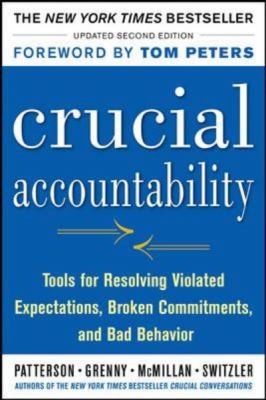
Crucial Accountability is the sequel to Crucial Conversations, narrowing its focus from high-stakes dialogue to one specific problem: what to do when someone fails to meet an expectation.
Kerry Patterson, Joseph Grenny, Ron McMillan, and Al Switzler · 2013 · 4h 15m
Full summary and key takeaways →The 12 questions
- 1.
Think of an accountability conversation you've been avoiding. What story are you telling yourself about why it will go badly?
- 2.
Patterson's diagnosis: motivation or ability? For the most persistent performance issue in your team, which do you actually think it is?
- 3.
When you last held an accountability conversation poorly, was the failure at safety, diagnosis, describing the gap, or follow-through?
- 4.
The CPR framework separates content from pattern from relationship. Which level do you most often conflate in difficult conversations?
- 5.
What natural consequences exist for the behavior you most need to address, and are you willing to actually let them happen?
- 6.
Have you ever made a commitment to someone and had them not follow up? What did their silence communicate to you about whether the expectation still stood?
- 7.
Think of a manager or leader who held you accountable well. What specifically did they do that made it feel fair rather than punitive?
- 8.
The book argues that most people assume motivation when the real problem is ability or resources. Can you think of an example where that diagnosis error played out?
- 9.
How does your organization's culture affect people's willingness to raise accountability issues upward? What would have to change for that to be safer?
- 10.
When you receive feedback that you haven't met an expectation, what's your first internal reaction — and does it serve you?
- 11.
The book says silence about a breach communicates acceptance. Where in your life are you inadvertently accepting behavior you'd prefer to change?
- 12.
Accountability requires clarity about expectations in the first place. Where are expectations in your team vague enough that accountability conversations are pre-emptively difficult?
How to run the discussion
- Pick six to eight, not all of them. An hour of real discussion covers fewer questions than anyone expects, and racing the list is what makes a book club feel like homework.
- Open with what people noticed, not what they concluded. Asking for a verdict first hardens opinions before anyone has heard each other.
- Let the disagreement run. The questions below that split a room are the ones worth the time; the ones everyone answers the same way can be skipped.
- Ask the quiet person a specific question. A direct, narrow question is far easier to answer than an open invitation to contribute.
Themes worth steering toward
If the conversation stalls, these are the threads that usually restart it.
Common questions
What are good book club questions for Crucial Accountability?
Here are 12 book club questions for Crucial Accountability by Kerry Patterson, Joseph Grenny, Ron McMillan, and Al Switzler, ordered to open easily and end somewhere worth arguing about. The strongest openers ask what each reader noticed rather than what they concluded, and the discussion usually turns on accountability, difficult conversations, leadership.
How long should a book club discussion of Crucial Accountability last?
Most groups run 60 to 90 minutes of actual discussion. That is roughly six to eight questions, not all of them, so pick the ones that suit your group rather than working down the list in order.
What are the main themes in Crucial Accountability?
Accountability, Difficult conversations, Leadership, Communication, Workplace behavior. Those are the threads most likely to divide a room, which makes them the useful places to steer a discussion that has gone quiet.
Picking the next one? See books like Crucial Accountability or questions for other book club picks.
