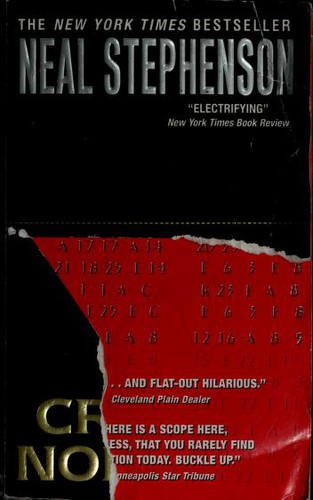
Talk to Cryptonomicon like its author wrote you back.
Get the ideas that fit your life — not generic summaries.
- Chat with the book
- Audiobook-style main ideas
- Adapts to your life and goals
- Helps you take action
What it argues
Cryptonomicon weaves together two storylines separated by half a century: World War II codebreakers and intelligence operatives running secret missions across the Pacific, and their grandchildren in the 1990s building a data haven in a fictional Southeast Asian country. The novel's engine is cryptography — actual, technically rigorous cryptography — woven into a thriller plot involving buried Nazi gold, corporate espionage, and the founding mythology of the internet. At 900-plus pages, it is a very long book that takes a very long time to do anything.
The book is really about the continuity between wartime secrecy and the information economy. The WWII generation created the infrastructure of secrets — the codes, the intelligence hierarchies, the strategic silence — and the 1990s generation inherits that infrastructure and tries to route it through fiber optic cable and offshore banking. Stephenson is interested in what it means to build systems for privacy in a world that wants surveillance, and whether "cypherpunk" libertarianism is a form of idealism or just rich men's self-interest dressed in principle.
What it gets right
- 1.
Information is power in its most abstract form, and the history of cryptography is the history of who gets to keep secrets from whom.
- 2.
The WWII generation's wartime innovations — in code, logistics, deception — laid the exact infrastructure that the internet generation inherited and monetized.
- 3.
Privacy is not a personal preference; it is a structural condition that has to be built deliberately into systems, or it will be removed deliberately by states.
What it covers
Who wrote it
Neal Stephenson is an American novelist best known for Snow Crash (1992), which coined the term "metaverse," and the Baroque Cycle trilogy, a three-volume historical novel about the birth of modern science and finance. His fiction ranges from near-future cyberpunk to deep historical speculation, and he is known for exhaustive research, technical depth, and prose that can run to hundreds of pages of digression without losing its reader. He has worked as a technical consultant for Blue Origin and other technology companies.
