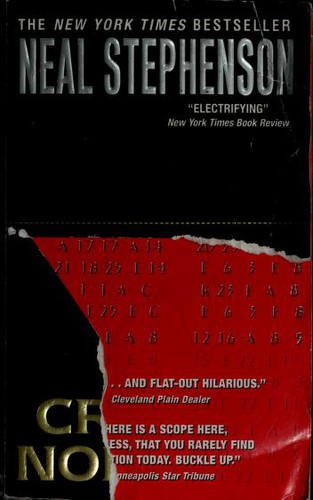
Talk to Cryptonomicon like its author wrote you back.
Get the ideas that fit your life — not generic summaries.
- Chat with the book
- Audiobook-style main ideas
- Adapts to your life and goals
- Helps you take action
Cryptonomicon, in detail
Cryptonomicon weaves together two storylines separated by half a century: World War II codebreakers and intelligence operatives running secret missions across the Pacific, and their grandchildren in the 1990s building a data haven in a fictional Southeast Asian country. The novel's engine is cryptography — actual, technically rigorous cryptography — woven into a thriller plot involving buried Nazi gold, corporate espionage, and the founding mythology of the internet. At 900-plus pages, it is a very long book that takes a very long time to do anything.
The book is really about the continuity between wartime secrecy and the information economy. The WWII generation created the infrastructure of secrets — the codes, the intelligence hierarchies, the strategic silence — and the 1990s generation inherits that infrastructure and tries to route it through fiber optic cable and offshore banking. Stephenson is interested in what it means to build systems for privacy in a world that wants surveillance, and whether "cypherpunk" libertarianism is a form of idealism or just rich men's self-interest dressed in principle.
What makes Cryptonomicon distinctive is its commitment to technical accuracy at the expense of pacing. Stephenson will spend twenty pages on a cryptographic algorithm, thirty pages on eating breakfast cereal, and then suddenly deliver a harrowing combat scene with novelistic precision. The tonal range is enormous and the voice — sardonic, digressive, genuinely brilliant — has no real equivalent in fiction. The result polarizes readers: some find the digressions the best part; others find them maddening.
This is a book for people who loved Neal Stephenson's Snow Crash and want more, for programmers and cryptographers who want their obsessions taken seriously by literature, and for readers who regard "too long" as a feature rather than a complaint. If you want a tightly paced thriller, this is the wrong book. If you want a 900-page meditation on the relationship between information, power, and freedom — told partly through WWII adventure and partly through dot-com satire — there is nothing else quite like it.
The big ideas
- 1.
Information is power in its most abstract form, and the history of cryptography is the history of who gets to keep secrets from whom.
- 2.
The WWII generation's wartime innovations — in code, logistics, deception — laid the exact infrastructure that the internet generation inherited and monetized.
- 3.
Privacy is not a personal preference; it is a structural condition that has to be built deliberately into systems, or it will be removed deliberately by states.
