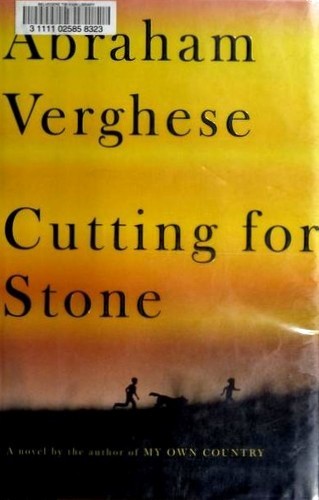
Talk to Cutting for Stone like its author wrote you back.
Get the ideas that fit your life — not generic summaries.
- Chat with the book
- Audiobook-style main ideas
- Adapts to your life and goals
- Helps you take action
Cutting for Stone, in detail
Cutting for Stone is Abraham Verghese's debut novel, a multigenerational saga set largely in Addis Ababa from the 1950s through the 1990s. Marion Stone narrates the story of his own origins: born to a British surgeon and an Ethiopian nun who dies in childbirth, he and his twin brother Shiva are raised by two Indian doctors at a mission hospital called Missing — a place whose name Verghese uses throughout as both fact and metaphor. The novel covers Marion's medical education, his exile to New York, and the catastrophic falling-out with his twin that drives the plot's back half.
The book is centrally interested in what it means to be formed by a place you didn't choose and to carry that formation into every subsequent life you inhabit. Ethiopia — its landscape, its civil wars, its medical poverty, its specific human texture — is rendered with the specificity of someone who knows it deeply, which Verghese does. The surgery scenes are genuinely instructive; Verghese is a practicing physician and the medical world he depicts is not borrowed but inhabited. The twin relationship gives the novel its moral core: the question of whether betrayal between those closest to you can be absorbed or whether it just changes what you are from then on.
The prose is warm, novelistic in the old mode, unhurried. This is a book that wants you to spend time with it, and it runs to 540 pages without apology. The pacing is deliberate — some readers find it generous, others find it slow. Verghese's literary influences are clearly nineteenth-century: he writes with the expressive confidence of someone who has read Dickens and Garcia Marquez and is not ashamed of the debt.
Cutting for Stone became a word-of-mouth phenomenon, passed between readers who found it the kind of big, humane novel that doesn't get written as often as it once was. Readers who bounce off it usually do so in the first hundred pages, before the Addis Ababa world is fully established. Those who stay tend to finish it in a rush and immediately recommend it to someone they love.
The big ideas
- 1.
The novel treats medicine not as a profession but as a vocation — a calling that shapes its practitioners' entire moral vocabulary, not just their working hours.
- 2.
Twinship is used throughout as a literalization of how we carry other people inside us, and how that can become a liability as well as a gift.
- 3.
Ethiopia is depicted with unusual specificity for Western literary fiction — its actual political history, geography, and culture rather than a vague 'African' backdrop.
