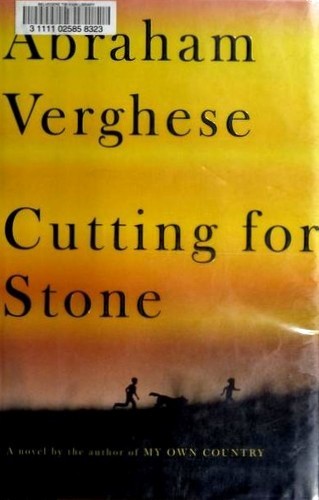
Cutting for Stone by Abraham Verghese is a 2009 literary fiction book about identity and origin, medicine and healing, father and son. The novel treats medicine not as a profession but as a vocation — a calling that shapes its practitioners' entire moral vocabulary, not just their working hours.
Summary
Cutting for Stone is Abraham Verghese's debut novel, a multigenerational saga set largely in Addis Ababa from the 1950s through the 1990s. Marion Stone narrates the story of his own origins: born to a British surgeon and an Ethiopian nun who dies in childbirth, he and his twin brother Shiva are raised by two Indian doctors at a mission hospital called Missing — a place whose name Verghese uses throughout as both fact and metaphor. The novel covers Marion's medical education, his exile to New York, and the catastrophic falling-out with his twin that drives the plot's back half.
The book is centrally interested in what it means to be formed by a place you didn't choose and to carry that formation into every subsequent life you inhabit. Ethiopia — its landscape, its civil wars, its medical poverty, its specific human texture — is rendered with the specificity of someone who knows it deeply, which Verghese does. The surgery scenes are genuinely instructive; Verghese is a practicing physician and the medical world he depicts is not borrowed but inhabited. The twin relationship gives the novel its moral core: the question of whether betrayal between those closest to you can be absorbed or whether it just changes what you are from then on.
The prose is warm, novelistic in the old mode, unhurried. This is a book that wants you to spend time with it, and it runs to 540 pages without apology. The pacing is deliberate — some readers find it generous, others find it slow. Verghese's literary influences are clearly nineteenth-century: he writes with the expressive confidence of someone who has read Dickens and Garcia Marquez and is not ashamed of the debt.
Cutting for Stone became a word-of-mouth phenomenon, passed between readers who found it the kind of big, humane novel that doesn't get written as often as it once was. Readers who bounce off it usually do so in the first hundred pages, before the Addis Ababa world is fully established. Those who stay tend to finish it in a rush and immediately recommend it to someone they love.
Talk to Cutting for Stone like its author wrote you back.
Get the ideas that fit your life — not generic summaries.
- Chat with the book
- Audiobook-style main ideas
- Adapts to your life and goals
- Helps you take action
Key takeaways
- 1.
The novel treats medicine not as a profession but as a vocation — a calling that shapes its practitioners' entire moral vocabulary, not just their working hours.
- 2.
Twinship is used throughout as a literalization of how we carry other people inside us, and how that can become a liability as well as a gift.
- 3.
Ethiopia is depicted with unusual specificity for Western literary fiction — its actual political history, geography, and culture rather than a vague 'African' backdrop.
- 4.
The central question of the book — what we owe to those who formed us, even when they failed or abandoned us — is asked without sentimentality and answered without easy resolution.
- 5.
Verghese's medical knowledge gives the surgery scenes a density of detail that reads as earned rather than decorative, and makes the healers feel like real professionals.
- 6.
Exile as a condition — not a temporary displacement but a permanent reorganization of what you belong to — runs through Marion's trajectory from Addis Ababa to New York.
- 7.
Betrayal between the closest people is treated as something that cannot be undone, only metabolized, and the novel is honest about how long that takes.
- 8.
The title, taken from a surgical aphorism about precision and care, becomes a recurring meditation on what it means to cut into another person's life and try to help.
Discussion questions
Use these on your own, with a book club, or as chat starters in Superbook. Book club version, ready to copy or print →
- 1.
Marion describes Missing hospital as a world complete in itself — is that idealization of an institution something you've encountered in your own life, and does the novel interrogate it honestly?
- 2.
Shiva and Marion are raised by the same people in the same place and become radically different. What does Verghese seem to think accounts for that divergence?
- 3.
The novel uses medicine as a lens for ethics throughout. Where do the moral frameworks of surgery — precision, cause and effect, repair — break down when applied to human relationships?
- 4.
Marion's biological father Thomas Stone is a figure of absence and then of complexity. Did you find his arc satisfying, or does the novel give him more grace than he earned?
- 5.
Ethiopia in the novel is a real, specific country with actual history — the Derg, the revolution, famine. How does Verghese balance the political with the personal without turning history into backdrop?
- 6.
Betrayal is the engine of the back half of the novel. Do you think the book resolves it too neatly, or is the resolution proportional to what it cost?
- 7.
The title comes from a quote attributed to Ambroise Paré: 'I dressed the wound, God healed it.' How does that aphorism function through the novel's various meanings of 'cutting'?
- 8.
Genet — the woman both brothers love — is presented largely through the brothers' eyes. Is she a fully realized character, or does she function primarily as a catalyst for male conflict?
- 9.
The novel is narrated from the end, by Marion who knows how everything turns out. How does that retrospective narration shape what we trust and what we question?
- 10.
Cutting for Stone is often compared to One Hundred Years of Solitude and to Dickens. Which comparison feels more accurate to you, and why?
- 11.
What does the novel suggest about what it means to be a good doctor — and are those qualities also what make someone a good person?
- 12.
The book ends on forgiveness. Did you find that ending earned by what came before, or was it a concession to the reader's desire for resolution?
Themes
Frequently asked questions
-
Is Cutting for Stone worth reading if I don't like medical fiction?
Probably yes. The medical content is specific and Verghese knows the material, but the novel is primarily about family, exile, and identity. The surgery scenes are not gratuitous. Think of the medicine as the professional world the characters inhabit, not as the subject of the book.
-
Is Cutting for Stone a long book?
Yes, around 540 pages and dense with incident and detail. It rewards patience. The first hundred pages establish a world that pays off later, but readers who find the opening slow should stick with it.
-
What is Cutting for Stone about, without spoilers?
Twin brothers born in a mission hospital in Ethiopia to an unlikely pair of parents, raised by surrogate doctors, separated by a catastrophic event, and trying to find each other across an ocean of exile and betrayal. It's a family saga with surgery at its center.
-
Why did Cutting for Stone become such a word-of-mouth hit?
It's a genuinely generous novel in a style that feels unfashionable — expansive, warm, morally serious, and deeply interested in its characters. Many readers passed it to someone immediately after finishing it, which is the oldest form of book marketing.
-
Who might not enjoy Cutting for Stone?
Readers who find long, unhurried novels frustrating. The pacing is deliberate and the world-building takes time to pay off. Also readers looking for formally experimental fiction — Verghese writes in a confident, traditional mode.