History · Book club
Dead Wake: The Last Crossing of the Lusitania book club questions
Here are 12 book club questions for Dead Wake: The Last Crossing of the Lusitania by Erik Larson, ordered to open easily and end somewhere worth arguing about. Copy them, print them, or bring them up one at a time.
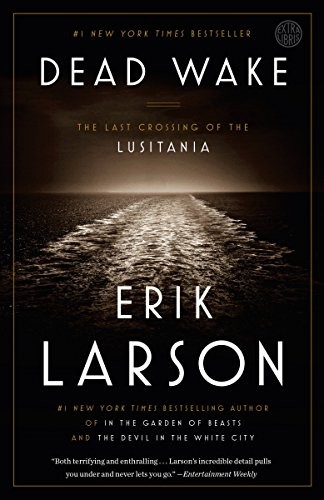
Dead Wake tells the story of the sinking of the RMS Lusitania on May 7, 1915, when a German U-boat torpedoed the British ocean liner off the coast of Ireland, killing 1,198 of the 1,959 people aboard, including 128 Americans.
Erik Larson · 2015 · 7h 42m
Full summary and key takeaways →The 12 questions
- 1.
Larson structures the book around three parallel narratives. Did that approach make the final convergence more or less emotionally effective?
- 2.
Room 40 had intelligence that could have protected the ship. Where does responsibility lie when bureaucratic failure produces a catastrophe — with individuals or with the system?
- 3.
Larson raises the possibility of deliberate Admiralty inaction without accusing anyone directly. Is that the right approach, or does it leave the reader in an unsatisfying middle ground?
- 4.
Captain Turner was blamed after the sinking and spent years defending himself. Does Larson's account change how you assess his decisions?
- 5.
The German submarine commander Schwieger kept a matter-of-fact log recording the attack. What does that voice tell you about how individuals participate in mass violence?
- 6.
The Lusitania was carrying some munitions, as Germany claimed. Does that change your moral assessment of the attack?
- 7.
Larson focuses on named individuals — Vanderbilt, Lauriat, Schwieger — to anchor the narrative. What are the costs and benefits of that approach for understanding a historical event?
- 8.
Dead Wake is partly a book about intelligence failures. How does it compare to other intelligence failures you know about, in terms of cause and consequence?
- 9.
The ship sank so quickly that most evacuation procedures were irrelevant. What does that imply about how we design safety systems — for ships, aircraft, or other mass transport?
- 10.
The sinking increased American pressure to enter the war but didn't immediately produce it. What does that suggest about how public opinion and political decision-making interact?
- 11.
Which passenger story moved you most, and what does it reveal about the randomness of who survives a disaster?
- 12.
Larson ends with the aftermath — the legal battles, the long shadow of the sinking. Does knowing the historical consequences add or subtract from the narrative's emotional impact?
How to run the discussion
- Pick six to eight, not all of them. An hour of real discussion covers fewer questions than anyone expects, and racing the list is what makes a book club feel like homework.
- Open with what people noticed, not what they concluded. Asking for a verdict first hardens opinions before anyone has heard each other.
- Let the disagreement run. The questions below that split a room are the ones worth the time; the ones everyone answers the same way can be skipped.
- Ask the quiet person a specific question. A direct, narrow question is far easier to answer than an open invitation to contribute.
Themes worth steering toward
If the conversation stalls, these are the threads that usually restart it.
Common questions
What are good book club questions for Dead Wake: The Last Crossing of the Lusitania?
Here are 12 book club questions for Dead Wake: The Last Crossing of the Lusitania by Erik Larson, ordered to open easily and end somewhere worth arguing about. The strongest openers ask what each reader noticed rather than what they concluded, and the discussion usually turns on world war i, maritime disaster, intelligence and decision-making.
How long should a book club discussion of Dead Wake: The Last Crossing of the Lusitania last?
Most groups run 60 to 90 minutes of actual discussion. That is roughly six to eight questions, not all of them, so pick the ones that suit your group rather than working down the list in order.
What are the main themes in Dead Wake: The Last Crossing of the Lusitania?
World War I, Maritime disaster, Intelligence and decision-making, Tragedy, Narrative history. Those are the threads most likely to divide a room, which makes them the useful places to steer a discussion that has gone quiet.
Picking the next one? See books like Dead Wake: The Last Crossing of the Lusitania or questions for other book club picks.
