Economics · Book club
Dealing with China book club questions
Here are 12 book club questions for Dealing with China by Henry M. Paulson Jr., ordered to open easily and end somewhere worth arguing about. Copy them, print them, or bring them up one at a time.
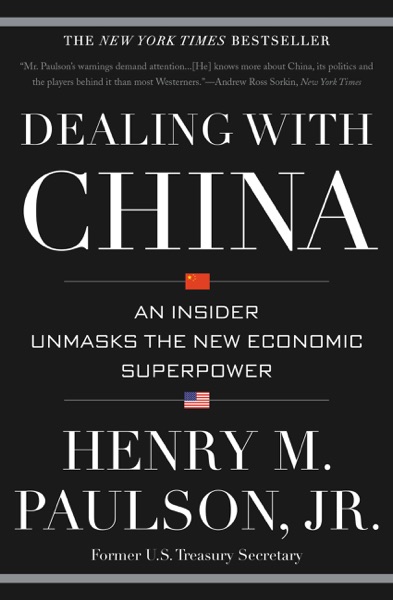
Dealing with China is Henry Paulson's account of thirty years of engagement with China's political and economic leadership, first as head of Goldman Sachs's Asia operations, then as the bank's CEO, and finally as US Treasury Secretary under President George W.
Henry M. Paulson Jr. · 2015 · 8h 45m
Full summary and key takeaways →The 12 questions
- 1.
Paulson argues that deep personal relationships with Chinese officials were essential to getting anything done. Does that model of diplomacy scale, or is it inherently fragile when individuals leave their posts?
- 2.
The book implicitly defends Goldman Sachs's engagement with Chinese state enterprises as commercially motivated but also development-positive. Is that framing convincing to you?
- 3.
He describes Chinese economic reformers of the 1990s as genuine believers in market-oriented reform. How does that characterization square with what has happened since Xi Jinping consolidated power?
- 4.
Paulson writes as someone who believed engagement would produce convergence. Looking back from 2026, where does that argument most clearly break down?
- 5.
The Strategic Economic Dialogue he ran with Wang Qishan was designed to create structured communication between the two governments on economic issues. What did it achieve, and what couldn't it achieve?
- 6.
He is candid that Wall Street's interest in China was commercial, not philanthropic. Does acknowledging the commercial motive make the engagement more credible or less, in your view?
- 7.
The 2008 financial crisis is described as a turning point in US credibility in China. What would the bilateral relationship look like today if the crisis had not happened?
- 8.
Paulson's most useful diplomatic tool was often framing Chinese concessions as serving Chinese domestic interests rather than American demands. Is that a transferable principle for negotiation more broadly?
- 9.
The book was published in 2015. Which of its observations have aged best, and which look most different from where we stand now?
- 10.
He argues against decoupling and for continued engagement. Given what has happened in the decade since publication, do you find that position still defensible or naive?
- 11.
What does the book reveal about the limits of economic logic in geopolitics — the moments where commercial logic and strategic logic pointed in opposite directions?
- 12.
Paulson had access that almost no other American did. What does that access reveal about China's approach to managing foreign relationships with key economic actors?
How to run the discussion
- Pick six to eight, not all of them. An hour of real discussion covers fewer questions than anyone expects, and racing the list is what makes a book club feel like homework.
- Open with what people noticed, not what they concluded. Asking for a verdict first hardens opinions before anyone has heard each other.
- Let the disagreement run. The questions below that split a room are the ones worth the time; the ones everyone answers the same way can be skipped.
- Ask the quiet person a specific question. A direct, narrow question is far easier to answer than an open invitation to contribute.
Themes worth steering toward
If the conversation stalls, these are the threads that usually restart it.
Common questions
What are good book club questions for Dealing with China?
Here are 12 book club questions for Dealing with China by Henry M. Paulson Jr., ordered to open easily and end somewhere worth arguing about. The strongest openers ask what each reader noticed rather than what they concluded, and the discussion usually turns on china, geopolitics, finance.
How long should a book club discussion of Dealing with China last?
Most groups run 60 to 90 minutes of actual discussion. That is roughly six to eight questions, not all of them, so pick the ones that suit your group rather than working down the list in order.
What are the main themes in Dealing with China?
China, Geopolitics, Finance, Diplomacy, Economic development. Those are the threads most likely to divide a room, which makes them the useful places to steer a discussion that has gone quiet.
Picking the next one? See books like Dealing with China or questions for other book club picks.
