Business · Book club
Dealing with Darwin book club questions
Here are 11 book club questions for Dealing with Darwin by Geoffrey Moore, ordered to open easily and end somewhere worth arguing about. Copy them, print them, or bring them up one at a time.
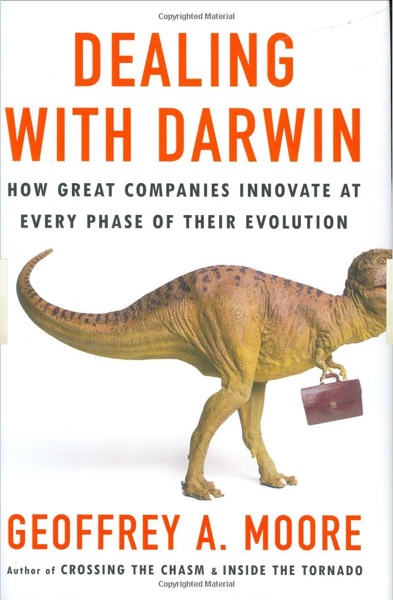
Dealing with Darwin is Geoffrey Moore's 2005 argument that established companies face a form of Darwinian selection pressure that startup logic cannot address, and that surviving it requires a clear understanding of where a company sits in its technology lifecycle and what kind of innovation is appropriate at each stage.
Geoffrey Moore · 2005 · 5h 45m
Full summary and key takeaways →The 11 questions
- 1.
Moore argues that different lifecycle stages require different innovation strategies. Think of a product or service you know well — where does it sit in the lifecycle, and is the innovation strategy being applied to it appropriate?
- 2.
The innovation zone / context zone distinction seems straightforward in theory. What makes it hard to execute in practice?
- 3.
Moore's examples are heavily weighted toward enterprise software and hardware. How well does his framework translate to other industries — retail, financial services, healthcare, consumer goods?
- 4.
He argues that large companies can't do disruptive innovation well and shouldn't try — they should acquire disruptions rather than create them. Is that a counsel of wisdom or of defeat?
- 5.
What happens to the people in the context zone when it gets outsourced or automated? Does Moore address this, and does his answer seem adequate?
- 6.
The book was written in 2005. Which of Moore's arguments feel more or less accurate given what has happened in the technology industry since then?
- 7.
Moore says established companies should compete in the innovation zone and minimize investment in context. But customers often can't tell the difference — what looks like context to the company can feel like core quality to the customer. How do you handle that?
- 8.
Think of a company you know that has stagnated. Does Moore's framework help explain why? What would the diagnosis suggest about what to do?
- 9.
The Crossing the Chasm framework argued that mainstream customers want complete solutions, not just leading-edge products. How does that insight extend into the Dealing with Darwin territory?
- 10.
Moore argues for concentrating innovation investment rather than distributing it broadly. How do you allocate innovation resources in your own work or organization?
- 11.
What's the most dangerous mistake an established company makes when it encounters a disruptive competitor, and what does Moore say to do about it?
How to run the discussion
- Pick six to eight, not all of them. An hour of real discussion covers fewer questions than anyone expects, and racing the list is what makes a book club feel like homework.
- Open with what people noticed, not what they concluded. Asking for a verdict first hardens opinions before anyone has heard each other.
- Let the disagreement run. The questions below that split a room are the ones worth the time; the ones everyone answers the same way can be skipped.
- Ask the quiet person a specific question. A direct, narrow question is far easier to answer than an open invitation to contribute.
Themes worth steering toward
If the conversation stalls, these are the threads that usually restart it.
Common questions
What are good book club questions for Dealing with Darwin?
Here are 11 book club questions for Dealing with Darwin by Geoffrey Moore, ordered to open easily and end somewhere worth arguing about. The strongest openers ask what each reader noticed rather than what they concluded, and the discussion usually turns on innovation, corporate strategy, competitive advantage.
How long should a book club discussion of Dealing with Darwin last?
Most groups run 60 to 90 minutes of actual discussion. That is roughly six to eight questions, not all of them, so pick the ones that suit your group rather than working down the list in order.
What are the main themes in Dealing with Darwin?
Innovation, Corporate strategy, Competitive advantage, Technology lifecycle, Organizational change. Those are the threads most likely to divide a room, which makes them the useful places to steer a discussion that has gone quiet.
Picking the next one? See books like Dealing with Darwin or questions for other book club picks.
