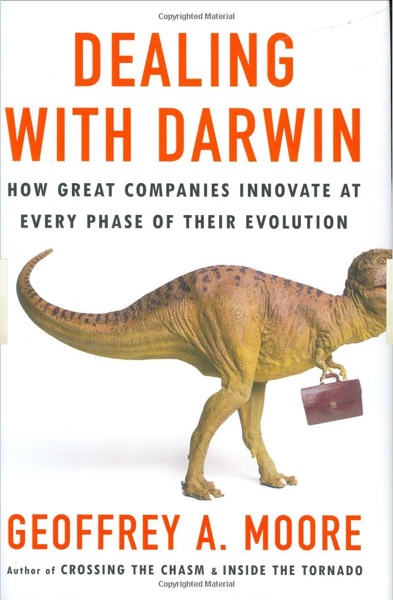
Dealing with Darwin by Geoffrey Moore is a 2005 business book about innovation, corporate strategy, competitive advantage. Innovation is not one thing. Disruptive, sustaining, and efficiency innovation require different strategies, different organizational structures, and different leadership approaches.
Summary
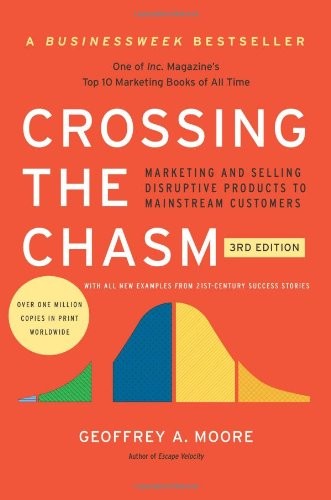
Dealing with Darwin is Geoffrey Moore's 2005 argument that established companies face a form of Darwinian selection pressure that startup logic cannot address, and that surviving it requires a clear understanding of where a company sits in its technology lifecycle and what kind of innovation is appropriate at each stage. Moore is best known for Crossing the Chasm, and this book extends that framework: where Chasm dealt with getting disruptive innovations to mainstream markets, Dealing with Darwin deals with the question of what an established company does after it has made it across.
The central framework is the innovation spectrum. At one end is disruptive innovation — the kind that creates new markets and redefines categories. At the other end is process innovation — optimizing and extracting value from existing offerings. Most companies need both, but the mistake Moore identifies is applying disruptive-innovation thinking to businesses that have reached maturity, or applying process optimization to categories that are still in flux. The two require different organizational cultures, different resource allocation, and different success metrics.
Moore introduces what he calls the innovation zone — the place where a company's differentiation actually lives and where innovation must be concentrated — and the context zone, where work needs to be done competently but doesn't differentiate the company. His prescription for most established companies is to migrate as much context work as possible to partners, outsourcing, and shared services, while concentrating internal investment on the zone where they can actually win. This is straightforward in theory and hard to execute against institutional resistance.
The book is practical rather than theoretical, and Moore's consulting background shows in both the clarity of the frameworks and the prevalence of enterprise tech examples. Readers outside the tech industry will need to do more translation work. But the core insight — that different stages of the technology lifecycle require fundamentally different innovation strategies, and that confusing them is the primary cause of large-company stagnation — is well argued and applicable beyond the specific examples Moore uses.
Talk to Dealing with Darwin like its author wrote you back.
Get the ideas that fit your life — not generic summaries.
- Chat with the book
- Audiobook-style main ideas
- Adapts to your life and goals
- Helps you take action
Key takeaways
- 1.
Innovation is not one thing. Disruptive, sustaining, and efficiency innovation require different strategies, different organizational structures, and different leadership approaches.
- 2.
Established companies are under Darwinian pressure to differentiate. The failure mode is not bad execution but misidentifying what kind of innovation is needed at the current lifecycle stage.
- 3.
The innovation zone is where a company's differentiation actually lives. Investment there should be aggressive. The context zone is where work must be done but doesn't win customers — investment there should be minimized through outsourcing and shared services.
- 4.
Migrating context to the lowest-cost provider frees resources for the innovation zone. Most large companies resist this because context work employs a lot of people and has internal champions.
- 5.
Category maturity changes the nature of competition. In a mature category, price and efficiency matter more; in an emerging one, feature differentiation and ecosystem positioning matter more.
- 6.
Large companies are better suited for sustaining and efficiency innovation than for disruptive innovation. This is not a failure of management; it is a structural property of established organizations.
- 7.
The technology adoption lifecycle — from early market through chasm to bowling alley to tornado to main street — determines what success looks like. Applying the wrong success metric at the wrong lifecycle stage reliably produces bad decisions.
Discussion questions
Use these on your own, with a book club, or as chat starters in Superbook. Book club version, ready to copy or print →
- 1.
Moore argues that different lifecycle stages require different innovation strategies. Think of a product or service you know well — where does it sit in the lifecycle, and is the innovation strategy being applied to it appropriate?
- 2.
The innovation zone / context zone distinction seems straightforward in theory. What makes it hard to execute in practice?
- 3.
Moore's examples are heavily weighted toward enterprise software and hardware. How well does his framework translate to other industries — retail, financial services, healthcare, consumer goods?
- 4.
He argues that large companies can't do disruptive innovation well and shouldn't try — they should acquire disruptions rather than create them. Is that a counsel of wisdom or of defeat?
- 5.
What happens to the people in the context zone when it gets outsourced or automated? Does Moore address this, and does his answer seem adequate?
- 6.
The book was written in 2005. Which of Moore's arguments feel more or less accurate given what has happened in the technology industry since then?
- 7.
Moore says established companies should compete in the innovation zone and minimize investment in context. But customers often can't tell the difference — what looks like context to the company can feel like core quality to the customer. How do you handle that?
- 8.
Think of a company you know that has stagnated. Does Moore's framework help explain why? What would the diagnosis suggest about what to do?
- 9.
The Crossing the Chasm framework argued that mainstream customers want complete solutions, not just leading-edge products. How does that insight extend into the Dealing with Darwin territory?
- 10.
Moore argues for concentrating innovation investment rather than distributing it broadly. How do you allocate innovation resources in your own work or organization?
- 11.
What's the most dangerous mistake an established company makes when it encounters a disruptive competitor, and what does Moore say to do about it?
Themes
Frequently asked questions
-
Do I need to read Crossing the Chasm before Dealing with Darwin?
It helps significantly. Dealing with Darwin extends and assumes the Chasm framework. The core concepts — the technology adoption lifecycle, the chasm between early adopters and mainstream customers — are referenced throughout. Readers unfamiliar with Moore's earlier work will find the first few chapters denser.
-
What is the main idea in Dealing with Darwin?
That established companies face Darwinian selection pressure and must identify the one or two places in their business where they can actually differentiate, concentrate innovation investment there, and migrate everything else to the lowest-cost provider. Confusing context work with differentiated work is the primary cause of large-company stagnation.
-
Is this book for startups or large companies?
Large companies and post-chasm businesses. Startup logic — disrupt, grow fast, worry about efficiency later — is the wrong framework for a company that has already crossed the chasm. Moore is writing for executives at established technology companies who need to compete sustainably rather than disruptively.
-
How long is Dealing with Darwin?
About 300 pages; most readers finish it in five to six hours. The frameworks are introduced systematically and the chapter structure is clear, which makes it easy to navigate.
-
What has held up best from this book?
The innovation zone / context zone distinction and the advice to outsource context aggressively. Companies that have done this — concentrating investment in differentiated capabilities while migrating commodity work to shared services — have generally performed better than those that tried to be excellent at everything. The advice is easier to give than to implement, but the diagnosis is accurate.