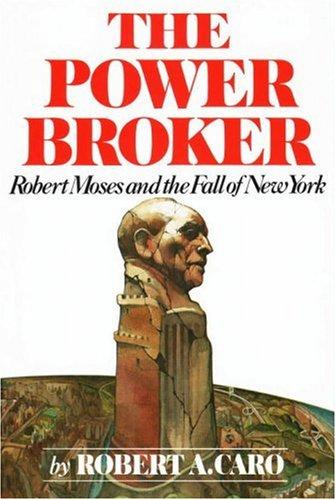
The Power Broker: Robert Moses and the Fall of New York by Robert A. Caro is a 1974 biography book about power, urban planning, new york. Administrative power without accountability produces both achievement and harm, and the harm tends to outlast the achievement. Moses's highways are still causing damage; most of the parks he built are still beautiful.
Summary
Robert A. Caro's Pulitzer Prize-winning biography of Robert Moses — who held no elected office but who shaped New York City more profoundly than any of its mayors, governors, or presidents — is one of the most sustained and brilliant acts of investigative biography in American letters. Published in 1974 after seven years of research, it runs to 1,162 pages and is not a book that can be fairly summarized; what it achieves is the accumulated demonstration of a thesis through hundreds of specific, documented instances.
The thesis is simple and devastating: unelected administrative power, once concentrated in the hands of a man with vision, energy, and no accountability to voters, produces both extraordinary achievement and extraordinary harm, and the harm tends to accelerate as the power becomes unchallengeable. Moses built 658 playgrounds, 13 bridges, 416 miles of parkways, 35 highways, Jones Beach, Lincoln Center, Shea Stadium, and much of what New York calls parks. He also destroyed hundreds of thousands of homes, concentrated poverty in massive housing projects, built a highway system that strangled the city's economy, and did it all with a comprehensive contempt for the poor and for Black New Yorkers that was not incidental to his plans but architectural.
The Moses who emerges from this biography is one of the most complex figures in the literature of American power. He was genuinely idealistic in his youth — the early chapters trace his progressive formation, his Oxford education, his early commitment to civil service reform — and the biography's central tragedy is watching that idealism erode as power accumulated. By mid-career Moses had become what he once opposed: a machine politician who used the mechanisms of reform to insulate himself from accountability.
Caro's research method — which involved interviewing hundreds of people, including many who had never before spoken on the record about Moses, and examining financial records that Moses had designed to be opaque — produced revelations about how political power actually works that no political science textbook provides. The Power Broker is the essential text for understanding how American cities were built and why they so often failed the people they were supposed to serve.
Talk to The Power Broker: Robert Moses and the Fall of New York like its author wrote you back.
Get the ideas that fit your life — not generic summaries.
- Chat with the book
- Audiobook-style main ideas
- Adapts to your life and goals
- Helps you take action
Key takeaways
- 1.
Administrative power without accountability produces both achievement and harm, and the harm tends to outlast the achievement. Moses's highways are still causing damage; most of the parks he built are still beautiful.
- 2.
Procedural knowledge is power. Moses understood bond covenants, project authorities, and bureaucratic structures better than any politician of his era, which is how he made himself unchallengeable.
- 3.
Racism can be architectural. Moses's bridge clearances over parkways were deliberately built too low for buses, ensuring that Black New Yorkers who depended on public transit could not reach beaches and parks his highways served.
- 4.
The ideal public servant can become the corrupt public servant through the same mechanism — the belief that he knows better than the people he serves — without ever noticing the transformation.
- 5.
Cities are built by people making specific decisions about specific parcels of land, and those decisions have physical and human consequences that last for generations.
- 6.
Robert Moses held multiple positions simultaneously — sometimes a dozen at once — making him accountable to no single authority and impossible to remove from any single post.
- 7.
Caro's method demonstrates that biography is a form of investigative journalism. The Power Broker would not be possible without the interviews of dozens of people who feared Moses during his lifetime.
- 8.
The poor bear the cost of urban redevelopment while the middle class receives the benefits. Moses's projects illustrate this dynamic with unusual clarity because his contempt for the displaced was explicit.
Discussion questions
Use these on your own, with a book club, or as chat starters in Superbook. Book club version, ready to copy or print →
- 1.
Moses never held elected office. How did he acquire and hold power for four decades? What does that mechanism suggest about democratic accountability?
- 2.
Caro argues that Moses's racism was not incidental but architectural — built into his projects at a physical level. Do you find that argument convincing?
- 3.
The early Moses — the progressive reformer — was genuinely idealistic. How does the biography explain the transformation into the figure he became?
- 4.
The book is 1,162 pages. Caro insists that every page is necessary. Do you agree? What would you cut?
- 5.
Moses's parks and beaches gave millions of New Yorkers experiences they could not otherwise have had. How do you weigh that against the destruction of neighborhoods and the concentration of poverty?
- 6.
Many of the politicians who knew Moses was using improper means to achieve ends they approved of looked the other way. What does the book suggest about the ethics of complicity?
- 7.
Caro spent seven years on the book and was told repeatedly that Moses would not cooperate. How does a biography proceed without its subject's cooperation? What are the limits?
- 8.
The Power Broker was published in 1974. How has New York changed since? Are the physical legacies Moses created better or worse than they appeared then?
- 9.
What does Moses's career suggest about whether administrative expertise and democratic accountability can coexist?
- 10.
Caro is equally or more famous for his multi-volume biography of Lyndon Johnson. Do you see continuities between his interest in Moses and his interest in Johnson?
- 11.
Is the book ultimately a tragedy — about a man who could have been great — or a warning? Does Caro distinguish between the two?
Themes
Frequently asked questions
-
Is The Power Broker readable despite its length?
Yes. Caro is one of the most skilled narrative nonfiction writers in American letters, and the book's pace rarely flags despite its size. Most readers who start it finish it. The opening hundred pages, which trace Moses's progressive formation, reward the patience they require.
-
Is the book about Moses specifically or about power generally?
Both. Caro uses Moses as a case study to demonstrate general principles about how administrative power operates without accountability. The book is as much a political science text as a biography.
-
How accurate is The Power Broker?
It is meticulous by the standards of the genre. Moses disputed some characterizations after publication, and a few specific facts have been challenged by subsequent researchers. The overall argument — about Moses's power, his methods, and his racism — is well-documented and widely accepted by urban historians.
-
Did Moses ever respond to the book?
Moses was furious. He prepared a lengthy rebuttal and sent it to Caro's publisher, who distributed it to reviewers. The rebuttal was widely considered to not substantially refute the book's central claims.
-
Where should I start if I want to read Caro but am not ready for The Power Broker?
Working, Caro's short memoir about his research methods, is an accessible entry point. The first volume of the LBJ biography, The Path to Power, is also more immediately engaging than its scale suggests. But The Power Broker is the book that most thoroughly demonstrates what Caro can do.