Psychology · Book club
Descartes' Error: Emotion, Reason, and the Human Brain book club questions
Here are 11 book club questions for Descartes' Error: Emotion, Reason, and the Human Brain by Antonio Damasio, ordered to open easily and end somewhere worth arguing about. Copy them, print them, or bring them up one at a time.
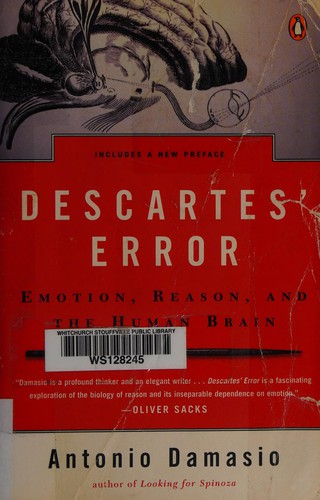
Antonio Damasio is a neurologist at USC whose work challenges the centuries-old idea that reason and emotion are separate faculties, with reason the reliable guide and emotion the unreliable interference.
Antonio Damasio · 1994 · 5h 0m
Full summary and key takeaways →The 11 questions
- 1.
Damasio's core claim is that emotion is necessary for good decision-making. Does that fit your experience — or can you think of cases where emotion clearly led you to a worse decision?
- 2.
The somatic marker hypothesis proposes that body states guide decisions before conscious deliberation begins. Can you identify examples in your own experience of noticing a physical response to an option before you had explicitly analyzed it?
- 3.
Phineas Gage was 'no longer Gage' after his accident but retained his intelligence. What does that suggest about the relationship between cognitive ability and personhood?
- 4.
Damasio argues that the Cartesian separation of mind from body has distorted how medicine treats illness. What aspects of medicine would be different if the body-mind connection were taken seriously from the start?
- 5.
The book was published in 1994. How has the somatic marker hypothesis been received and developed in the subsequent thirty years of neuroscience?
- 6.
He argues that pure reason — reasoning disconnected from emotional knowledge — produces poor real-world decisions. What are the implications for how we design and evaluate AI systems that reason without bodies?
- 7.
The frontal lobe cases show that practical wisdom is not the same as intelligence. Can you think of people you know who are highly intelligent but lack practical wisdom, and what might explain the gap?
- 8.
Damasio's work implies that decisions made by patients with orbitofrontal damage are not simply bad choices but are physiologically impaired. What are the implications for legal and moral responsibility?
- 9.
He distinguishes between primary emotions (instinctive responses to stimuli) and secondary emotions (acquired responses to representations). How does that distinction map onto how you experience your own emotional responses?
- 10.
The embodiment argument means you cannot separate clear thinking from bodily state. What practical implications does this have for when and how you make important decisions?
- 11.
Which aspect of Damasio's argument do you find most convincing, and which seems most speculative?
How to run the discussion
- Pick six to eight, not all of them. An hour of real discussion covers fewer questions than anyone expects, and racing the list is what makes a book club feel like homework.
- Open with what people noticed, not what they concluded. Asking for a verdict first hardens opinions before anyone has heard each other.
- Let the disagreement run. The questions below that split a room are the ones worth the time; the ones everyone answers the same way can be skipped.
- Ask the quiet person a specific question. A direct, narrow question is far easier to answer than an open invitation to contribute.
Themes worth steering toward
If the conversation stalls, these are the threads that usually restart it.
Common questions
What are good book club questions for Descartes' Error: Emotion, Reason, and the Human Brain?
Here are 11 book club questions for Descartes' Error: Emotion, Reason, and the Human Brain by Antonio Damasio, ordered to open easily and end somewhere worth arguing about. The strongest openers ask what each reader noticed rather than what they concluded, and the discussion usually turns on emotion and reason, neuroscience, consciousness.
How long should a book club discussion of Descartes' Error: Emotion, Reason, and the Human Brain last?
Most groups run 60 to 90 minutes of actual discussion. That is roughly six to eight questions, not all of them, so pick the ones that suit your group rather than working down the list in order.
What are the main themes in Descartes' Error: Emotion, Reason, and the Human Brain?
Emotion and reason, Neuroscience, Consciousness, Decision-making, Embodiment. Those are the threads most likely to divide a room, which makes them the useful places to steer a discussion that has gone quiet.
Picking the next one? See books like Descartes' Error: Emotion, Reason, and the Human Brain or questions for other book club picks.
