Self-help · Book club
Design Is Storytelling book club questions
Here are 11 book club questions for Design Is Storytelling by Ellen Lupton, ordered to open easily and end somewhere worth arguing about. Copy them, print them, or bring them up one at a time.
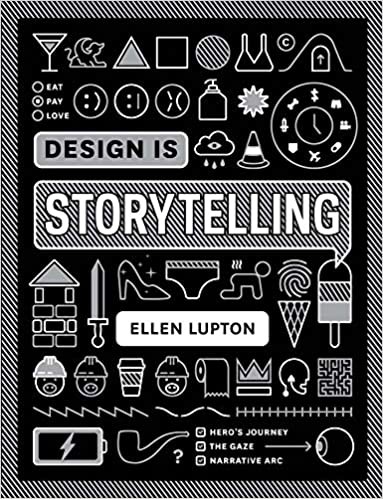
Design Is Storytelling is Ellen Lupton's compact guide to narrative thinking as a design skill.
Ellen Lupton · 2017 · 3h 20m
Full summary and key takeaways →The 11 questions
- 1.
Lupton argues that designed experiences have narrative arc. Can you identify an example from your own work or use where this structure was handled well — and one where it was not?
- 2.
Journey mapping tracks emotional states as well as behaviors. In your experience, do design processes at your organization actually attend to how users feel at each stage, or primarily to what they do?
- 3.
The book draws on the hero's journey and other narrative archetypes. Is this a useful frame for product and service design, or does it impose literary conventions on something fundamentally different?
- 4.
Lupton treats typography and color as rhetorical tools — arguments made through visual form. Can you analyze a recent piece of visual communication you encountered as rhetoric? What case was it making?
- 5.
The book is both an argument about design and a designed object. How does the relationship between content and form work in the book itself? Does it demonstrate its thesis?
- 6.
Point of view in design means the perspective from which a story is told. Most design defaults to an institutional perspective. What would change if the default were explicitly the user's perspective?
- 7.
Empathy in design has become a widely used but also widely criticized term. What do you think empathy actually requires of a designer in practice, and what are its limits?
- 8.
Design Is Storytelling is short and broad. Does a book about design need to go deep to be useful, or is breadth more valuable for a diverse professional audience?
- 9.
Lupton is a curator and design educator, not primarily a practitioner. Does her institutional position affect the argument she makes or the examples she chooses?
- 10.
How does the storytelling framework apply to industrial or product design — objects rather than interfaces or communications? Where does it work, and where does it break down?
- 11.
The book draws on gestalt psychology to explain visual perception. How much of visual communication is based on universal perceptual principles versus culturally specific conventions?
How to run the discussion
- Pick six to eight, not all of them. An hour of real discussion covers fewer questions than anyone expects, and racing the list is what makes a book club feel like homework.
- Open with what people noticed, not what they concluded. Asking for a verdict first hardens opinions before anyone has heard each other.
- Let the disagreement run. The questions below that split a room are the ones worth the time; the ones everyone answers the same way can be skipped.
- Ask the quiet person a specific question. A direct, narrow question is far easier to answer than an open invitation to contribute.
Themes worth steering toward
If the conversation stalls, these are the threads that usually restart it.
Common questions
What are good book club questions for Design Is Storytelling?
Here are 11 book club questions for Design Is Storytelling by Ellen Lupton, ordered to open easily and end somewhere worth arguing about. The strongest openers ask what each reader noticed rather than what they concluded, and the discussion usually turns on visual storytelling, design, narrative.
How long should a book club discussion of Design Is Storytelling last?
Most groups run 60 to 90 minutes of actual discussion. That is roughly six to eight questions, not all of them, so pick the ones that suit your group rather than working down the list in order.
What are the main themes in Design Is Storytelling?
Visual storytelling, Design, Narrative, Empathy, Communication. Those are the threads most likely to divide a room, which makes them the useful places to steer a discussion that has gone quiet.
Picking the next one? See books like Design Is Storytelling or questions for other book club picks.
