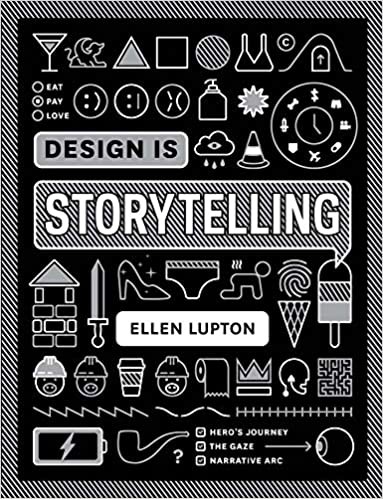
Design Is Storytelling by Ellen Lupton is a 2017 self-help book about visual storytelling, design, narrative. Narrative structure — arc, tension, resolution — is not a literary concept borrowed by designers but a fundamental property of any designed experience that unfolds over time.
Summary
Design Is Storytelling is Ellen Lupton's compact guide to narrative thinking as a design skill. Published in 2017 by the Cooper Hewitt, Smithsonian Design Museum — where Lupton serves as senior curator of contemporary design — the book argues that the tools of narrative: arc, tension, character, point of view, empathy, are not metaphors borrowed from literature but structural principles that apply directly to graphic design, interface design, exhibition design, and visual communication of all kinds.
The book is organized in three parts. The first, "Action," examines narrative arc: how the classic three-act structure (setup, confrontation, resolution) maps onto everything from a landing page to a museum exhibit. Lupton introduces Freytag's pyramid and variants of it, arguing that designed experiences have emotional momentum that can be shaped — accelerated, delayed, punctuated — just as a story can. She extends this to journey mapping, showing how understanding a user's emotional state at each stage of an interaction is a design problem as much as a technical one.
The second part, "Emotion," covers visual rhetoric and the way typography, color, image, and composition create feeling and guide attention. Lupton draws on gestalt psychology and semiotics but keeps the material accessible and visually demonstrated. The book is richly illustrated throughout — it is a designed object as well as an argument about design. The third part, "Thinking," addresses point of view and the designer's relationship to the audience: who is telling this story, for whom, and from what vantage.
Design Is Storytelling is short and visually oriented, intended to be useful in a classroom or studio. It does not go deep on any single topic but covers a wide range of concepts — empathy mapping, the hero's journey, visual hierarchy, affordances, the role of friction — with enough specificity to be actionable. For designers who have worked intuitively with narrative but never had a vocabulary for it, the book provides a framework without being prescriptive. It is most useful as a prompt for reflection rather than a recipe.
Talk to Design Is Storytelling like its author wrote you back.
Get the ideas that fit your life — not generic summaries.
- Chat with the book
- Audiobook-style main ideas
- Adapts to your life and goals
- Helps you take action
Key takeaways
- 1.
Narrative structure — arc, tension, resolution — is not a literary concept borrowed by designers but a fundamental property of any designed experience that unfolds over time.
- 2.
Journey mapping treats the user's emotional state at each stage of an interaction as a design problem. Anxiety, delight, confusion, and trust are design outcomes, not side effects.
- 3.
Freytag's pyramid (rising action, climax, falling action) maps onto interfaces, exhibits, campaigns, and products wherever there is a beginning, middle, and end to the user's experience.
- 4.
Typography, color, and composition are rhetorical tools: they make arguments, create emphasis, and produce emotional states in ways that are analyzable and reproducible.
- 5.
Point of view matters in design. Every designed object implies a narrator — a perspective from which the story is being told — and being explicit about that perspective improves the coherence of the work.
- 6.
Empathy — understanding the user's situation, goals, and emotional state — is a storytelling skill before it is a user research method. It requires imagination as much as data.
- 7.
Visual hierarchy controls attention: what the viewer sees first, second, and last shapes the meaning of the whole. Flat hierarchy is not neutral; it is a design failure.
Discussion questions
Use these on your own, with a book club, or as chat starters in Superbook. Book club version, ready to copy or print →
- 1.
Lupton argues that designed experiences have narrative arc. Can you identify an example from your own work or use where this structure was handled well — and one where it was not?
- 2.
Journey mapping tracks emotional states as well as behaviors. In your experience, do design processes at your organization actually attend to how users feel at each stage, or primarily to what they do?
- 3.
The book draws on the hero's journey and other narrative archetypes. Is this a useful frame for product and service design, or does it impose literary conventions on something fundamentally different?
- 4.
Lupton treats typography and color as rhetorical tools — arguments made through visual form. Can you analyze a recent piece of visual communication you encountered as rhetoric? What case was it making?
- 5.
The book is both an argument about design and a designed object. How does the relationship between content and form work in the book itself? Does it demonstrate its thesis?
- 6.
Point of view in design means the perspective from which a story is told. Most design defaults to an institutional perspective. What would change if the default were explicitly the user's perspective?
- 7.
Empathy in design has become a widely used but also widely criticized term. What do you think empathy actually requires of a designer in practice, and what are its limits?
- 8.
Design Is Storytelling is short and broad. Does a book about design need to go deep to be useful, or is breadth more valuable for a diverse professional audience?
- 9.
Lupton is a curator and design educator, not primarily a practitioner. Does her institutional position affect the argument she makes or the examples she chooses?
- 10.
How does the storytelling framework apply to industrial or product design — objects rather than interfaces or communications? Where does it work, and where does it break down?
- 11.
The book draws on gestalt psychology to explain visual perception. How much of visual communication is based on universal perceptual principles versus culturally specific conventions?
Themes
Frequently asked questions
-
What is Design Is Storytelling about?
Ellen Lupton's argument that narrative tools — arc, tension, empathy, point of view — are structural principles that apply directly to graphic design, interface design, and visual communication, not literary metaphors. The book gives designers a vocabulary for thinking about the emotional and temporal dimensions of designed experiences.
-
Is Design Is Storytelling only for graphic designers?
No. The principles apply to anyone making designed experiences: product designers, UX practitioners, exhibition curators, educators, and communicators. The book is visually illustrated throughout, which makes it accessible even to readers without formal design training.
-
How long is Design Is Storytelling?
About 160 pages, generously illustrated. It reads quickly — two to three hours — and is designed to be browsed as well as read. The visual examples carry much of the argument.
-
How does this book compare to Lupton's other work?
It is more conceptual and less technical than Thinking with Type, which is a detailed reference on typography. Design Is Storytelling is broader and more theoretical — a framework book rather than a reference. Both are accessible, but they serve different purposes.
-
What is the most actionable idea in Design Is Storytelling?
Journey mapping with emotional states as explicit design targets. Rather than mapping only what users do at each step, Lupton's framework asks what they feel — anxious, confident, confused, delighted — and treats those emotional states as design outcomes to be deliberately shaped.