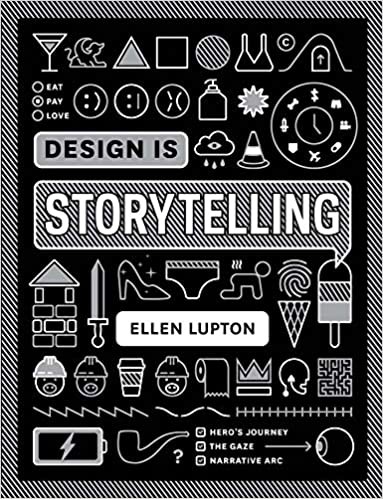
Talk to Design Is Storytelling like its author wrote you back.
Get the ideas that fit your life — not generic summaries.
- Chat with the book
- Audiobook-style main ideas
- Adapts to your life and goals
- Helps you take action
Design Is Storytelling, in detail
Design Is Storytelling is Ellen Lupton's compact guide to narrative thinking as a design skill. Published in 2017 by the Cooper Hewitt, Smithsonian Design Museum — where Lupton serves as senior curator of contemporary design — the book argues that the tools of narrative: arc, tension, character, point of view, empathy, are not metaphors borrowed from literature but structural principles that apply directly to graphic design, interface design, exhibition design, and visual communication of all kinds.
The book is organized in three parts. The first, "Action," examines narrative arc: how the classic three-act structure (setup, confrontation, resolution) maps onto everything from a landing page to a museum exhibit. Lupton introduces Freytag's pyramid and variants of it, arguing that designed experiences have emotional momentum that can be shaped — accelerated, delayed, punctuated — just as a story can. She extends this to journey mapping, showing how understanding a user's emotional state at each stage of an interaction is a design problem as much as a technical one.
The second part, "Emotion," covers visual rhetoric and the way typography, color, image, and composition create feeling and guide attention. Lupton draws on gestalt psychology and semiotics but keeps the material accessible and visually demonstrated. The book is richly illustrated throughout — it is a designed object as well as an argument about design. The third part, "Thinking," addresses point of view and the designer's relationship to the audience: who is telling this story, for whom, and from what vantage.
Design Is Storytelling is short and visually oriented, intended to be useful in a classroom or studio. It does not go deep on any single topic but covers a wide range of concepts — empathy mapping, the hero's journey, visual hierarchy, affordances, the role of friction — with enough specificity to be actionable. For designers who have worked intuitively with narrative but never had a vocabulary for it, the book provides a framework without being prescriptive. It is most useful as a prompt for reflection rather than a recipe.
The big ideas
- 1.
Narrative structure — arc, tension, resolution — is not a literary concept borrowed by designers but a fundamental property of any designed experience that unfolds over time.
- 2.
Journey mapping treats the user's emotional state at each stage of an interaction as a design problem. Anxiety, delight, confusion, and trust are design outcomes, not side effects.
- 3.
Freytag's pyramid (rising action, climax, falling action) maps onto interfaces, exhibits, campaigns, and products wherever there is a beginning, middle, and end to the user's experience.
