History · Book club
Devil Take the Hindmost: A History of Financial Speculation book club questions
Here are 11 book club questions for Devil Take the Hindmost: A History of Financial Speculation by Edward Chancellor, ordered to open easily and end somewhere worth arguing about. Copy them, print them, or bring them up one at a time.
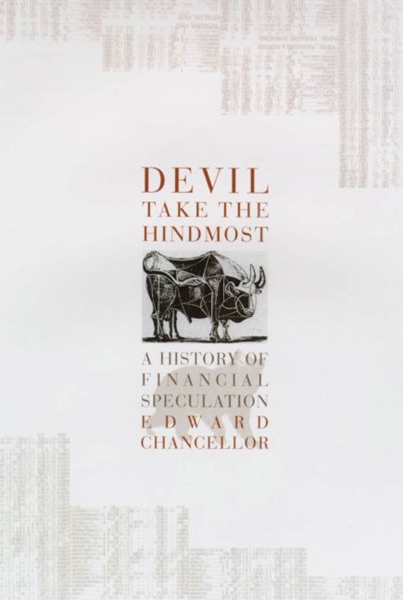
Edward Chancellor's 1999 history of financial speculation begins with seventeenth-century Holland and ends with the Japanese bubble of the 1980s and early signs of the dot-com excess that would peak after the book's publication.
Edward Chancellor · 1999 · 8h 45m
Full summary and key takeaways →The 11 questions
- 1.
Chancellor identifies the same pattern across four centuries of financial manias. What does the recurrence suggest about whether these patterns can be prevented, or whether they are simply endemic to financial markets?
- 2.
The South Sea Bubble destroyed thousands of ordinary investors while enriching its promoters. What institutional changes, if any, would have made a difference?
- 3.
The belief that 'this time is different' is identified as the core cognitive error of speculative manias. Have you ever held that belief about an investment or financial trend? What made it feel justified?
- 4.
Chancellor notes that the railroad manias funded infrastructure that still exists and generates value, even though investors lost money. How do we evaluate a bubble that destroys investors but creates real productive capacity?
- 5.
Insider selling — directors and executives exiting while retail investors arrive — is documented in every case in the book. What regulatory or legal frameworks have tried to address this, and why do they keep failing?
- 6.
Japan's lost decade followed one of the most extreme asset price bubbles in history. What does the Japanese case suggest about the long-term effects of a bubble of that magnitude?
- 7.
Chancellor was writing in 1999, just before the dot-com peak. What specific features of the late-1990s technology bubble does he identify, and how accurate was his implicit warning?
- 8.
The book ends before the 2008 financial crisis. Using Chancellor's framework, what were the features of the mortgage securitization bubble that fit the historical pattern?
- 9.
Financial history suggests that speculative manias occur regardless of regulatory environment. Does that mean regulation is futile, or does it mean that specific kinds of regulation are more effective than others?
- 10.
Which of the historical episodes Chancellor describes feels most analogous to financial dynamics you can observe in markets today?
- 11.
The title comes from a phrase used in early races — the winner takes all and the last-place finisher faces the worst consequences. Who are the 'hindmost' in a financial bubble, and is there a way to protect them?
How to run the discussion
- Pick six to eight, not all of them. An hour of real discussion covers fewer questions than anyone expects, and racing the list is what makes a book club feel like homework.
- Open with what people noticed, not what they concluded. Asking for a verdict first hardens opinions before anyone has heard each other.
- Let the disagreement run. The questions below that split a room are the ones worth the time; the ones everyone answers the same way can be skipped.
- Ask the quiet person a specific question. A direct, narrow question is far easier to answer than an open invitation to contribute.
Themes worth steering toward
If the conversation stalls, these are the threads that usually restart it.
Common questions
What are good book club questions for Devil Take the Hindmost: A History of Financial Speculation?
Here are 11 book club questions for Devil Take the Hindmost: A History of Financial Speculation by Edward Chancellor, ordered to open easily and end somewhere worth arguing about. The strongest openers ask what each reader noticed rather than what they concluded, and the discussion usually turns on financial speculation, market bubbles, financial history.
How long should a book club discussion of Devil Take the Hindmost: A History of Financial Speculation last?
Most groups run 60 to 90 minutes of actual discussion. That is roughly six to eight questions, not all of them, so pick the ones that suit your group rather than working down the list in order.
What are the main themes in Devil Take the Hindmost: A History of Financial Speculation?
Financial speculation, Market bubbles, Financial history, Human behavior, Economic crises. Those are the threads most likely to divide a room, which makes them the useful places to steer a discussion that has gone quiet.
Picking the next one? See books like Devil Take the Hindmost: A History of Financial Speculation or questions for other book club picks.
