Business · Book club
Diagnosing and Changing Organizational Culture book club questions
Here are 11 book club questions for Diagnosing and Changing Organizational Culture by Kim S. Cameron and Robert E. Quinn, ordered to open easily and end somewhere worth arguing about. Copy them, print them, or bring them up one at a time.
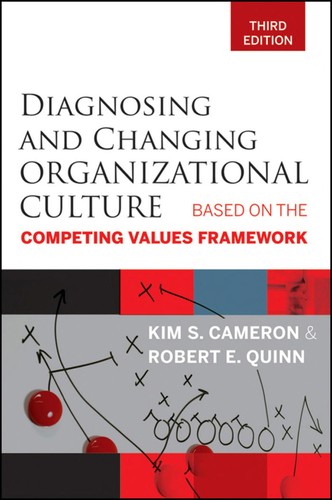
Diagnosing and Changing Organizational Culture introduces the Competing Values Framework, a model Cameron and Quinn developed at the University of Michigan for assessing and intentionally changing organizational culture.
Kim S. Cameron and Robert E. Quinn · 1999 · 4h 45m
Full summary and key takeaways →The 11 questions
- 1.
Using the four culture types — Clan, Adhocracy, Market, Hierarchy — how would you describe your organization's current profile? Where is it over-indexed?
- 2.
Cameron and Quinn argue that stated values and actual culture regularly diverge. Where is that gap most visible in your organization?
- 3.
If your team or organization ran the OCAI, what gap between current and preferred culture do you predict you'd find?
- 4.
Which culture type is most underrepresented in your organization, and is that absence a strategic liability or an appropriate tradeoff?
- 5.
Think of a leader in your organization whose behavior most shapes the culture. Which type does their behavior actually reinforce — regardless of what they say?
- 6.
The authors say culture change requires leadership behavior change first. What specific behavior change would signal the cultural shift your organization needs most?
- 7.
How has the culture of your organization changed over the past five years? What drove the shift — deliberate effort, leadership change, or external pressure?
- 8.
Organizations in different stages — startup, scaling, mature — typically need different culture profiles. Is your organization's culture matched to its current stage?
- 9.
The Hierarchy quadrant is often treated as negative in popular management literature. Can you think of a situation where strong Hierarchy type culture was genuinely appropriate?
- 10.
What is the biggest obstacle to an honest conversation about organizational culture in your setting — defensiveness, lack of language, leadership insecurity?
- 11.
If you could shift your organization's culture by ten percent in one direction, which direction would you choose and why?
How to run the discussion
- Pick six to eight, not all of them. An hour of real discussion covers fewer questions than anyone expects, and racing the list is what makes a book club feel like homework.
- Open with what people noticed, not what they concluded. Asking for a verdict first hardens opinions before anyone has heard each other.
- Let the disagreement run. The questions below that split a room are the ones worth the time; the ones everyone answers the same way can be skipped.
- Ask the quiet person a specific question. A direct, narrow question is far easier to answer than an open invitation to contribute.
Themes worth steering toward
If the conversation stalls, these are the threads that usually restart it.
Common questions
What are good book club questions for Diagnosing and Changing Organizational Culture?
Here are 11 book club questions for Diagnosing and Changing Organizational Culture by Kim S. Cameron and Robert E. Quinn, ordered to open easily and end somewhere worth arguing about. The strongest openers ask what each reader noticed rather than what they concluded, and the discussion usually turns on organizational culture, leadership, culture change.
How long should a book club discussion of Diagnosing and Changing Organizational Culture last?
Most groups run 60 to 90 minutes of actual discussion. That is roughly six to eight questions, not all of them, so pick the ones that suit your group rather than working down the list in order.
What are the main themes in Diagnosing and Changing Organizational Culture?
Organizational culture, Leadership, Culture change, Assessment, Organizational development. Those are the threads most likely to divide a room, which makes them the useful places to steer a discussion that has gone quiet.
Picking the next one? See books like Diagnosing and Changing Organizational Culture or questions for other book club picks.
