Business · Book club
Difficult Conversations book club questions
Here are 12 book club questions for Difficult Conversations by Douglas Stone, Bruce Patton, and Sheila Heen, ordered to open easily and end somewhere worth arguing about. Copy them, print them, or bring them up one at a time.
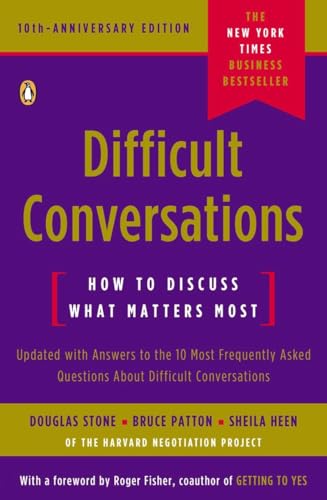
Difficult Conversations is the product of the Harvard Negotiation Project, the same research group that produced Getting to Yes.
Douglas Stone, Bruce Patton, and Sheila Heen · 1999 · 5h 15m
Full summary and key takeaways →The 12 questions
- 1.
Think about a difficult conversation you've been avoiding. Which of the three conversations — what happened, feelings, or identity — are you most afraid of?
- 2.
Stone and Patton say attributing intentions is almost always a guess. Think of a time you assumed bad intent and turned out to be wrong. What was the cost?
- 3.
What's a conversation you've had that went badly because feelings were never named? What difference would it have made to name them?
- 4.
The contribution framework asks how each person contributed to a problem rather than who was at fault. Apply it to a current difficult relationship at work. What's your contribution to the dynamic?
- 5.
What core identity belief of yours is most commonly threatened by hard feedback? 'I'm a good person,' 'I'm competent,' 'I'm fair' — which one comes up most?
- 6.
When have you had a learning conversation rather than a delivering-a-message conversation? What made that possible?
- 7.
The book says difficult conversations are hard because they threaten three things simultaneously. Which of the three feels most threatening to you?
- 8.
What conversation should you have had in the last six months that you avoided? What would the cost of continuing to avoid it be?
- 9.
How do you currently name feelings in workplace conversations? Is there language that makes it easier, and language that makes it harder?
- 10.
The book distinguishes between your story about what happened and the other person's story. In a current or recent conflict, what do you think their story is? Have you actually checked?
- 11.
What does it feel like to be in a conversation where the other person has shifted from 'delivering a message' to genuinely wanting to understand? What changed?
- 12.
The book is framed around individual conversations. What would it change about your team's culture if everyone read it and applied it consistently?
How to run the discussion
- Pick six to eight, not all of them. An hour of real discussion covers fewer questions than anyone expects, and racing the list is what makes a book club feel like homework.
- Open with what people noticed, not what they concluded. Asking for a verdict first hardens opinions before anyone has heard each other.
- Let the disagreement run. The questions below that split a room are the ones worth the time; the ones everyone answers the same way can be skipped.
- Ask the quiet person a specific question. A direct, narrow question is far easier to answer than an open invitation to contribute.
Themes worth steering toward
If the conversation stalls, these are the threads that usually restart it.
Common questions
What are good book club questions for Difficult Conversations?
Here are 12 book club questions for Difficult Conversations by Douglas Stone, Bruce Patton, and Sheila Heen, ordered to open easily and end somewhere worth arguing about. The strongest openers ask what each reader noticed rather than what they concluded, and the discussion usually turns on communication, conflict, self-awareness.
How long should a book club discussion of Difficult Conversations last?
Most groups run 60 to 90 minutes of actual discussion. That is roughly six to eight questions, not all of them, so pick the ones that suit your group rather than working down the list in order.
What are the main themes in Difficult Conversations?
Communication, Conflict, Self-awareness, Relationships, Leadership. Those are the threads most likely to divide a room, which makes them the useful places to steer a discussion that has gone quiet.
Picking the next one? See books like Difficult Conversations or questions for other book club picks.
