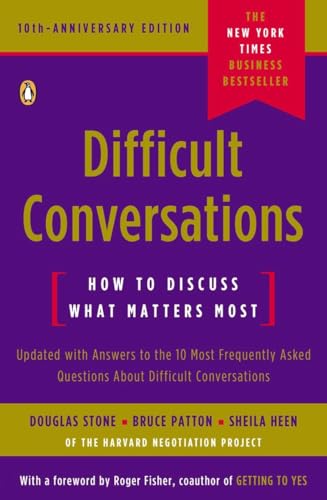
Difficult Conversations by Douglas Stone, Bruce Patton, and Sheila Heen is a 1999 business book about communication, conflict, self-awareness. Every difficult conversation is three conversations: what happened (facts and interpretations), feelings (emotions that often go unnamed), and identity (what the conversation implies about who you are).
Summary
Difficult Conversations is the product of the Harvard Negotiation Project, the same research group that produced Getting to Yes. Where Getting to Yes is about negotiating agreements, Difficult Conversations is about the interpersonal conversations that are hardest to have — telling someone they're being let go, confronting someone about their behavior, admitting you've made a mistake, or asking for what you need from someone who has more power than you.
The book's central insight is that every difficult conversation is actually three conversations happening simultaneously. The "what happened" conversation is about the facts, intentions, and contributions to a situation. The feelings conversation is about the emotions both parties have that rarely get named. The identity conversation is about what each person believes the outcome will say about who they are. Most conversations go badly because people stay in the "what happened" conversation without acknowledging the feelings and identity conversations running underneath.
Stone, Patton, and Heen argue that most of our assumptions about who is right, who is at fault, and what someone intended are less certain than we believe. Shifting from "delivering a message" to "having a learning conversation" — one where you're genuinely curious about the other person's perspective rather than trying to win — changes the character of the conversation and often its outcome.
The contribution and impact framing is among the book's most useful contributions. Most hard conversations attribute blame — someone did something wrong and you're here to tell them. The contribution framework asks instead: how did each of us contribute to this situation? This isn't about avoiding accountability; it's about acknowledging that most interpersonal situations are genuinely complex and that one person's contribution rarely explains the whole problem.
Talk to Difficult Conversations like its author wrote you back.
Get the ideas that fit your life — not generic summaries.
- Chat with the book
- Audiobook-style main ideas
- Adapts to your life and goals
- Helps you take action
Key takeaways
- 1.
Every difficult conversation is three conversations: what happened (facts and interpretations), feelings (emotions that often go unnamed), and identity (what the conversation implies about who you are).
- 2.
Staying in the 'what happened' conversation while feelings and identity run unacknowledged underneath is the most common reason difficult conversations go badly.
- 3.
Attributing intentions — 'you did this on purpose to hurt me' — is almost always a guess, and acting as if the guess is a fact makes the conversation worse. Ask about intentions; don't assume them.
- 4.
Contribution, not blame: almost all interpersonal problems have multiple contributions. Focusing on contribution opens exploration; focusing on blame closes it.
- 5.
The shift from 'delivering a message' to 'having a learning conversation' changes the nature of the interaction. Learning conversations require genuine curiosity about the other perspective.
- 6.
Your feelings are data, not truth. Acknowledging them — to yourself first, then potentially to the other person — usually reduces their power over the conversation.
- 7.
Identity conversations are triggered when the outcome threatens a core belief about who you are. Leaders who have developed more nuanced self-concepts are more resilient to these threats.
- 8.
The purpose of difficult conversations is not to win or to be right but to improve the situation. Keeping that purpose in view changes what you say and how you say it.
Discussion questions
Use these on your own, with a book club, or as chat starters in Superbook. Book club version, ready to copy or print →
- 1.
Think about a difficult conversation you've been avoiding. Which of the three conversations — what happened, feelings, or identity — are you most afraid of?
- 2.
Stone and Patton say attributing intentions is almost always a guess. Think of a time you assumed bad intent and turned out to be wrong. What was the cost?
- 3.
What's a conversation you've had that went badly because feelings were never named? What difference would it have made to name them?
- 4.
The contribution framework asks how each person contributed to a problem rather than who was at fault. Apply it to a current difficult relationship at work. What's your contribution to the dynamic?
- 5.
What core identity belief of yours is most commonly threatened by hard feedback? 'I'm a good person,' 'I'm competent,' 'I'm fair' — which one comes up most?
- 6.
When have you had a learning conversation rather than a delivering-a-message conversation? What made that possible?
- 7.
The book says difficult conversations are hard because they threaten three things simultaneously. Which of the three feels most threatening to you?
- 8.
What conversation should you have had in the last six months that you avoided? What would the cost of continuing to avoid it be?
- 9.
How do you currently name feelings in workplace conversations? Is there language that makes it easier, and language that makes it harder?
- 10.
The book distinguishes between your story about what happened and the other person's story. In a current or recent conflict, what do you think their story is? Have you actually checked?
- 11.
What does it feel like to be in a conversation where the other person has shifted from 'delivering a message' to genuinely wanting to understand? What changed?
- 12.
The book is framed around individual conversations. What would it change about your team's culture if everyone read it and applied it consistently?
Themes
Frequently asked questions
-
Is Difficult Conversations worth reading?
Yes. It's one of the most practically useful books on interpersonal communication available. The three-conversation framework gives you a lens for understanding why hard conversations go wrong, and the contribution-not-blame reframe is one of those ideas that genuinely changes how you approach conflict.
-
How long does it take to read Difficult Conversations?
Around five hours for the 286-page book. It reads clearly and the examples are drawn from recognizable situations, making it fast despite the conceptual depth.
-
How does Difficult Conversations differ from Getting to Yes?
Getting to Yes is about reaching agreements in formal negotiations. Difficult Conversations is about the informal interpersonal conversations that most people find hardest — the performance review, the relationship confrontation, the mistake admission. They share theoretical roots but address very different practical situations.
-
Who should read Difficult Conversations?
Anyone who finds it hard to have honest conversations with people they care about or depend on professionally. Managers who avoid performance conversations, people who escalate interpersonal conflicts rather than addressing them, and anyone who wants a better framework for understanding why hard conversations are hard.
-
What's the most important idea in the book?
The contribution framework. Shifting from 'who's at fault?' to 'how did each of us contribute to this situation?' doesn't let anyone off the hook — it opens up what actually happened. Most interpersonal problems are genuinely multi-causal, and conversations that treat them as single-cause usually miss the real pattern.
Similar books
Thanks for the Feedback
Douglas Stone and Sheila Heen
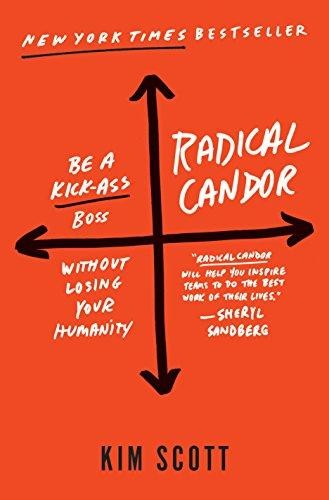
Radical Candor
Kim Scott
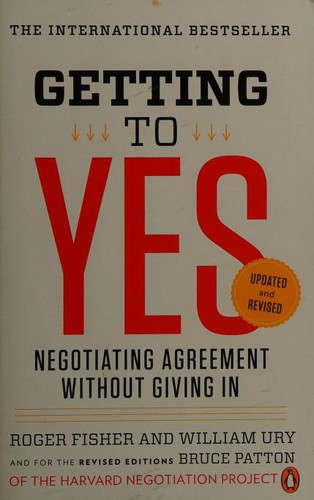
Getting to Yes: Negotiating Agreement Without Giving In
Roger Fisher and William Ury
Nonviolent Communication
Marshall B. Rosenberg
