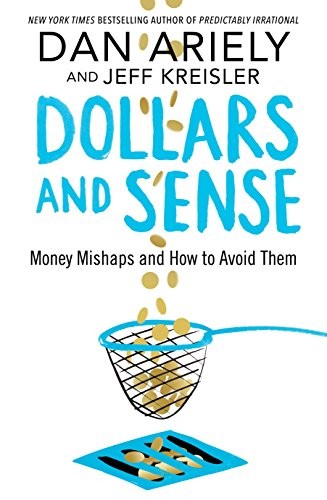
Talk to Dollars and Sense like its author wrote you back.
Get the ideas that fit your life — not generic summaries.
- Chat with the book
- Audiobook-style main ideas
- Adapts to your life and goals
- Helps you take action
Dollars and Sense, in detail
Dollars and Sense is Dan Ariely and Jeff Kreisler's examination of why people consistently make bad financial decisions even when they have the information and intention to do otherwise. Ariely, a behavioral economist and the author of Predictably Irrational, applies his research on human irrationality specifically to money: how spending decisions are made, how they go wrong, and what it would take to make them better.
The book's central argument is that humans are wired to evaluate money badly. We make financial decisions based on context, comparison, and emotion rather than absolute value. The same hundred dollars feels different depending on how we got it, what we're comparing it to, and how payment is structured. Ariely and Kreisler document the mechanisms through which retailers, banks, and financial services exploit these irrationalities — from anchoring to pain-of-paying elimination to the way "free" scrambles rational analysis.
The chapters on spending pain are particularly strong. Ariely's research shows that cash payment creates the most vivid sense of loss and therefore the most restraint, while credit cards and auto-pay subscriptions suppress that sense almost entirely. The practical implication — and a recurring theme — is that convenience in financial systems is often designed to lower your guard, and restoring friction is one of the most effective spending controls available.
Ariely and Kreisler are honest that knowledge of these biases doesn't eliminate them. Knowing that relative pricing is irrational doesn't make you immune to it; knowing that subscription services exploit low salience doesn't make it easy to audit them. The book's prescriptions tend toward designing systems that take biased judgment out of the equation: automatic savings, friction for discretionary spending, and clear rules for common categories rather than ad hoc decisions in the moment.
The big ideas
- 1.
We evaluate money relatively, not absolutely. Whether a price seems fair depends entirely on what we compare it to, which makes us highly manipulable by anchoring and framing.
- 2.
The pain of paying is a real psychological phenomenon that regulates spending. Cash maximizes this pain; credit cards, tap payments, and subscriptions minimize it — often by design.
- 3.
Mental accounting — treating money differently based on its source or intended purpose — leads to predictable errors. A tax refund feels like found money and gets spent freely even though it is simply deferred income.
