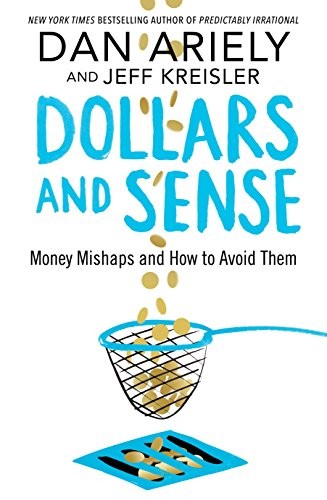
Dollars and Sense by Dan Ariely is a 2017 psychology book about behavioral economics, spending psychology, decision-making. We evaluate money relatively, not absolutely. Whether a price seems fair depends entirely on what we compare it to, which makes us highly manipulable by anchoring and framing.
Summary
Dollars and Sense is Dan Ariely and Jeff Kreisler's examination of why people consistently make bad financial decisions even when they have the information and intention to do otherwise. Ariely, a behavioral economist and the author of Predictably Irrational, applies his research on human irrationality specifically to money: how spending decisions are made, how they go wrong, and what it would take to make them better.
The book's central argument is that humans are wired to evaluate money badly. We make financial decisions based on context, comparison, and emotion rather than absolute value. The same hundred dollars feels different depending on how we got it, what we're comparing it to, and how payment is structured. Ariely and Kreisler document the mechanisms through which retailers, banks, and financial services exploit these irrationalities — from anchoring to pain-of-paying elimination to the way "free" scrambles rational analysis.
The chapters on spending pain are particularly strong. Ariely's research shows that cash payment creates the most vivid sense of loss and therefore the most restraint, while credit cards and auto-pay subscriptions suppress that sense almost entirely. The practical implication — and a recurring theme — is that convenience in financial systems is often designed to lower your guard, and restoring friction is one of the most effective spending controls available.
Ariely and Kreisler are honest that knowledge of these biases doesn't eliminate them. Knowing that relative pricing is irrational doesn't make you immune to it; knowing that subscription services exploit low salience doesn't make it easy to audit them. The book's prescriptions tend toward designing systems that take biased judgment out of the equation: automatic savings, friction for discretionary spending, and clear rules for common categories rather than ad hoc decisions in the moment.
Talk to Dollars and Sense like its author wrote you back.
Get the ideas that fit your life — not generic summaries.
- Chat with the book
- Audiobook-style main ideas
- Adapts to your life and goals
- Helps you take action
Key takeaways
- 1.
We evaluate money relatively, not absolutely. Whether a price seems fair depends entirely on what we compare it to, which makes us highly manipulable by anchoring and framing.
- 2.
The pain of paying is a real psychological phenomenon that regulates spending. Cash maximizes this pain; credit cards, tap payments, and subscriptions minimize it — often by design.
- 3.
Mental accounting — treating money differently based on its source or intended purpose — leads to predictable errors. A tax refund feels like found money and gets spent freely even though it is simply deferred income.
- 4.
Loss aversion means the pain of losing money is approximately twice as powerful as the pleasure of gaining the same amount. This asymmetry distorts decisions around risk, insurance, and investment.
- 5.
Opportunity cost is almost never spontaneously considered. When evaluating a purchase, most people compare it to similar purchases rather than to the best alternative use of that money.
- 6.
Expectation shapes experience. More expensive wine tastes better in studies not because of the wine but because price creates a positive expectation that the brain then confirms. This same principle distorts evaluation of financial products.
- 7.
Subscription creep — the accumulation of small, low-salience recurring charges — is one of the most effective mechanisms for increasing spending without triggering conscious review.
- 8.
Pre-commitment devices — decisions made in advance, before emotions are engaged — are among the most reliable tools for improving financial behavior. Automatic savings and rule-based spending restrictions both work through this mechanism.
Discussion questions
Use these on your own, with a book club, or as chat starters in Superbook. Book club version, ready to copy or print →
- 1.
Ariely argues that we evaluate prices relative to nearby anchors rather than in absolute terms. Can you identify a recent purchase where anchoring influenced what you were willing to pay?
- 2.
Think about your credit cards and automatic subscriptions. How many are you certain you want to keep? When did you last audit them all in one sitting?
- 3.
The pain-of-paying research suggests that cash creates more restraint than cards. Would you spend differently if you paid cash for one spending category for a month? Which category would you choose?
- 4.
Mental accounting means we treat money differently based on its source. Do you treat a work bonus, a tax refund, and a regular paycheck identically in practice?
- 5.
The book covers opportunity cost — the thing you can't buy because you bought this instead. For your three largest monthly expenses, can you articulate the specific opportunity cost?
- 6.
Ariely documents how retailers use anchoring to make prices seem reasonable. What's the most sophisticated pricing manipulation you've noticed in your own spending environment?
- 7.
Loss aversion distorts investment behavior. Think about a time you held a declining investment longer than you should have, or avoided a reasonable risk — which bias was driving that?
- 8.
Subscription services are designed to be low-salience. What would it take to genuinely feel the cost of each one every month instead of just letting them run?
- 9.
Pre-commitment devices work by deciding before emotions engage. What financial pre-commitments do you currently have? Are there decisions you should pre-commit to that you haven't?
- 10.
Ariely's research suggests expertise doesn't eliminate bias. Do you think you're less susceptible to financial irrationality than the average person? What's your evidence?
- 11.
The book argues that convenience in financial systems is often designed to lower your guard. Which financial products in your life are suspiciously convenient?
- 12.
How do you make decisions about charitable giving? Which of the biases in this book do you think most influences whether and how much you give?
Themes
Frequently asked questions
-
Is Dollars and Sense worth reading if I've already read Predictably Irrational?
Yes if personal finance is your focus. This book applies Ariely's behavioral economics framework specifically to money decisions — spending, saving, debt, and pricing psychology — rather than covering irrationality broadly. The overlap is moderate but the financial applications are new.
-
How long does it take to read?
Around four hours at average reading pace. The chapters are structured around specific biases and can be read independently.
-
What is the main practical takeaway from Dollars and Sense?
Design financial systems that take bad judgment out of the equation rather than relying on willpower to overcome bias in real-time. Automatic savings, friction for discretionary spending, and written rules for common categories are more reliable than trying to decide correctly in the moment.
-
Who should read this book?
Anyone who feels their spending behavior doesn't match their stated values or intentions. Also useful for people who manage money professionally and want to understand the psychological landscape their clients navigate.
-
Does the book tell you how to budget or invest?
No. It explains the psychological mechanisms that undermine financial decisions but doesn't provide a specific budgeting system or investment strategy. Readers who want practical mechanics should pair it with a more prescriptive personal finance book.