Psychology · Book club
Drive: The Surprising Truth About What Motivates Us book club questions
Here are 12 book club questions for Drive: The Surprising Truth About What Motivates Us by Daniel H. Pink, ordered to open easily and end somewhere worth arguing about. Copy them, print them, or bring them up one at a time.
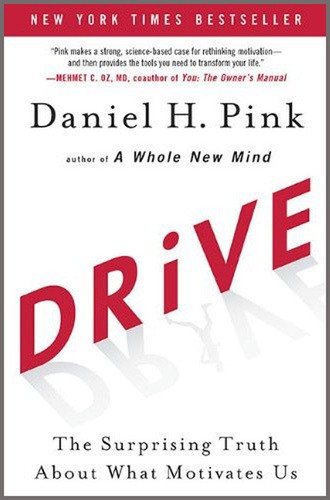
Drive is Daniel Pink's argument that the motivational model most organizations still run on — reward the behavior you want, punish the behavior you don't — is badly mismatched to the kind of work that matters most in a modern economy.
Daniel H. Pink · 2009 · 4h 45m
Full summary and key takeaways →The 12 questions
- 1.
Pink argues that 'if-then' rewards reliably undermine creative work. Think of a time you were paid or rewarded to do something you had enjoyed before. Did the reward change how you felt about it?
- 2.
Of the three elements — autonomy, mastery, purpose — which one is most missing from work you've done? What would it have taken to add it?
- 3.
Which of the four dimensions of autonomy (task, time, technique, team) does your current work give you most of, and which does it withhold most tightly?
- 4.
Pink distinguishes between 'baseline rewards' — pay that takes money off the table — and performance bonuses. Does the compensation structure where you work or have worked match that model? How would it change behavior if it did?
- 5.
Mastery requires accepting that you'll be a novice for a long time. What skill or domain have you avoided seriously pursuing because the early incompetence felt too uncomfortable?
- 6.
The book argues that purpose works when it's embedded in daily work, not just announced from above. Where have you experienced that difference?
- 7.
Pink uses Google's 20% time and Atlassian's FedEx Days as examples of structured autonomy. What would the equivalent look like in a context you know well — a school, a hospital, a family?
- 8.
Results Only Work Environments judge employees purely on output, not hours or location. What would change about how your own work is evaluated if you switched to that model?
- 9.
Drive's critique is mostly aimed at managers and organizations. To what extent do you think individuals can create their own Motivation 3.0 conditions inside an organization not designed for them?
- 10.
Pink draws heavily on Deci and Ryan's self-determination theory. Where in your life outside work have you seen the three elements — autonomy, mastery, purpose — produce engagement you couldn't manufacture by trying harder?
- 11.
The book claims intrinsic motivation applies broadly, but most of the examples are knowledge workers at tech companies. How well do you think the framework travels to fields like manufacturing, teaching, or caregiving?
- 12.
Pink says mastery is asymptotic — you approach it but never reach it. Does that framing make sustained effort feel more worthwhile or less, for you personally?
How to run the discussion
- Pick six to eight, not all of them. An hour of real discussion covers fewer questions than anyone expects, and racing the list is what makes a book club feel like homework.
- Open with what people noticed, not what they concluded. Asking for a verdict first hardens opinions before anyone has heard each other.
- Let the disagreement run. The questions below that split a room are the ones worth the time; the ones everyone answers the same way can be skipped.
- Ask the quiet person a specific question. A direct, narrow question is far easier to answer than an open invitation to contribute.
Themes worth steering toward
If the conversation stalls, these are the threads that usually restart it.
Common questions
What are good book club questions for Drive: The Surprising Truth About What Motivates Us?
Here are 12 book club questions for Drive: The Surprising Truth About What Motivates Us by Daniel H. Pink, ordered to open easily and end somewhere worth arguing about. The strongest openers ask what each reader noticed rather than what they concluded, and the discussion usually turns on motivation, autonomy, mastery.
How long should a book club discussion of Drive: The Surprising Truth About What Motivates Us last?
Most groups run 60 to 90 minutes of actual discussion. That is roughly six to eight questions, not all of them, so pick the ones that suit your group rather than working down the list in order.
What are the main themes in Drive: The Surprising Truth About What Motivates Us?
Motivation, Autonomy, Mastery, Purpose, Behavior change. Those are the threads most likely to divide a room, which makes them the useful places to steer a discussion that has gone quiet.
Picking the next one? See books like Drive: The Surprising Truth About What Motivates Us or questions for other book club picks.
