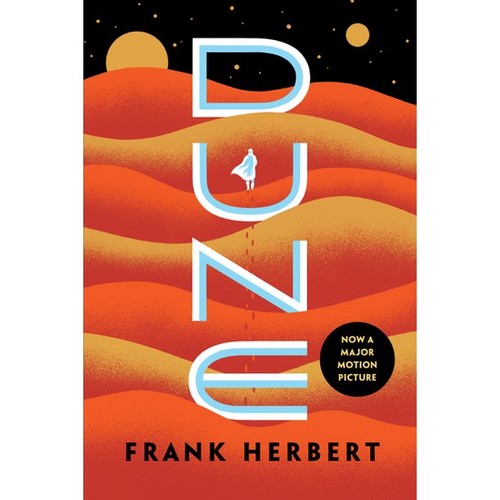
Talk to Dune like its author wrote you back.
Get the ideas that fit your life — not generic summaries.
- Chat with the book
- Audiobook-style main ideas
- Adapts to your life and goals
- Helps you take action
What it argues
Dune is set in a feudal interstellar civilization thousands of years in the future, on the desert planet Arrakis — the only source of the spice melange, which enables space travel and extends life. The story follows Paul Atreides, heir to a noble house that takes control of Arrakis, only to be betrayed and driven into the desert where he must survive among the Fremen, the planet's indigenous people. Paul's story is a destined-hero narrative that Herbert constructs with full self-awareness of the dangers of destined-hero narratives.
The central ambivalence of the novel is not hidden: Herbert wrote Dune as a critique of charismatic leadership and messianic thinking. Paul becomes the Fremen's prophesied messiah, and by the end of the novel has mobilized a religious jihad that will, the appendices tell us, kill sixty billion people across the galaxy. The book presents this as catastrophic. Paul achieves his victory and knows it is a disaster. Herbert's ecological worldview — he was influenced by systems theory and the work on dune stabilization in Oregon that directly inspired the planet — runs through the whole novel: change one variable and the consequences cascade unpredictably.
What it gets right
- 1.
Herbert wrote Dune as a critique of the hero-messiah archetype it appears to celebrate — Paul's victory is simultaneously a civilizational catastrophe, and Herbert was clear about this in interviews.
- 2.
The ecology of Arrakis is the novel's most original contribution. Fremen culture is shaped entirely by water scarcity, and their terraforming project drives the plot of multiple sequels.
- 3.
The spice melange as the indispensable resource of civilization maps explicitly onto oil — Herbert was drawing on 1960s resource politics, and the novel reads differently after every major oil crisis.
What it covers
Who wrote it
Frank Herbert (1920–1986) was an American science fiction writer and journalist. He worked as a newspaper reporter and editor before publishing Dune in 1965, after it was rejected by more than twenty publishers. The novel won the inaugural Nebula Award for Best Novel and shared the Hugo Award, and is the best-selling science fiction novel of all time. Herbert wrote five sequels, ending with Chapterhouse: Dune (1985), published the year before his death. His son Brian Herbert and Kevin J. Anderson have continued the series. Herbert was a committed environmentalist and systems thinker.
