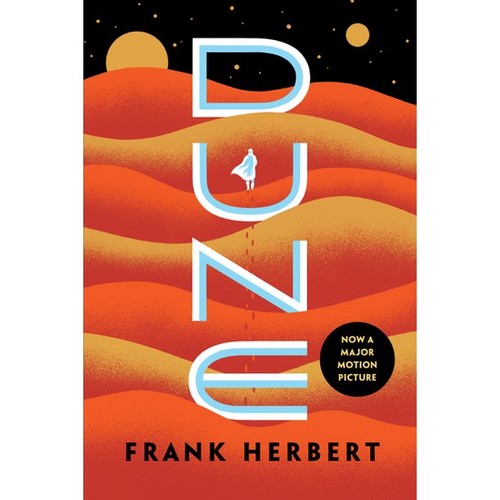
Dune by Frank Herbert is a 1965 science fiction book about ecology and environment, religion and messianic prophecy, power and political control. Herbert wrote Dune as a critique of the hero-messiah archetype it appears to celebrate — Paul's victory is simultaneously a civilizational catastrophe, and Herbert was clear about this in interviews.
Summary
Dune is set in a feudal interstellar civilization thousands of years in the future, on the desert planet Arrakis — the only source of the spice melange, which enables space travel and extends life. The story follows Paul Atreides, heir to a noble house that takes control of Arrakis, only to be betrayed and driven into the desert where he must survive among the Fremen, the planet's indigenous people. Paul's story is a destined-hero narrative that Herbert constructs with full self-awareness of the dangers of destined-hero narratives.
The central ambivalence of the novel is not hidden: Herbert wrote Dune as a critique of charismatic leadership and messianic thinking. Paul becomes the Fremen's prophesied messiah, and by the end of the novel has mobilized a religious jihad that will, the appendices tell us, kill sixty billion people across the galaxy. The book presents this as catastrophic. Paul achieves his victory and knows it is a disaster. Herbert's ecological worldview — he was influenced by systems theory and the work on dune stabilization in Oregon that directly inspired the planet — runs through the whole novel: change one variable and the consequences cascade unpredictably.
What makes Dune endure is the density of its world. Herbert invented a complete ecology, a history spanning thousands of years, a political philosophy, multiple religions, a language, a pharmacology, a feudal economics. The appendices and glossary are not decorative — they model the idea that civilization is deeper than any single narrative can surface. The novel reads on multiple levels simultaneously: adventure story, political meditation, ecological parable, Jungian myth critique.
Dune is demanding in ways that genre science fiction typically is not. The dense world-building requires patience in the first hundred pages; the political machinations require tracking; the religious material requires engagement rather than dismissal. Readers who bounce off it usually do so early. Those who don't are almost uniformly devoted for life. The sequels, beginning with Dune Messiah (1969), push the critique of Paul's messianism further and are worth reading, though they are less accessible.
Talk to Dune like its author wrote you back.
Get the ideas that fit your life — not generic summaries.
- Chat with the book
- Audiobook-style main ideas
- Adapts to your life and goals
- Helps you take action
Key takeaways
- 1.
Herbert wrote Dune as a critique of the hero-messiah archetype it appears to celebrate — Paul's victory is simultaneously a civilizational catastrophe, and Herbert was clear about this in interviews.
- 2.
The ecology of Arrakis is the novel's most original contribution. Fremen culture is shaped entirely by water scarcity, and their terraforming project drives the plot of multiple sequels.
- 3.
The spice melange as the indispensable resource of civilization maps explicitly onto oil — Herbert was drawing on 1960s resource politics, and the novel reads differently after every major oil crisis.
- 4.
The Bene Gesserit's multi-generational breeding program is the novel's deepest horror: the idea that human beings can be reduced to genetic instruments of an institutional agenda.
- 5.
Paul's prescience is not a superpower in any comfortable sense. Seeing the future means seeing the terrible futures and the only paths through them, and the novel insists the price is real.
- 6.
The Fremen are drawn with detail and respect unusual for indigenous or colonized peoples in 1960s science fiction, though some elements of the noble-primitive trope are present and worth examining.
- 7.
The novel's narrative structure mirrors the myth patterns Joseph Campbell described — Herbert knew Campbell's work well — and simultaneously critiques the myth by showing its political consequences.
- 8.
Dune's appendices and glossary are themselves a formal argument: they model the idea that the world is larger than any story told about it, and that official histories always simplify.
Discussion questions
Use these on your own, with a book club, or as chat starters in Superbook. Book club version, ready to copy or print →
- 1.
Herbert said he wanted to write a 'hero with a thousand faces' myth and then show the thousand ways that myth is dangerous. Does the novel succeed in holding both the myth and the critique simultaneously?
- 2.
Paul at the end of the novel has everything he wanted and knows it is a catastrophe. Is that a tragic ending, an ironic one, or a warning? How does your reading of the tone change the novel's moral?
- 3.
The Fremen's culture is entirely adapted to Arrakis's ecology. If the terraforming plan succeeds, it destroys the culture. Is that a cost the novel acknowledges clearly enough?
- 4.
The spice melange is obviously oil. Herbert was explicit about this. Does the allegory feel too schematic, or does the science fiction frame give it enough room to breathe?
- 5.
The Bene Gesserit have been manipulating humanity's genetic future for millennia. Are they villains, pragmatists, or something more ambiguous?
- 6.
Lady Jessica's decision to raise Paul as a Reverend Mother rather than the daughter the Bene Gesserit intended sets everything in motion. Is she heroic, irresponsible, or following her own version of prophecy?
- 7.
The novel is famous for its density. Did the glossary and appendices feel like world-building excess, or did they do something the main narrative couldn't?
- 8.
Stilgar and the Fremen are the novel's most vivid human characters. Does Paul's role as messiah reduce them from protagonists to supporting cast in their own revolution?
- 9.
Dune Messiah (the sequel) punishes Paul for everything he achieved in Dune. Does knowing that change how you read this novel's ending?
- 10.
The Denis Villeneuve films (2021, 2024) are close and careful adaptations. Does the film version add to or subtract from your reading of the novel?
- 11.
Herbert was writing in 1965, during the height of Cold War geopolitics and the early environmental movement. Which of those contexts feels most alive in the novel today?
- 12.
Is there a hero you can identify with in Dune, or does Herbert deliberately keep you at a distance from all the major players?
- 13.
The novel's treatment of prescience suggests that knowing the future is not the same as being able to change it. What does Herbert believe about free will and determinism?
Themes
Frequently asked questions
-
Is Dune worth reading in 2026?
Yes. The ecological politics, the critique of charismatic leadership, and the resource-extraction allegory are all more relevant than when Herbert wrote it. The films have introduced new readers to the story, but the novel goes deeper on every axis — the political philosophy especially doesn't translate to film.
-
Is Dune hard to read?
The first hundred pages require patience — Herbert drops you into a fully constructed world and expects you to orient yourself. The glossary helps. Once you have the political situation clear, the novel moves confidently. Most readers who quit do so before page 150; most who don't quit become devoted.
-
Do I need to read the sequels?
Dune is complete on its own. Dune Messiah (1969) is worth reading as Herbert's direct corrective to the first novel — it punishes Paul for everything he achieved. Children of Dune continues the arc. God Emperor of Dune (1981) is the most philosophically ambitious but very demanding. The later sequels are for completists.
-
Is Dune actually a critique of heroes, or is it a hero story?
Both, simultaneously, which is what makes it interesting. Herbert's hero is genuinely heroic by the conventions of adventure fiction and genuinely catastrophic by the novel's own ecological and political logic. The sequels remove any ambiguity: Paul's messianic victory is a disaster, and Herbert knew it from the beginning.
-
Who shouldn't read Dune?
Readers who need clean characterization and emotional directness. Herbert's characters are functional and politically complex but not deeply individuated in a literary fiction sense. If you need to love the protagonist, Paul Atreides may be too cold and strategic to provide that. If you need the world-building to have limits, Dune may overwhelm.