Self-help · Book club
Eat That Frog! book club questions
Here are 11 book club questions for Eat That Frog! by Brian Tracy, ordered to open easily and end somewhere worth arguing about. Copy them, print them, or bring them up one at a time.
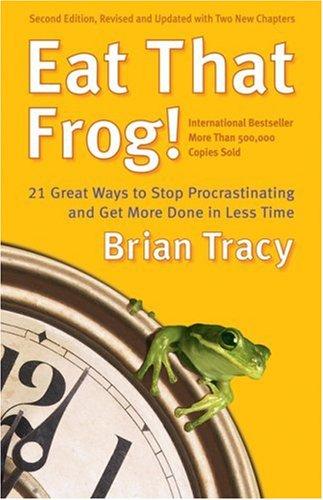
The 11 questions
- 1.
What is your frog today — the task you've been avoiding that would have the most impact if done? What specifically makes it feel hard to start?
- 2.
Tracy's ABCDE method requires honest self-assessment about what's actually important versus what's comfortable. How accurate is your current to-do list at reflecting that distinction?
- 3.
Think of a recent week. Estimate what percentage of your time went to the genuinely high-leverage 20% of your work. Does that surprise you?
- 4.
Single-handling requires protecting a block of time from interruption. What is the biggest source of interruption in your work life? Is it external or self-generated?
- 5.
Tracy says clarity about goals and outcomes eliminates most procrastination. What is the most important project in your life right now that lacks clear next actions?
- 6.
What task have you been putting off for more than a week that you know you should do? What specifically would it take to start it in the next twenty-four hours?
- 7.
He talks about developing the 'habit of completing.' What does your track record of finishing what you start look like? Where do things typically stall?
- 8.
The book is deliberately short and simple. Does that simplicity feel like a virtue or like a limitation? What does it leave out that you wish it addressed?
- 9.
If you applied the ABCDE method rigorously to your current task list, which tasks would move to D (delegate) or E (eliminate)?
- 10.
When is your highest-energy time of day? Is your current schedule actually protecting that time for your hardest work?
- 11.
Tracy assumes that doing more important work is the path to success and satisfaction. Is that premise true in your own experience?
How to run the discussion
- Pick six to eight, not all of them. An hour of real discussion covers fewer questions than anyone expects, and racing the list is what makes a book club feel like homework.
- Open with what people noticed, not what they concluded. Asking for a verdict first hardens opinions before anyone has heard each other.
- Let the disagreement run. The questions below that split a room are the ones worth the time; the ones everyone answers the same way can be skipped.
- Ask the quiet person a specific question. A direct, narrow question is far easier to answer than an open invitation to contribute.
Themes worth steering toward
If the conversation stalls, these are the threads that usually restart it.
Common questions
What are good book club questions for Eat That Frog!?
Here are 11 book club questions for Eat That Frog! by Brian Tracy, ordered to open easily and end somewhere worth arguing about. The strongest openers ask what each reader noticed rather than what they concluded, and the discussion usually turns on procrastination, time management, productivity.
How long should a book club discussion of Eat That Frog! last?
Most groups run 60 to 90 minutes of actual discussion. That is roughly six to eight questions, not all of them, so pick the ones that suit your group rather than working down the list in order.
What are the main themes in Eat That Frog!?
Procrastination, Time management, Productivity, Prioritization, Focus. Those are the threads most likely to divide a room, which makes them the useful places to steer a discussion that has gone quiet.
Picking the next one? See books like Eat That Frog! or questions for other book club picks.
