Economics · Book club
Economics in One Lesson book club questions
Here are 12 book club questions for Economics in One Lesson by Henry Hazlitt, ordered to open easily and end somewhere worth arguing about. Copy them, print them, or bring them up one at a time.
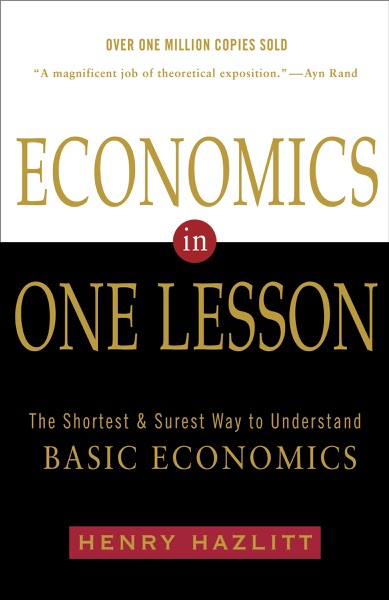
Henry Hazlitt wrote Economics in One Lesson in 1946, based on a single insight he credited to the nineteenth-century French economist Frédéric Bastiat: the difference between a good economist and a bad economist is that the good economist considers the effects of a policy on all groups, not just the immediately visible beneficiaries, and over the long run, not just the immediate term.
Henry Hazlitt · 1946 · 3h 45m
Full summary and key takeaways →The 12 questions
- 1.
Apply the seen/unseen framework to a current policy debate. What are the visible benefits, and what costs or forgone alternatives are less visible?
- 2.
Hazlitt argues public works don't create net employment. How does this analysis hold up during a recession, when some private resources are genuinely idle?
- 3.
The broken window fallacy is compelling in simple cases. Does it apply equally well to more complex situations, like government investment in basic research or infrastructure?
- 4.
Hazlitt's analysis of tariffs was written before global supply chains existed. Does the argument become more or less powerful in a world of complex international production?
- 5.
The minimum wage chapter has been tested empirically far more since 1946. What does the evidence on employment effects suggest about the strength of his analysis?
- 6.
How does Hazlitt's treatment of saving and capital formation compare to Keynesian arguments about the paradox of thrift?
- 7.
The book was written against the backdrop of New Deal interventionism. How much of it reads as a product of that specific debate rather than as timeless economics?
- 8.
Hazlitt focuses on misallocations caused by intervention. What kinds of market failures — monopoly, externalities, information asymmetries — does his framework struggle to address?
- 9.
The seen/unseen argument is powerful against bad policy analysis. Is it also powerful enough to tell you when intervention is justified, or only when it is unjustified?
- 10.
Hazlitt is a journalist who learned economics by reading. Does that background show in the book, and is it a strength or a weakness?
- 11.
Which chapter did you find most persuasive? Which did you find least persuasive, and why?
- 12.
The book has been widely recommended as an introduction to free-market economics. What would you recommend reading alongside it to get a fuller picture?
How to run the discussion
- Pick six to eight, not all of them. An hour of real discussion covers fewer questions than anyone expects, and racing the list is what makes a book club feel like homework.
- Open with what people noticed, not what they concluded. Asking for a verdict first hardens opinions before anyone has heard each other.
- Let the disagreement run. The questions below that split a room are the ones worth the time; the ones everyone answers the same way can be skipped.
- Ask the quiet person a specific question. A direct, narrow question is far easier to answer than an open invitation to contribute.
Themes worth steering toward
If the conversation stalls, these are the threads that usually restart it.
Common questions
What are good book club questions for Economics in One Lesson?
Here are 12 book club questions for Economics in One Lesson by Henry Hazlitt, ordered to open easily and end somewhere worth arguing about. The strongest openers ask what each reader noticed rather than what they concluded, and the discussion usually turns on unintended consequences, seen vs. unseen, free markets.
How long should a book club discussion of Economics in One Lesson last?
Most groups run 60 to 90 minutes of actual discussion. That is roughly six to eight questions, not all of them, so pick the ones that suit your group rather than working down the list in order.
What are the main themes in Economics in One Lesson?
Unintended consequences, Seen vs. unseen, Free markets, Economic fallacies, Price mechanisms. Those are the threads most likely to divide a room, which makes them the useful places to steer a discussion that has gone quiet.
Picking the next one? See books like Economics in One Lesson or questions for other book club picks.
