History · Book club
Empires of Light book club questions
Here are 12 book club questions for Empires of Light by Jill Jonnes, ordered to open easily and end somewhere worth arguing about. Copy them, print them, or bring them up one at a time.
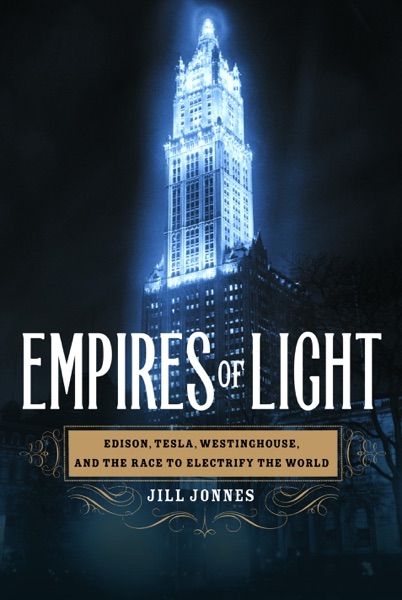
Empires of Light is Jill Jonnes's history of the War of Currents — the late-nineteenth-century battle between Thomas Edison's direct-current electrical system and George Westinghouse's alternating-current system, with Nikola Tesla as the third figure whose genius made AC practical.
Jill Jonnes · 2003 · 7h 0m
Full summary and key takeaways →The 12 questions
- 1.
Edison knew DC had serious limitations but fought AC anyway. What personal and financial incentives explain his resistance, and are they understandable?
- 2.
Jonnes portrays Tesla as a genius who was repeatedly exploited by more commercially minded men. Does the record support that characterization, or is it too simple?
- 3.
How did the Chicago World's Fair function as a technology demonstration, and what similar product or technology demonstrations in more recent history have played a comparable role?
- 4.
The War of Currents involved propaganda, staged events, and deliberate misinformation. What does the campaign against AC suggest about how technological change is contested?
- 5.
Westinghouse matched Tesla's technical vision with organizational and capital resources. Can you think of examples where technical brilliance without that backing led to lost opportunities?
- 6.
Tesla signed away enormous royalties to save Westinghouse's company. How do you evaluate that decision — as nobility, naivety, or something more complicated?
- 7.
Morgan's role in reshaping Edison's company illustrates how financial power shapes technology outcomes. What current technology markets show similar patterns?
- 8.
Jonnes gives considerable attention to the personalities of all three protagonists. Do you think biographical focus helps or obscures understanding of a technological transition of this kind?
- 9.
The AC victory was clear by the late 1890s. Why did it take as long as it did for the market to settle?
- 10.
What parallels do you see between the War of Currents and current disputes over energy infrastructure — electric vehicles, solar, grid design?
- 11.
The book ends with Tesla in decline and obscurity. What made his story so different from Edison's or Westinghouse's, despite his greater technical contributions?
- 12.
Infrastructure decisions made in the 1890s shaped how electricity reached homes and businesses for over a century. What infrastructure decisions being made now might have similar long-term lock-in?
How to run the discussion
- Pick six to eight, not all of them. An hour of real discussion covers fewer questions than anyone expects, and racing the list is what makes a book club feel like homework.
- Open with what people noticed, not what they concluded. Asking for a verdict first hardens opinions before anyone has heard each other.
- Let the disagreement run. The questions below that split a room are the ones worth the time; the ones everyone answers the same way can be skipped.
- Ask the quiet person a specific question. A direct, narrow question is far easier to answer than an open invitation to contribute.
Themes worth steering toward
If the conversation stalls, these are the threads that usually restart it.
Common questions
What are good book club questions for Empires of Light?
Here are 12 book club questions for Empires of Light by Jill Jonnes, ordered to open easily and end somewhere worth arguing about. The strongest openers ask what each reader noticed rather than what they concluded, and the discussion usually turns on innovation, electricity, industrial history.
How long should a book club discussion of Empires of Light last?
Most groups run 60 to 90 minutes of actual discussion. That is roughly six to eight questions, not all of them, so pick the ones that suit your group rather than working down the list in order.
What are the main themes in Empires of Light?
Innovation, Electricity, Industrial history, Competition, Technology. Those are the threads most likely to divide a room, which makes them the useful places to steer a discussion that has gone quiet.
Picking the next one? See books like Empires of Light or questions for other book club picks.
