Biography · Book club
Empty Mansions book club questions
Here are 11 book club questions for Empty Mansions by Bill Dedman, ordered to open easily and end somewhere worth arguing about. Copy them, print them, or bring them up one at a time.
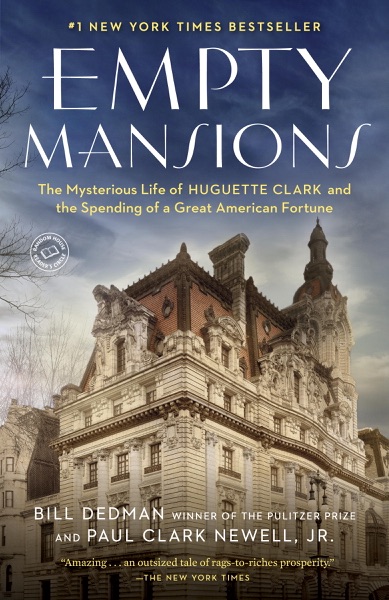
Empty Mansions is the biography of Huguette Clark, an extraordinarily wealthy woman who died in 2011 at the age of 104, having spent the last twenty years of her life in a hospital room she chose not to leave despite being in good health and owning a Santa Barbara estate, a Fifth Avenue apartment, and a Connecticut mansion — all maintained, staffed, and largely unvisited.
Bill Dedman · 2013 · 7h 15m
Full summary and key takeaways →The 11 questions
- 1.
Huguette chose isolation even when she had the resources to live any life she wanted. What does her story suggest about the relationship between wealth and happiness, or between solitude and suffering?
- 2.
Dedman reconstructs her life from documents and interviews with people who knew her. How do you read a biography of someone who worked so hard to avoid being known?
- 3.
The disputed will raises the question of whether Huguette's bequests were freely made. How do you think about undue influence when the person being influenced is isolated, elderly, and has no other close relationships?
- 4.
William Andrews Clark is one of the more disturbing characters in the book — a man who openly bribed his way to a Senate seat and whose philanthropy seemed to coexist comfortably with his methods. What does his story reveal about Gilded Age America?
- 5.
The empty mansions are the book's most striking image — fully staffed properties that their owner almost never visited. What does the maintenance of those empty houses mean to you?
- 6.
Huguette never explained her choices to anyone who wrote them down. What's your interpretation of why she chose the hospital over her homes?
- 7.
The book raises the question of how wealthy, isolated elderly people should be protected from financial exploitation. What would adequate protection look like without being paternalistic?
- 8.
Dedman writes about a world — Fifth Avenue apartments, French dolls, dollhouse collectors — that feels entirely alien to most readers. Did that unfamiliarity affect how you read Huguette's story?
- 9.
Is there something admirable about Huguette's chosen life, or is it purely a portrait of loss and withdrawal? How did you read her as a person?
- 10.
The family members who contested the will had not seen Huguette in decades but were her legal heirs. The hospital staff who received the bequest were her daily companions. Who do you think had the better claim?
- 11.
What does Empty Mansions say about the persistence of class and inherited wealth in American life? Does the story feel dated or recognizable?
How to run the discussion
- Pick six to eight, not all of them. An hour of real discussion covers fewer questions than anyone expects, and racing the list is what makes a book club feel like homework.
- Open with what people noticed, not what they concluded. Asking for a verdict first hardens opinions before anyone has heard each other.
- Let the disagreement run. The questions below that split a room are the ones worth the time; the ones everyone answers the same way can be skipped.
- Ask the quiet person a specific question. A direct, narrow question is far easier to answer than an open invitation to contribute.
Themes worth steering toward
If the conversation stalls, these are the threads that usually restart it.
Common questions
What are good book club questions for Empty Mansions?
Here are 11 book club questions for Empty Mansions by Bill Dedman, ordered to open easily and end somewhere worth arguing about. The strongest openers ask what each reader noticed rather than what they concluded, and the discussion usually turns on wealth and isolation, gilded age america, inheritance.
How long should a book club discussion of Empty Mansions last?
Most groups run 60 to 90 minutes of actual discussion. That is roughly six to eight questions, not all of them, so pick the ones that suit your group rather than working down the list in order.
What are the main themes in Empty Mansions?
Wealth and isolation, Gilded Age America, Inheritance, Eccentricity, American history. Those are the threads most likely to divide a room, which makes them the useful places to steer a discussion that has gone quiet.
Picking the next one? See books like Empty Mansions or questions for other book club picks.
