Science · Book club
Entangled Life: How Fungi Make Our Worlds, Change Our Minds and Shape Our Futures book club questions
Here are 12 book club questions for Entangled Life: How Fungi Make Our Worlds, Change Our Minds and Shape Our Futures by Merlin Sheldrake, ordered to open easily and end somewhere worth arguing about. Copy them, print them, or bring them up one at a time.
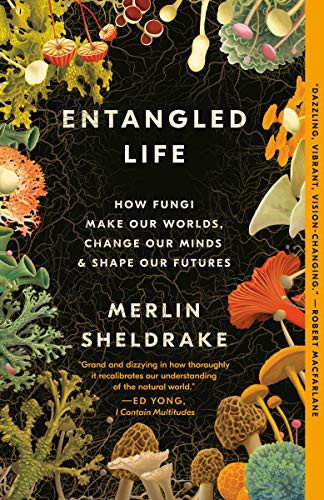
Merlin Sheldrake is a biologist who has spent his career studying fungi, and Entangled Life is his account of what fungi are, what they do, and why most people who think they know something about the natural world understand almost nothing about this kingdom of life.
Merlin Sheldrake · 2020 · 5h 15m
Full summary and key takeaways →The 12 questions
- 1.
Sheldrake argues that fungi force us to reconsider basic categories — individual versus collective, animal versus plant, cognition versus chemistry. Which of those challenged your intuitions most?
- 2.
The wood wide web has become a popular concept in ways that sometimes outrun the evidence. After reading Sheldrake, how do you think about the gap between scientific finding and popular interpretation?
- 3.
Sheldrake is careful about what he claims and doesn't claim regarding fungal cognition. Did that carefulness increase or decrease your confidence in the broader argument?
- 4.
Lichens as symbioses raise the question of what an individual organism is. Does the category of 'individual' still feel useful to you as a unit of biological analysis?
- 5.
The chapter on mind-altering fungi covers both the traditional ceremonial use of psilocybin and the current clinical research. How do those two contexts affect how you think about the compound?
- 6.
Entangled Life and The Hidden Life of Trees cover overlapping science on mycorrhizal networks. How did Sheldrake's treatment of the evidence compare to Wohlleben's?
- 7.
Sheldrake mentions that fungi may be useful for plastic bioremediation and building materials. How do you think about the relationship between understanding nature and exploiting it?
- 8.
The book is full of examples where fungi do things that seem to serve some function but where the mechanism is unclear. How comfortable are you with scientific uncertainty as a reader?
- 9.
Sheldrake wrote this book after years of research on mycorrhizal networks. How did his first-person presence in the writing affect your reading compared to more conventional science writing?
- 10.
The Ophiocordyceps zombie ant fungi are among the most dramatic examples in the book. Did they change how you think about the line between behavior and manipulation?
- 11.
Sheldrake ends by fermenting a copy of his own book using fungi. What did you make of that gesture?
- 12.
What aspect of fungi has most changed how you think about the living world around you?
How to run the discussion
- Pick six to eight, not all of them. An hour of real discussion covers fewer questions than anyone expects, and racing the list is what makes a book club feel like homework.
- Open with what people noticed, not what they concluded. Asking for a verdict first hardens opinions before anyone has heard each other.
- Let the disagreement run. The questions below that split a room are the ones worth the time; the ones everyone answers the same way can be skipped.
- Ask the quiet person a specific question. A direct, narrow question is far easier to answer than an open invitation to contribute.
Themes worth steering toward
If the conversation stalls, these are the threads that usually restart it.
Common questions
What are good book club questions for Entangled Life: How Fungi Make Our Worlds, Change Our Minds and Shape Our Futures?
Here are 12 book club questions for Entangled Life: How Fungi Make Our Worlds, Change Our Minds and Shape Our Futures by Merlin Sheldrake, ordered to open easily and end somewhere worth arguing about. The strongest openers ask what each reader noticed rather than what they concluded, and the discussion usually turns on fungi, ecology, consciousness.
How long should a book club discussion of Entangled Life: How Fungi Make Our Worlds, Change Our Minds and Shape Our Futures last?
Most groups run 60 to 90 minutes of actual discussion. That is roughly six to eight questions, not all of them, so pick the ones that suit your group rather than working down the list in order.
What are the main themes in Entangled Life: How Fungi Make Our Worlds, Change Our Minds and Shape Our Futures?
Fungi, Ecology, Consciousness, Mycorrhizal networks, Evolutionary biology. Those are the threads most likely to divide a room, which makes them the useful places to steer a discussion that has gone quiet.
Picking the next one? See books like Entangled Life: How Fungi Make Our Worlds, Change Our Minds and Shape Our Futures or questions for other book club picks.
