Entangled Life: How Fungi Make Our Worlds, Change Our Minds and Shape Our Futures by Merlin Sheldrake is a 2020 science book about fungi, ecology, consciousness. Fungi are more closely related to animals than to plants, and constitute a distinct kingdom of life that evolved before most multicellular organisms.
Summary
Merlin Sheldrake is a biologist who has spent his career studying fungi, and Entangled Life is his account of what fungi are, what they do, and why most people who think they know something about the natural world understand almost nothing about this kingdom of life. Fungi are not plants. They are not animals. They predate both, they are more closely related to animals than to plants, and their ways of existing in the world challenge almost every intuition humans bring to thinking about life.
The book is organized around the different things fungi do rather than around taxonomy. Sheldrake covers mycorrhizal fungi, which form symbiotic relationships with the roots of roughly 90 percent of plant species and have shaped the evolution of terrestrial plant life for 450 million years. He covers lichens, which are symbioses between fungi and photosynthetic organisms and represent some of the most extreme survivors on Earth. He covers the wood wide web in more rigorous detail than Wohlleben, grounding the claims in the specific experimental evidence and acknowledging what remains contested. He covers psilocybin-producing fungi, the history of ergot and its role in the Salem witch trials, and the fungi that control ant behavior in ways that look like something from science fiction.
The writing is genuinely good — lucid, curious, willing to sit with uncertainty rather than resolve it into false clarity. Sheldrake is honest about what science knows and doesn't know about fungal cognition, fungal communication, and the degree to which mycorrhizal networks function as information systems rather than mere plumbing. He also writes about fungi that are breaking down plastic waste, fungi that might be used in building materials, and the genuinely plausible possibility that mycelial networks process information in ways that are not yet well understood.
Entangled Life is the best popular science book on fungi because it refuses to oversimplify a kingdom of life that is genuinely strange. Sheldrake's background gives him the authority to engage with the frontier science, and his intellectual honesty makes the book more interesting than confident popular accounts that paper over uncertainty with enthusiasm.
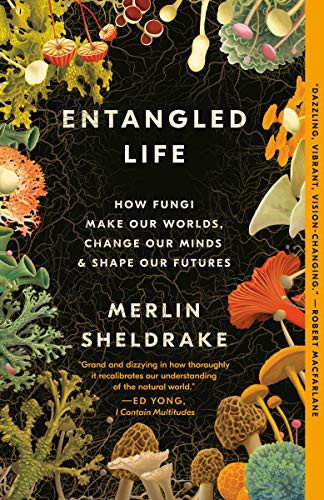
Talk to Entangled Life: How Fungi Make Our Worlds, Change Our Minds and Shape Our Futures like its author wrote you back.
Get the ideas that fit your life — not generic summaries.
- Chat with the book
- Audiobook-style main ideas
- Adapts to your life and goals
- Helps you take action
Key takeaways
- 1.
Fungi are more closely related to animals than to plants, and constitute a distinct kingdom of life that evolved before most multicellular organisms.
- 2.
Mycorrhizal fungi form symbioses with approximately 90 percent of plant species. Plants provide sugars; fungi provide water, phosphorus, and other minerals — a trade that has shaped terrestrial ecology for 450 million years.
- 3.
Lichens are not single organisms but symbioses between fungi and photosynthetic algae or cyanobacteria, and represent some of the most successful pioneers in extreme environments.
- 4.
The wood wide web — mycorrhizal fungal networks connecting tree roots — is real and well-established, but the degree to which it functions as an active information-sharing system versus passive plumbing remains actively debated.
- 5.
Ophiocordyceps fungi manipulate the behavior of infected ants in highly specific ways — controlling their movements and positioning their bodies for optimal spore dispersal after death.
- 6.
Psilocybin-producing fungi have been used in religious and ceremonial contexts for thousands of years. Recent clinical research on psilocybin's therapeutic potential represents a reengagement with these compounds after decades of prohibition.
- 7.
Some fungi are capable of breaking down plastic waste, including polyurethane, and are being studied as potential tools for bioremediation of contaminated environments.
- 8.
Mycelial networks process environmental information and respond to it over time scales and in ways that challenge simple notions of stimulus and response, though whether this constitutes cognition in any meaningful sense is philosophically contested.
Discussion questions
Use these on your own, with a book club, or as chat starters in Superbook. Book club version, ready to copy or print →
- 1.
Sheldrake argues that fungi force us to reconsider basic categories — individual versus collective, animal versus plant, cognition versus chemistry. Which of those challenged your intuitions most?
- 2.
The wood wide web has become a popular concept in ways that sometimes outrun the evidence. After reading Sheldrake, how do you think about the gap between scientific finding and popular interpretation?
- 3.
Sheldrake is careful about what he claims and doesn't claim regarding fungal cognition. Did that carefulness increase or decrease your confidence in the broader argument?
- 4.
Lichens as symbioses raise the question of what an individual organism is. Does the category of 'individual' still feel useful to you as a unit of biological analysis?
- 5.
The chapter on mind-altering fungi covers both the traditional ceremonial use of psilocybin and the current clinical research. How do those two contexts affect how you think about the compound?
- 6.
Entangled Life and The Hidden Life of Trees cover overlapping science on mycorrhizal networks. How did Sheldrake's treatment of the evidence compare to Wohlleben's?
- 7.
Sheldrake mentions that fungi may be useful for plastic bioremediation and building materials. How do you think about the relationship between understanding nature and exploiting it?
- 8.
The book is full of examples where fungi do things that seem to serve some function but where the mechanism is unclear. How comfortable are you with scientific uncertainty as a reader?
- 9.
Sheldrake wrote this book after years of research on mycorrhizal networks. How did his first-person presence in the writing affect your reading compared to more conventional science writing?
- 10.
The Ophiocordyceps zombie ant fungi are among the most dramatic examples in the book. Did they change how you think about the line between behavior and manipulation?
- 11.
Sheldrake ends by fermenting a copy of his own book using fungi. What did you make of that gesture?
- 12.
What aspect of fungi has most changed how you think about the living world around you?
Themes
Frequently asked questions
-
Do I need a biology background to read Entangled Life?
No. Sheldrake explains the relevant biology clearly for non-specialists without being condescending. Some chapters are denser than others, but the writing is consistently accessible.
-
Is Entangled Life better or worse than The Hidden Life of Trees?
They are different books with different strengths. Sheldrake is more scientifically rigorous and covers a broader range of fungi. Wohlleben is more accessible and emotionally direct. If you want depth on mycorrhizal networks and accurate caveats, Sheldrake is the better choice.
-
What is Entangled Life about in one sentence?
It is a tour of the kingdom Fungi — what fungi are, how they evolved, how they interact with plants, animals, and the physical environment — written by a working researcher who is genuinely curious about what remains unknown.
-
Does the book cover psychedelic mushrooms?
Yes, in one chapter. Sheldrake covers the evolutionary context of psilocybin-producing fungi, the history of their ceremonial use, and the current clinical research on therapeutic applications. It is one chapter among many, not the focus of the book.
-
Who should read Entangled Life?
Anyone interested in ecology, evolutionary biology, or the science underlying popular concepts like the wood wide web. Also anyone who found The Hidden Life of Trees compelling and wants a more rigorous treatment of the underlying science.
Similar books
The Hidden Life of Trees
Peter Wohlleben
The Sixth Extinction: An Unnatural History
Elizabeth Kolbert
A Short History of Nearly Everything
Bill Bryson
How to Change Your Mind
Michael Pollan
