Business · Book club
Extreme Ownership book club questions
Here are 12 book club questions for Extreme Ownership by Jocko Willink and Leif Babin, ordered to open easily and end somewhere worth arguing about. Copy them, print them, or bring them up one at a time.
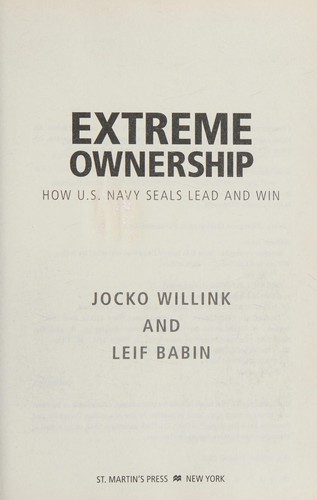
Extreme Ownership is former Navy SEAL commanders Jocko Willink and Leif Babin's argument that the single most important principle in leadership is taking total responsibility for everything that happens under your command — not just your own actions but your team's performance, your mission's failure, and the behavior of those above you when it doesn't support your mission.
Jocko Willink and Leif Babin · 2015 · 5h 15m
Full summary and key takeaways →The 12 questions
- 1.
Extreme ownership means taking responsibility for your team's failures, not just your own. What's the hardest failure you've ever genuinely owned rather than attributed to your team or circumstances?
- 2.
Willink opens with a friendly fire incident where he took full responsibility even though other factors contributed. Is that the right response? What are the limits of extreme ownership?
- 3.
'No bad teams, only bad leaders' — do you believe this? Where does it apply cleanly and where does it break down?
- 4.
The book argues that complexity in a plan signals failure ahead. Where are the most complex processes in your organization? Could they be simplified without loss of effectiveness?
- 5.
Have you ever led a team without believing in the mission? What was the effect on your leadership and on the team?
- 6.
Decentralized command requires that team members understand the mission well enough to act without instructions. How much do the people on your team understand about the broader purpose of what they're doing?
- 7.
Prioritize and execute: in a crisis, pick the most important problem and solve it first. What's the most important unsolved problem in your organization right now? Are you actually spending time on it?
- 8.
The 'check your ego' principle is easy to agree with and hard to practice. In what specific situations does your ego most often get in the way of good leadership?
- 9.
Willink and Babin apply military principles to business. What transfers cleanly, and what requires adaptation? Where does the military-to-business metaphor mislead?
- 10.
Cover and move: teams must support each other. What's the biggest 'silo' problem in your organization — where teams compete rather than cooperate? What's maintaining it?
- 11.
The book is written in an extremely direct, authoritative style. Does that style help or hinder you in taking the ideas seriously? What does the style signal about the underlying philosophy?
- 12.
Is extreme ownership compatible with healthy accountability culture — where everyone at every level takes responsibility? Or does it concentrate responsibility at the top?
How to run the discussion
- Pick six to eight, not all of them. An hour of real discussion covers fewer questions than anyone expects, and racing the list is what makes a book club feel like homework.
- Open with what people noticed, not what they concluded. Asking for a verdict first hardens opinions before anyone has heard each other.
- Let the disagreement run. The questions below that split a room are the ones worth the time; the ones everyone answers the same way can be skipped.
- Ask the quiet person a specific question. A direct, narrow question is far easier to answer than an open invitation to contribute.
Themes worth steering toward
If the conversation stalls, these are the threads that usually restart it.
Common questions
What are good book club questions for Extreme Ownership?
Here are 12 book club questions for Extreme Ownership by Jocko Willink and Leif Babin, ordered to open easily and end somewhere worth arguing about. The strongest openers ask what each reader noticed rather than what they concluded, and the discussion usually turns on leadership, accountability, ownership.
How long should a book club discussion of Extreme Ownership last?
Most groups run 60 to 90 minutes of actual discussion. That is roughly six to eight questions, not all of them, so pick the ones that suit your group rather than working down the list in order.
What are the main themes in Extreme Ownership?
Leadership, Accountability, Ownership, Military leadership, Team performance. Those are the threads most likely to divide a room, which makes them the useful places to steer a discussion that has gone quiet.
Picking the next one? See books like Extreme Ownership or questions for other book club picks.
