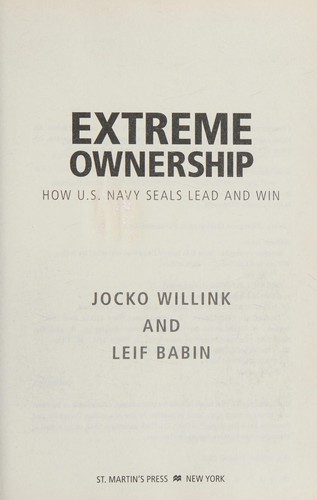
Extreme Ownership by Jocko Willink and Leif Babin is a 2015 business book about leadership, accountability, ownership. Extreme Ownership means taking full responsibility for everything under your command — not just your own actions but your team's failures, mission outcomes, and the conditions you operate in.
Summary
Extreme Ownership is former Navy SEAL commanders Jocko Willink and Leif Babin's argument that the single most important principle in leadership is taking total responsibility for everything that happens under your command — not just your own actions but your team's performance, your mission's failure, and the behavior of those above you when it doesn't support your mission. The title is also the principle: extreme, unreserved, no-excuses ownership.
Each chapter presents a principle, illustrated by a combat story from the authors' deployments in Ramadi, Iraq, and then applied to a business context. The military stories are vivid and often harrowing — including the opening chapter where Willink describes friendly fire killing one of his SEALs and the investigation that followed, during which he took full responsibility in front of his superiors even though other factors contributed. The business applications show the same principle operating in more familiar organizational contexts.
The twelve principles include cover and move (teams must support each other), simple beats complex (plans complex enough that not everyone can understand them will fail under pressure), prioritize and execute (in a crisis, pick the most important problem and solve it before moving to the next), and decentralized command (train subordinates to understand the mission well enough to make decisions independently when communication is severed).
The book is intentionally direct to the point of bluntness. Willink and Babin believe that most leadership failures are not failures of strategy or knowledge but failures of ownership — leaders who attribute team underperformance to the team rather than to themselves, who blame external conditions rather than their own preparation, and who wait for permission when they should act. The antidote is not nuance but uncompromising responsibility.
Talk to Extreme Ownership like its author wrote you back.
Get the ideas that fit your life — not generic summaries.
- Chat with the book
- Audiobook-style main ideas
- Adapts to your life and goals
- Helps you take action
Key takeaways
- 1.
Extreme Ownership means taking full responsibility for everything under your command — not just your own actions but your team's failures, mission outcomes, and the conditions you operate in.
- 2.
There are no bad teams, only bad leaders. When a team underperforms, the leader must first look at their own standards, communication, and preparation before attributing failure to the team.
- 3.
Decentralized command requires that every team member understands the mission well enough to make decisions independently when communication fails or the situation changes.
- 4.
Cover and move: every unit exists to support other units. When teams compete rather than cooperate, the mission fails. The leader's job is to enforce the truth that the team's success is the only success.
- 5.
Simple plans survive contact with reality. Complex plans require perfect conditions and break down under pressure. Leaders who design for simplicity are designing for actual execution.
- 6.
Prioritize and execute: in a crisis, never try to solve all problems simultaneously. Identify the most critical problem, apply maximum effort to it, then move to the next.
- 7.
Check your ego. The leader who needs to be right in every situation will make decisions based on self-protection rather than mission effectiveness.
- 8.
Believe in the mission. A leader who doesn't genuinely believe in the mission cannot convince others to sacrifice for it. Understanding the 'why' is not optional.
Discussion questions
Use these on your own, with a book club, or as chat starters in Superbook. Book club version, ready to copy or print →
- 1.
Extreme ownership means taking responsibility for your team's failures, not just your own. What's the hardest failure you've ever genuinely owned rather than attributed to your team or circumstances?
- 2.
Willink opens with a friendly fire incident where he took full responsibility even though other factors contributed. Is that the right response? What are the limits of extreme ownership?
- 3.
'No bad teams, only bad leaders' — do you believe this? Where does it apply cleanly and where does it break down?
- 4.
The book argues that complexity in a plan signals failure ahead. Where are the most complex processes in your organization? Could they be simplified without loss of effectiveness?
- 5.
Have you ever led a team without believing in the mission? What was the effect on your leadership and on the team?
- 6.
Decentralized command requires that team members understand the mission well enough to act without instructions. How much do the people on your team understand about the broader purpose of what they're doing?
- 7.
Prioritize and execute: in a crisis, pick the most important problem and solve it first. What's the most important unsolved problem in your organization right now? Are you actually spending time on it?
- 8.
The 'check your ego' principle is easy to agree with and hard to practice. In what specific situations does your ego most often get in the way of good leadership?
- 9.
Willink and Babin apply military principles to business. What transfers cleanly, and what requires adaptation? Where does the military-to-business metaphor mislead?
- 10.
Cover and move: teams must support each other. What's the biggest 'silo' problem in your organization — where teams compete rather than cooperate? What's maintaining it?
- 11.
The book is written in an extremely direct, authoritative style. Does that style help or hinder you in taking the ideas seriously? What does the style signal about the underlying philosophy?
- 12.
Is extreme ownership compatible with healthy accountability culture — where everyone at every level takes responsibility? Or does it concentrate responsibility at the top?
Themes
Frequently asked questions
-
Is Extreme Ownership worth reading?
Yes, if you can engage with a very direct, uncompromising style. The military stories are compelling and the business applications are concrete. The core principle — that leaders bear full responsibility for what happens under their command — is sound and counterculturally direct in environments that default to diffused accountability.
-
How long does it take to read Extreme Ownership?
Around five hours for the 286-page book. Each chapter follows the same structure (combat story, principle, business application), which makes it easy to read in sessions.
-
Is the extreme ownership principle realistic in hierarchical organizations?
Partially. Taking full responsibility for your team's outcomes regardless of external factors is a useful orientation. But applying it literally in organizations where leaders lack real authority over outcomes can become a kind of moral masochism. The useful version is taking responsibility for what you can actually influence.
-
Who should read Extreme Ownership?
Leaders who want a direct, no-excuses framework for thinking about accountability, anyone who works in or manages high-stakes teams where mistakes have serious consequences, and people who are looking for a leadership model that is unambiguous about where responsibility lies.
-
What's the most important idea in the book?
That when something goes wrong, the leader's first question should always be 'what could I have done differently?' rather than 'who failed?' This reorientation — from attribution to ownership — changes what gets learned from failure and changes who feels responsible for preventing the next one.
Similar books
Extreme Ownership vs.
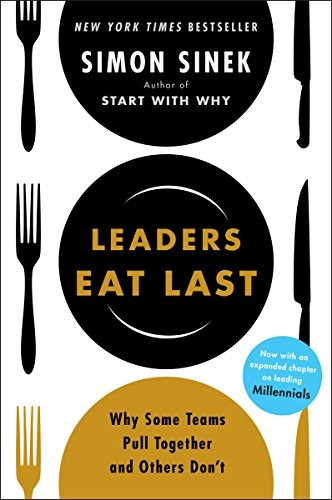
Deciding between two books? Extreme Ownership vs Leaders Eat Last .
