Economics · Book club
Factfulness: Ten Reasons We're Wrong About the World book club questions
Here are 12 book club questions for Factfulness: Ten Reasons We're Wrong About the World by Hans Rosling, ordered to open easily and end somewhere worth arguing about. Copy them, print them, or bring them up one at a time.
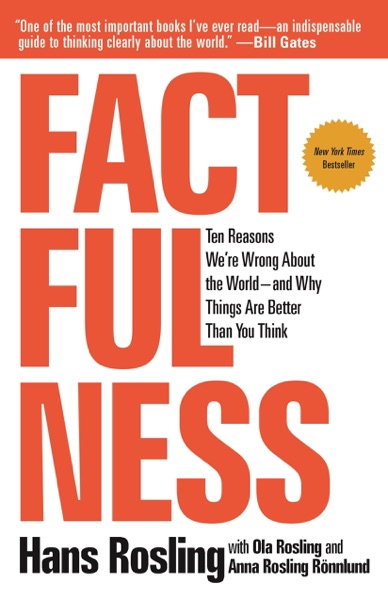
Hans Rosling spent decades testing audiences of students, professors, journalists, and politicians on basic facts about global development — child mortality rates, literacy, extreme poverty, life expectancy — and found consistently that even well-educated, well-intentioned people performed worse than chance.
Hans Rosling · 2018 · 5h 20m
Full summary and key takeaways →The 12 questions
- 1.
Rosling argues most educated people believe the world is worse than it is. Did you find that true of yourself when you checked your own assumptions?
- 2.
The four income levels framework is designed to replace 'developed/developing.' How useful did you find that replacement, and what does it still leave out?
- 3.
Which of the ten instincts do you think most distorts how you personally perceive global events? Can you give a recent example?
- 4.
Rosling attributes the negativity instinct partly to news media. How do you calibrate your information diet given that compelling stories and genuine progress are both real?
- 5.
The book focuses on long-run trends. How does that framing affect how we should think about recent setbacks — COVID deaths, rising inequality, climate disruption?
- 6.
Rosling is deliberately optimistic about development as a corrective to misperception. Does that stance risk its own form of selective emphasis?
- 7.
How does Factfulness engage with structural critiques of development — colonialism, debt, trade terms? Is that engagement adequate?
- 8.
Child mortality rates have fallen dramatically. What factors does Rosling attribute this to, and how convincing do you find the attribution?
- 9.
The book was finished posthumously by Rosling's family. Does knowing that affect how you read it?
- 10.
Rosling argues that good data should change how we prioritize aid and policy. Which priorities would shift if decision-makers fully absorbed his framework?
- 11.
The generalization instinct chapter argues we rely on stereotypes about regions and groups. Where did you notice yourself doing this while reading the book?
- 12.
Rosling distinguishes between factfulness and optimism: one is about evidence, the other is about mood. Is that distinction practical in real decision-making?
How to run the discussion
- Pick six to eight, not all of them. An hour of real discussion covers fewer questions than anyone expects, and racing the list is what makes a book club feel like homework.
- Open with what people noticed, not what they concluded. Asking for a verdict first hardens opinions before anyone has heard each other.
- Let the disagreement run. The questions below that split a room are the ones worth the time; the ones everyone answers the same way can be skipped.
- Ask the quiet person a specific question. A direct, narrow question is far easier to answer than an open invitation to contribute.
Themes worth steering toward
If the conversation stalls, these are the threads that usually restart it.
Common questions
What are good book club questions for Factfulness: Ten Reasons We're Wrong About the World?
Here are 12 book club questions for Factfulness: Ten Reasons We're Wrong About the World by Hans Rosling, ordered to open easily and end somewhere worth arguing about. The strongest openers ask what each reader noticed rather than what they concluded, and the discussion usually turns on human progress, global development, statistical literacy.
How long should a book club discussion of Factfulness: Ten Reasons We're Wrong About the World last?
Most groups run 60 to 90 minutes of actual discussion. That is roughly six to eight questions, not all of them, so pick the ones that suit your group rather than working down the list in order.
What are the main themes in Factfulness: Ten Reasons We're Wrong About the World?
Human progress, Global development, Statistical literacy, Cognitive bias, Poverty reduction. Those are the threads most likely to divide a room, which makes them the useful places to steer a discussion that has gone quiet.
Picking the next one? See books like Factfulness: Ten Reasons We're Wrong About the World or questions for other book club picks.
