Psychology · Book club
Far from the Tree: Parents, Children, and the Search for Identity book club questions
Here are 12 book club questions for Far from the Tree: Parents, Children, and the Search for Identity by Andrew Solomon, ordered to open easily and end somewhere worth arguing about. Copy them, print them, or bring them up one at a time.
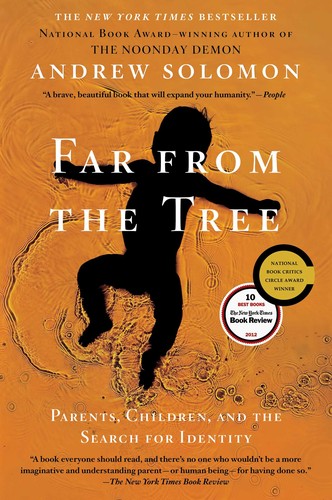
Andrew Solomon's book is a ten-year investigation into families raising children who are profoundly different from their parents — deaf children of hearing parents, children with Down syndrome, autism, schizophrenia, severe physical disabilities, and other conditions that create what Solomon calls "horizontal identity": an identity shared with peers rather than inherited from family.
Andrew Solomon · 2012 · 23h 15m
Full summary and key takeaways →The 12 questions
- 1.
Solomon distinguishes vertical from horizontal identity. Which aspects of your own identity were transmitted vertically from your family, and which did you have to find elsewhere?
- 2.
The deaf community's resistance to cochlear implants is presented seriously. Do you find the identity model of deafness persuasive, and what are the limits of applying it to children too young to consent?
- 3.
Solomon argues that the question 'what makes a life worth living?' is unavoidable for parents of severely disabled children. How would you answer it, and what assumptions does your answer rely on?
- 4.
The book reports that many parents of profoundly different children describe their lives as unexpectedly enriched. How do you evaluate that claim — is it credible, or a coping mechanism, or both?
- 5.
Which chapter or case in the book made you most uncomfortable, and what does that discomfort reveal about your assumptions?
- 6.
Solomon is gay and draws on his own experience of horizontal identity throughout the book. How does his personal stake in the subject strengthen or complicate the argument?
- 7.
The book covers both disability and criminality as forms of difference that create mismatch between parent and child. Is that comparison illuminating or does it risk conflating very different situations?
- 8.
What obligations do societies have toward children with severe differences that parents cannot fully meet? Where should the boundary between family and state responsibility lie?
- 9.
Solomon describes how some parents grieve the child they expected before coming to love the child they have. Is that grief legitimate, and how should it be held alongside love for the actual child?
- 10.
The book is nearly a thousand pages long. What does the length itself argue — is exhaustiveness part of the ethical stance, or is it excess?
- 11.
If you were a parent in one of the situations Solomon describes, which identity model — medical or social — do you think you would be drawn to, and why?
- 12.
Solomon ends with an argument for radical acceptance alongside genuine provision of care and treatment. Is that combination coherent, or does it require resolving a tension that can't be resolved?
How to run the discussion
- Pick six to eight, not all of them. An hour of real discussion covers fewer questions than anyone expects, and racing the list is what makes a book club feel like homework.
- Open with what people noticed, not what they concluded. Asking for a verdict first hardens opinions before anyone has heard each other.
- Let the disagreement run. The questions below that split a room are the ones worth the time; the ones everyone answers the same way can be skipped.
- Ask the quiet person a specific question. A direct, narrow question is far easier to answer than an open invitation to contribute.
Themes worth steering toward
If the conversation stalls, these are the threads that usually restart it.
Common questions
What are good book club questions for Far from the Tree: Parents, Children, and the Search for Identity?
Here are 12 book club questions for Far from the Tree: Parents, Children, and the Search for Identity by Andrew Solomon, ordered to open easily and end somewhere worth arguing about. The strongest openers ask what each reader noticed rather than what they concluded, and the discussion usually turns on identity, family, disability.
How long should a book club discussion of Far from the Tree: Parents, Children, and the Search for Identity last?
Most groups run 60 to 90 minutes of actual discussion. That is roughly six to eight questions, not all of them, so pick the ones that suit your group rather than working down the list in order.
What are the main themes in Far from the Tree: Parents, Children, and the Search for Identity?
Identity, Family, Disability, Difference, Parenting. Those are the threads most likely to divide a room, which makes them the useful places to steer a discussion that has gone quiet.
Picking the next one? See books like Far from the Tree: Parents, Children, and the Search for Identity or questions for other book club picks.
