History · Book club
Fiasco: The American Military Adventure in Iraq book club questions
Here are 12 book club questions for Fiasco: The American Military Adventure in Iraq by Thomas E. Ricks, ordered to open easily and end somewhere worth arguing about. Copy them, print them, or bring them up one at a time.
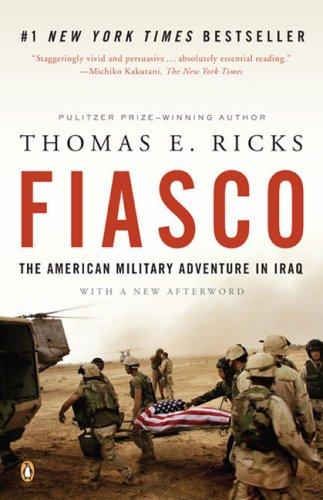
Thomas Ricks was the Pentagon correspondent for the Washington Post when he wrote Fiasco, and the book reflects years of direct access to the military officials, planners, and soldiers involved in the Iraq War.
Thomas E. Ricks · 2006 · 10h 15m
Full summary and key takeaways →The 12 questions
- 1.
Ricks argues the invasion was the product of specific, avoidable decisions rather than bad luck. Which decision does he identify as most consequential, and do you find that argument persuasive?
- 2.
The Army officers who understood the strategic situation most clearly were often marginalized. What institutional incentives produce that pattern in large organizations?
- 3.
Ricks draws a distinction between tactical competence and strategic incoherence. Can an institution be genuinely good at one while failing at the other?
- 4.
The disbanding of the Iraqi army is presented as a turning point. What information was available at the time that should have prevented that decision?
- 5.
How does the book's portrait of civilian leadership — particularly Rumsfeld and Bremer — compare to how those figures have characterized their own decisions?
- 6.
Ricks was embedded with American forces and had extensive access to military officials. How does that access shape what he can and cannot see in the story?
- 7.
The book was published in 2006, while the war was ongoing. How does writing contemporary history while events are still unfolding differ from writing retrospectively?
- 8.
Ricks identifies specific commanders who performed well and others who did not. What differentiates the two groups in his account?
- 9.
The intelligence manipulation before the invasion involved many people who knew the evidence was being distorted. What explains the silence of those individuals?
- 10.
The book's title is a judgment, not a description. Do you think the word 'fiasco' is accurate, or does it oversimplify a more complicated outcome?
- 11.
What lessons from Fiasco are applicable to institutional failures in non-military contexts — corporations, governments, nonprofits?
- 12.
Ricks followed Fiasco with The Gamble, covering the surge. How does knowing the subsequent history change how you read the ending of this book?
How to run the discussion
- Pick six to eight, not all of them. An hour of real discussion covers fewer questions than anyone expects, and racing the list is what makes a book club feel like homework.
- Open with what people noticed, not what they concluded. Asking for a verdict first hardens opinions before anyone has heard each other.
- Let the disagreement run. The questions below that split a room are the ones worth the time; the ones everyone answers the same way can be skipped.
- Ask the quiet person a specific question. A direct, narrow question is far easier to answer than an open invitation to contribute.
Themes worth steering toward
If the conversation stalls, these are the threads that usually restart it.
Common questions
What are good book club questions for Fiasco: The American Military Adventure in Iraq?
Here are 12 book club questions for Fiasco: The American Military Adventure in Iraq by Thomas E. Ricks, ordered to open easily and end somewhere worth arguing about. The strongest openers ask what each reader noticed rather than what they concluded, and the discussion usually turns on iraq war, military strategy, political decision-making.
How long should a book club discussion of Fiasco: The American Military Adventure in Iraq last?
Most groups run 60 to 90 minutes of actual discussion. That is roughly six to eight questions, not all of them, so pick the ones that suit your group rather than working down the list in order.
What are the main themes in Fiasco: The American Military Adventure in Iraq?
Iraq War, Military strategy, Political decision-making, Counterinsurgency, Institutional failure. Those are the threads most likely to divide a room, which makes them the useful places to steer a discussion that has gone quiet.
Picking the next one? See books like Fiasco: The American Military Adventure in Iraq or questions for other book club picks.
