Business · Book club
Fierce Conversations book club questions
Here are 11 book club questions for Fierce Conversations by Susan Scott, ordered to open easily and end somewhere worth arguing about. Copy them, print them, or bring them up one at a time.
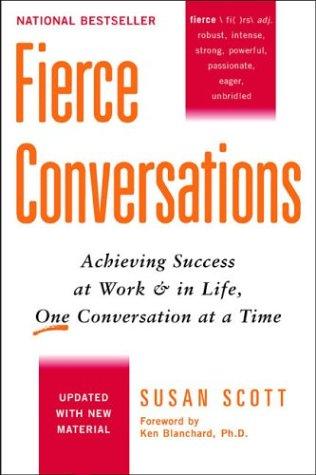
Fierce Conversations is Susan Scott's argument that the quality of your relationships is determined by the quality of your conversations — and that the conversations most people avoid are precisely the ones that would most improve their relationships and results.
Susan Scott · 2002 · 4h 45m
Full summary and key takeaways →The 11 questions
- 1.
What's the most important conversation you're currently not having? What's the cost of not having it?
- 2.
Scott says the conversations you're avoiding are making decisions for you. What decision is currently being made by your avoidance?
- 3.
Think about your emotional wake — the effect you leave in interactions. What would your team say you leave behind after a difficult conversation? After a routine one?
- 4.
What's a story you're telling yourself about a key relationship at work? Have you interrogated it — asked whether it's actually true?
- 5.
When was the last time you used silence in a conversation as a tool rather than rushing to fill it? What did the silence produce?
- 6.
Scott distinguishes fierce from managed conversations. What percentage of your important professional conversations are managed — where both parties know what won't be said?
- 7.
What's the difference between being authentically direct and being cruel? How does caring about the relationship change the character of directness?
- 8.
Have you ever received feedback about your presence in conversations — that you're intimidating, or distracted, or not really listening? What did you do with it?
- 9.
Scott says many people know what they really think fifteen seconds after their first socially acceptable answer. What's your equivalent — the thought or feeling that comes after the performed one?
- 10.
What would change in your team if every team member committed to having one 'fierce' conversation this week that they've been avoiding?
- 11.
The title 'Fierce Conversations' is deliberately provocative. Does the word fierce describe the conversations you most need to have, or does it over-dramatize what's actually needed?
How to run the discussion
- Pick six to eight, not all of them. An hour of real discussion covers fewer questions than anyone expects, and racing the list is what makes a book club feel like homework.
- Open with what people noticed, not what they concluded. Asking for a verdict first hardens opinions before anyone has heard each other.
- Let the disagreement run. The questions below that split a room are the ones worth the time; the ones everyone answers the same way can be skipped.
- Ask the quiet person a specific question. A direct, narrow question is far easier to answer than an open invitation to contribute.
Themes worth steering toward
If the conversation stalls, these are the threads that usually restart it.
Common questions
What are good book club questions for Fierce Conversations?
Here are 11 book club questions for Fierce Conversations by Susan Scott, ordered to open easily and end somewhere worth arguing about. The strongest openers ask what each reader noticed rather than what they concluded, and the discussion usually turns on communication, leadership, relationships.
How long should a book club discussion of Fierce Conversations last?
Most groups run 60 to 90 minutes of actual discussion. That is roughly six to eight questions, not all of them, so pick the ones that suit your group rather than working down the list in order.
What are the main themes in Fierce Conversations?
Communication, Leadership, Relationships, Authenticity, Conflict. Those are the threads most likely to divide a room, which makes them the useful places to steer a discussion that has gone quiet.
Picking the next one? See books like Fierce Conversations or questions for other book club picks.
