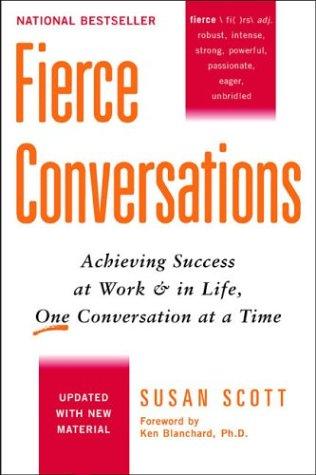
Fierce Conversations by Susan Scott is a 2002 business book about communication, leadership, relationships. The conversations you're not having are making decisions for you. Avoiding a conversation doesn't make the underlying issue go away — it makes it worse.
Summary
Fierce Conversations is Susan Scott's argument that the quality of your relationships is determined by the quality of your conversations — and that the conversations most people avoid are precisely the ones that would most improve their relationships and results. Scott founded her executive training company, Fierce, Inc., after spending years helping executives have the conversations they were afraid to have, and this book distills that experience.
The title's "fierce" is not aggressive — it means something closer to "alive and passionate." A fierce conversation is one where both parties are genuinely present, honest, and willing to be changed by what they hear. Scott's contrast is the "managed conversation," where both parties know what will and won't be said and nothing of consequence gets addressed. Most organizational conversations are managed; the conversations that move things forward are fierce.
The book is organized around seven principles: master the courage to interrogate reality, come out from behind yourself and make the conversation real, be here and prepared to be nowhere else, tackle your toughest challenge today, obey your instincts, take responsibility for your emotional wake, and let silence do the heavy lifting. Each principle addresses a different dimension of what makes conversations fail or succeed.
Scott is particularly useful on the concept of the emotional wake: the effect that your presence and manner leave on the people you interact with. Leaders who believe their words are the communication are missing the larger signal — their tone, energy, and presence are the context that determines whether the words are heard as care or as control. The practice of asking "what is the effect of my presence?" is among the most useful self-diagnostic exercises in the book.
Talk to Fierce Conversations like its author wrote you back.
Get the ideas that fit your life — not generic summaries.
- Chat with the book
- Audiobook-style main ideas
- Adapts to your life and goals
- Helps you take action
Key takeaways
- 1.
The conversations you're not having are making decisions for you. Avoiding a conversation doesn't make the underlying issue go away — it makes it worse.
- 2.
Fierce means real, not aggressive. A fierce conversation is one where you're genuinely present, honest, and willing to be changed by what the other person has to say.
- 3.
The emotional wake is the effect your presence and manner leave on people after interactions. Leaders who are unaware of their wake cause damage they never see.
- 4.
Silence does heavy lifting. After asking a real question, staying silent long enough for the other person to actually think rather than produce a canned answer changes what emerges.
- 5.
Interrogating reality means questioning the stories you've told yourself about what's happening in your most important relationships. Most people treat their interpretations as facts.
- 6.
Many people know what they think while they're saying it. The most honest answer to a difficult question often comes fifteen seconds after the socially acceptable first answer.
- 7.
Managed conversations maintain the illusion of communication while nothing of consequence is said or decided. Organizations full of managed conversations are hiding from their problems.
- 8.
Taking responsibility for your emotional wake means noticing and adjusting the effect you're having on people — not as a technique but as a genuine commitment to the relationship.
Discussion questions
Use these on your own, with a book club, or as chat starters in Superbook. Book club version, ready to copy or print →
- 1.
What's the most important conversation you're currently not having? What's the cost of not having it?
- 2.
Scott says the conversations you're avoiding are making decisions for you. What decision is currently being made by your avoidance?
- 3.
Think about your emotional wake — the effect you leave in interactions. What would your team say you leave behind after a difficult conversation? After a routine one?
- 4.
What's a story you're telling yourself about a key relationship at work? Have you interrogated it — asked whether it's actually true?
- 5.
When was the last time you used silence in a conversation as a tool rather than rushing to fill it? What did the silence produce?
- 6.
Scott distinguishes fierce from managed conversations. What percentage of your important professional conversations are managed — where both parties know what won't be said?
- 7.
What's the difference between being authentically direct and being cruel? How does caring about the relationship change the character of directness?
- 8.
Have you ever received feedback about your presence in conversations — that you're intimidating, or distracted, or not really listening? What did you do with it?
- 9.
Scott says many people know what they really think fifteen seconds after their first socially acceptable answer. What's your equivalent — the thought or feeling that comes after the performed one?
- 10.
What would change in your team if every team member committed to having one 'fierce' conversation this week that they've been avoiding?
- 11.
The title 'Fierce Conversations' is deliberately provocative. Does the word fierce describe the conversations you most need to have, or does it over-dramatize what's actually needed?
Themes
Frequently asked questions
-
Is Fierce Conversations worth reading?
Yes. It's practically oriented and the writing is engaging without being prescriptive. The seven principles are memorable and most readers find at least two or three directly applicable to situations they're currently in. The concept of the emotional wake alone is worth the read.
-
How long does it take to read Fierce Conversations?
Around four to five hours for the 288-page book. Scott writes accessibly and the chapters are self-contained, making it easy to read in sessions.
-
Is this book primarily about confrontation?
No. Scott is careful to distinguish fierce from aggressive. The book is primarily about presence and honesty in conversations — being fully there, saying what's true, and staying in the conversation when it gets uncomfortable. Many of the examples are about conversations that are difficult not because of conflict but because of the vulnerability required to have them.
-
Who should read Fierce Conversations?
Leaders who find it hard to have honest conversations with people they care about, managers who sense important things are going unsaid in their organizations, and anyone who wants a practical framework for understanding why their most important relationships aren't as effective as they should be.
-
What's the most actionable idea in Fierce Conversations?
Paying attention to your emotional wake. After every significant interaction, ask: what did I leave behind? What effect did my presence have on that person? Most leaders are so focused on the content of what they said that they're unaware of the climate they created. Starting to notice the climate is the first step to changing it.