Self-help · Book club
Financial Freedom book club questions
Here are 12 book club questions for Financial Freedom by Grant Sabatier, ordered to open easily and end somewhere worth arguing about. Copy them, print them, or bring them up one at a time.
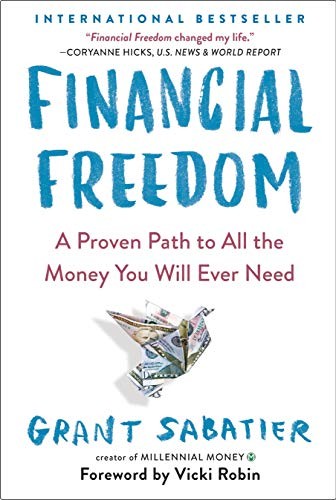
Financial Freedom is Grant Sabatier's account of how he went from $2.26 in his bank account at age 24 to financially independent at 30, and the principles he extracted from that experience into a guide for others pursuing the same goal.
Grant Sabatier · 2019 · 4h 0m
Full summary and key takeaways →The 12 questions
- 1.
Sabatier went from $2.26 to financially independent in six years, primarily through income growth rather than frugality. How much of that path is replicable, and how much depended on his specific circumstances?
- 2.
The savings rate projections Sabatier provides — different rates leading to financial independence in different timeframes — make the tradeoff concrete. What rate are you at now, and what would you give up to increase it significantly?
- 3.
Sabatier gives significant attention to income growth, which most personal finance books underweight. For your career and skills, what is the most realistic path to meaningfully higher income?
- 4.
The 'why' of financial independence — what you want to do with the freedom — is often left unanswered until after the financial work is done. What is your own answer to what you would do with full time freedom?
- 5.
Sabatier argues that financial independence is about optionality, not about stopping work. Does that framing change whether you would still pursue it if you could only retire to your current life?
- 6.
The target number of 25 times annual expenses means that spending reduction is leveraged: cutting $1,000 from annual spending reduces the target by $25,000. How does that arithmetic change how you think about specific expenses?
- 7.
Sabatier's aggressive approach — high savings rate, income growth, side hustles — is demanding. Is his path compatible with the rest of your life's priorities, or does it require trade-offs you're not willing to make?
- 8.
The book was published in 2019, before significant inflation and interest rate changes. How has the macroeconomic environment changed the math on FIRE calculations since then?
- 9.
Sabatier describes the psychological adjustment to financial independence — loss of work identity, structure, and social connection. Is that transition something you have prepared for?
- 10.
What specific income-growth action from the book could you take in the next six months? What's stopping you from taking it?
- 11.
The FIRE community has been criticized for being disproportionately white, male, and high-income. Does the approach Sabatier describes feel accessible across income and demographic groups?
- 12.
Sabatier is explicit that his six-year timeline involved extreme effort and some luck. What timeline is realistic for you, and at what point would the effort stop being worth it?
How to run the discussion
- Pick six to eight, not all of them. An hour of real discussion covers fewer questions than anyone expects, and racing the list is what makes a book club feel like homework.
- Open with what people noticed, not what they concluded. Asking for a verdict first hardens opinions before anyone has heard each other.
- Let the disagreement run. The questions below that split a room are the ones worth the time; the ones everyone answers the same way can be skipped.
- Ask the quiet person a specific question. A direct, narrow question is far easier to answer than an open invitation to contribute.
Themes worth steering toward
If the conversation stalls, these are the threads that usually restart it.
Common questions
What are good book club questions for Financial Freedom?
Here are 12 book club questions for Financial Freedom by Grant Sabatier, ordered to open easily and end somewhere worth arguing about. The strongest openers ask what each reader noticed rather than what they concluded, and the discussion usually turns on financial independence, fire movement, savings optimization.
How long should a book club discussion of Financial Freedom last?
Most groups run 60 to 90 minutes of actual discussion. That is roughly six to eight questions, not all of them, so pick the ones that suit your group rather than working down the list in order.
What are the main themes in Financial Freedom?
Financial independence, FIRE movement, Savings optimization, Income generation, Retirement planning. Those are the threads most likely to divide a room, which makes them the useful places to steer a discussion that has gone quiet.
Picking the next one? See books like Financial Freedom or questions for other book club picks.
