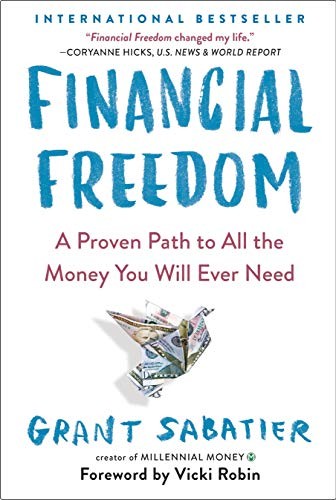
Financial Freedom by Grant Sabatier is a 2019 self-help book about financial independence, fire movement, savings optimization. Financial independence requires working both sides: increasing income and reducing spending simultaneously. A focus on only one side extends the timeline significantly.
Summary
Financial Freedom is Grant Sabatier's account of how he went from $2.26 in his bank account at age 24 to financially independent at 30, and the principles he extracted from that experience into a guide for others pursuing the same goal. Sabatier runs the Millennial Money blog and positioned this book as the FIRE (financial independence, retire early) movement's comprehensive modern guide — addressing not just the investment side but the income generation, psychological preparation, and life design questions that standard personal finance books often skip.
Sabatier's starting proposition is that achieving financial independence in years rather than decades requires working on both sides of the equation simultaneously: increasing income and optimizing spending, not just one or the other. He is more aggressive than most FIRE books about income growth, dedicating significant space to salary negotiation, side hustles, business building, and finding work that pays better in less time. This dual focus distinguishes the book from approaches that primarily emphasize frugality.
The investment framework follows the evidence-based consensus: low-cost index funds, tax-advantaged accounts maxed before taxable, a savings rate aggressive enough to generate the accumulation needed at the target retirement date. Sabatier calculates what different savings rates imply for time to financial independence — a 50 percent savings rate gets you there in roughly 17 years; a 75 percent savings rate in under 10 — and uses these projections to make the impact of savings rate decisions concrete.
The book's most distinctive contribution is the life design section. Sabatier argues that the point of financial independence is not to stop working but to have the freedom to work on what you choose. He addresses the psychological preparation for leaving traditional employment, the questions of identity and purpose that arrive when work is no longer obligatory, and how to evaluate what you actually want to do with time freedom before you achieve it. These questions are often ignored in financial independence writing, and Sabatier's treatment of them adds genuine value beyond the financial framework.
Talk to Financial Freedom like its author wrote you back.
Get the ideas that fit your life — not generic summaries.
- Chat with the book
- Audiobook-style main ideas
- Adapts to your life and goals
- Helps you take action
Key takeaways
- 1.
Financial independence requires working both sides: increasing income and reducing spending simultaneously. A focus on only one side extends the timeline significantly.
- 2.
Your savings rate, more than your investment returns, determines how quickly you reach financial independence. Moving from 20% to 50% savings rate cuts the timeline dramatically.
- 3.
The target number is 25 times annual expenses. Every dollar you eliminate from ongoing spending reduces the required target by 25 dollars — spending reduction is leveraged.
- 4.
Tax-advantaged accounts — 401(k), IRA, HSA — dramatically accelerate accumulation. Maxing them is the highest-priority investment decision for most workers.
- 5.
Income growth is underemphasized in most personal finance. Salary negotiation, skills development, and side income generation can accelerate accumulation more than further spending reductions.
- 6.
Financial independence does not require stopping work. It requires having the option to stop. Most people who achieve it continue working, but on different terms.
- 7.
The psychological transition from accumulation to spending down a portfolio requires preparation that most financial independence books skip. Identity and purpose matter as much as the financial structure.
- 8.
Compound interest works against debt the same way it works for investment. Eliminating high-interest debt early is equivalent to a guaranteed investment return at that interest rate.
Discussion questions
Use these on your own, with a book club, or as chat starters in Superbook. Book club version, ready to copy or print →
- 1.
Sabatier went from $2.26 to financially independent in six years, primarily through income growth rather than frugality. How much of that path is replicable, and how much depended on his specific circumstances?
- 2.
The savings rate projections Sabatier provides — different rates leading to financial independence in different timeframes — make the tradeoff concrete. What rate are you at now, and what would you give up to increase it significantly?
- 3.
Sabatier gives significant attention to income growth, which most personal finance books underweight. For your career and skills, what is the most realistic path to meaningfully higher income?
- 4.
The 'why' of financial independence — what you want to do with the freedom — is often left unanswered until after the financial work is done. What is your own answer to what you would do with full time freedom?
- 5.
Sabatier argues that financial independence is about optionality, not about stopping work. Does that framing change whether you would still pursue it if you could only retire to your current life?
- 6.
The target number of 25 times annual expenses means that spending reduction is leveraged: cutting $1,000 from annual spending reduces the target by $25,000. How does that arithmetic change how you think about specific expenses?
- 7.
Sabatier's aggressive approach — high savings rate, income growth, side hustles — is demanding. Is his path compatible with the rest of your life's priorities, or does it require trade-offs you're not willing to make?
- 8.
The book was published in 2019, before significant inflation and interest rate changes. How has the macroeconomic environment changed the math on FIRE calculations since then?
- 9.
Sabatier describes the psychological adjustment to financial independence — loss of work identity, structure, and social connection. Is that transition something you have prepared for?
- 10.
What specific income-growth action from the book could you take in the next six months? What's stopping you from taking it?
- 11.
The FIRE community has been criticized for being disproportionately white, male, and high-income. Does the approach Sabatier describes feel accessible across income and demographic groups?
- 12.
Sabatier is explicit that his six-year timeline involved extreme effort and some luck. What timeline is realistic for you, and at what point would the effort stop being worth it?
Themes
Frequently asked questions
-
How did Grant Sabatier reach financial independence so quickly?
Primarily through income growth: he took on multiple consulting clients, built a digital marketing agency, and grew his income substantially while keeping living expenses relatively stable. He invested aggressively in index funds during a bull market period. The combination of high savings rate and market performance over six years produced the result. The market conditions were favorable; the income growth required genuine effort.
-
What is the difference between Financial Freedom and Your Money or Your Life?
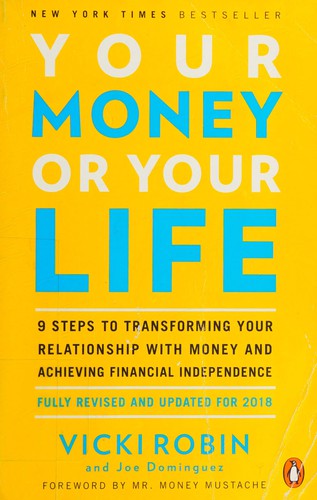
Your Money or Your Life is a philosophical book about redesigning your relationship with work and money; it doesn't provide much specific investment guidance. Financial Freedom provides a comprehensive tactical plan: specific account types, fund choices, savings rate calculations, and income-growth strategies. It is more actionable and more specific, though less philosophically rich.
-
Is the 4 percent rule the right withdrawal rate?
Sabatier discusses this in depth. The 4 percent rule emerged from Trinity Study research on historical 30-year retirements with a 50-50 stock-bond allocation. For longer retirements (FIRE at 30 means potentially 60+ years), a lower withdrawal rate may be more conservative. Sabatier discusses 3.5 percent as a more conservative target for very early retirees.
-
What is the target number?
25 times your annual expenses. If you spend $40,000 per year, you need $1 million invested in a diversified portfolio to be financially independent at the 4 percent withdrawal rate. Every $1 of annual spending reduced saves $25 in required portfolio balance — which is why spending reduction is so powerful for FIRE calculations.
-
Does Financial Freedom recommend index funds?
Yes, consistently. Sabatier recommends low-cost index funds — specifically Vanguard's total market and international funds — as the investment vehicle for both the accumulation and distribution phases. This is consistent with the broader evidence-based personal finance consensus.