Business · Book club
First, Break All the Rules book club questions
Here are 12 book club questions for First, Break All the Rules by Marcus Buckingham and Curt Coffman, ordered to open easily and end somewhere worth arguing about. Copy them, print them, or bring them up one at a time.
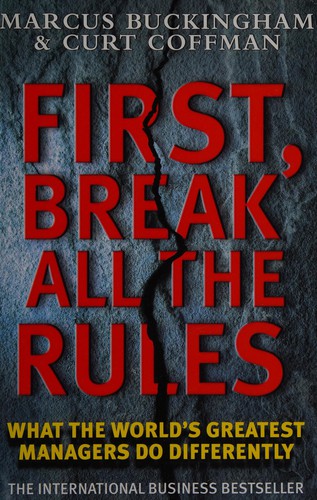
First, Break All the Rules is the result of Gallup's analysis of interviews with more than 80,000 managers across a variety of industries, aimed at identifying what distinguishes the best managers from the rest.
Marcus Buckingham and Curt Coffman · 1999 · 5h 0m
Full summary and key takeaways →The 12 questions
- 1.
Gallup's data shows the direct manager matters more than any other variable. Think back to your best and worst work experiences — how true does this finding feel in your own history?
- 2.
The book argues that great managers build on strengths rather than fixing weaknesses. In your current role, are you spending more time developing strengths or correcting weaknesses — your own or your team's?
- 3.
Which of the Q12 questions would your team currently score lowest on? What specifically would need to change to improve that score?
- 4.
Buckingham and Coffman say treating everyone fairly means treating each person according to what they need, not treating everyone identically. How do you currently customize your management style to individual team members?
- 5.
Have you ever been promoted into a role you were poorly suited for — or watched someone else be promoted in that situation? What made the promotion the wrong call?
- 6.
What's the most important 'rule' of conventional management wisdom that you've observed being broken by excellent managers? What were the results?
- 7.
The Q12 includes 'I have a best friend at work.' This sounds soft, but the data supports it as a performance predictor. What does this say about the relationship between social connection and performance?
- 8.
Where in your team are you trying to fix a weakness rather than build on a strength? What would the strengths-based alternative look like?
- 9.
The book was published in 1999. Which of its prescriptions feel like obvious conventional wisdom now, and which are still genuinely counterintuitive in your organization?
- 10.
If your team answered the Q12 right now, what score do you think you'd get? Where are the gaps between your self-assessment and what you think they'd actually say?
- 11.
People don't leave companies, they leave managers. Is this true in your experience? What's the best evidence you have either way?
- 12.
What does your organization actually do to develop managers, as opposed to what it says it does? Is the investment proportionate to how much managers matter?
How to run the discussion
- Pick six to eight, not all of them. An hour of real discussion covers fewer questions than anyone expects, and racing the list is what makes a book club feel like homework.
- Open with what people noticed, not what they concluded. Asking for a verdict first hardens opinions before anyone has heard each other.
- Let the disagreement run. The questions below that split a room are the ones worth the time; the ones everyone answers the same way can be skipped.
- Ask the quiet person a specific question. A direct, narrow question is far easier to answer than an open invitation to contribute.
Themes worth steering toward
If the conversation stalls, these are the threads that usually restart it.
Common questions
What are good book club questions for First, Break All the Rules?
Here are 12 book club questions for First, Break All the Rules by Marcus Buckingham and Curt Coffman, ordered to open easily and end somewhere worth arguing about. The strongest openers ask what each reader noticed rather than what they concluded, and the discussion usually turns on management, employee engagement, strengths.
How long should a book club discussion of First, Break All the Rules last?
Most groups run 60 to 90 minutes of actual discussion. That is roughly six to eight questions, not all of them, so pick the ones that suit your group rather than working down the list in order.
What are the main themes in First, Break All the Rules?
Management, Employee engagement, Strengths, Talent development, Workplace performance. Those are the threads most likely to divide a room, which makes them the useful places to steer a discussion that has gone quiet.
Picking the next one? See books like First, Break All the Rules or questions for other book club picks.
