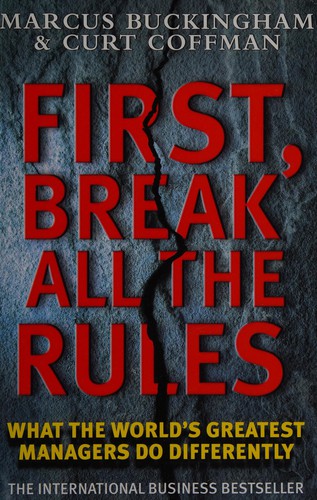
First, Break All the Rules by Marcus Buckingham and Curt Coffman is a 1999 business book about management, employee engagement, strengths. The single most important variable in employee performance and retention is the quality of the relationship with the direct manager. Everything else is secondary.
Summary
First, Break All the Rules is the result of Gallup's analysis of interviews with more than 80,000 managers across a variety of industries, aimed at identifying what distinguishes the best managers from the rest. The central finding is both simple and counterintuitive: great managers don't follow the conventional wisdom about management. They break the rules. And they break them in consistent, specific ways.
The most important finding is that the relationship between an employee and their direct manager matters more than any other variable in employee performance and retention — more than company policies, compensation, or executive leadership. The authors use this to argue that companies should hire managers more carefully, develop them more deliberately, and hold them more accountable than most organizations currently do.
The book is built around twelve questions that measure employee engagement — known as the Q12 — covering whether employees know what's expected of them, whether they have the tools to do their job, whether they have the opportunity to do what they do best, and whether anyone at work cares about their development. Buckingham and Coffman argue that managers who score well on the Q12 consistently outperform on every business metric.
The second half of the book challenges conventional management wisdom directly: the best managers don't try to fix weaknesses, they build on strengths. They don't treat everyone the same, they treat each person according to their unique talent profile. They don't promote the best performers, they promote those who have the talent to thrive at the next level. These prescriptions cut against most HR orthodoxy of the time and remain genuinely countercultural in many organizations today.
Talk to First, Break All the Rules like its author wrote you back.
Get the ideas that fit your life — not generic summaries.
- Chat with the book
- Audiobook-style main ideas
- Adapts to your life and goals
- Helps you take action
Key takeaways
- 1.
The single most important variable in employee performance and retention is the quality of the relationship with the direct manager. Everything else is secondary.
- 2.
Great managers don't try to fix weaknesses — they identify each person's unique talents and build roles that leverage those talents instead.
- 3.
The Q12 — twelve questions measuring employee engagement — predicts business unit performance more reliably than most financial metrics. Managers who score well on these questions outperform consistently.
- 4.
Treating everyone fairly does not mean treating everyone the same. The best managers customize their approach to each individual's needs, motivations, and working style.
- 5.
Promoting the best performer is one of the most common management mistakes. Talent for performing in a role is not the same as talent for managing that role.
- 6.
Most conventional management wisdom — 'help people overcome their weaknesses,' 'treat everyone equally,' 'promote the best performers' — is wrong, and the data shows it.
- 7.
The catalyst for performance is the direct manager, not corporate programs. HR initiatives that bypass the manager and try to engage employees directly are almost always ineffective.
- 8.
People don't leave companies — they leave managers. Turnover analysis that focuses on company factors rather than manager factors is missing the main cause.
Discussion questions
Use these on your own, with a book club, or as chat starters in Superbook. Book club version, ready to copy or print →
- 1.
Gallup's data shows the direct manager matters more than any other variable. Think back to your best and worst work experiences — how true does this finding feel in your own history?
- 2.
The book argues that great managers build on strengths rather than fixing weaknesses. In your current role, are you spending more time developing strengths or correcting weaknesses — your own or your team's?
- 3.
Which of the Q12 questions would your team currently score lowest on? What specifically would need to change to improve that score?
- 4.
Buckingham and Coffman say treating everyone fairly means treating each person according to what they need, not treating everyone identically. How do you currently customize your management style to individual team members?
- 5.
Have you ever been promoted into a role you were poorly suited for — or watched someone else be promoted in that situation? What made the promotion the wrong call?
- 6.
What's the most important 'rule' of conventional management wisdom that you've observed being broken by excellent managers? What were the results?
- 7.
The Q12 includes 'I have a best friend at work.' This sounds soft, but the data supports it as a performance predictor. What does this say about the relationship between social connection and performance?
- 8.
Where in your team are you trying to fix a weakness rather than build on a strength? What would the strengths-based alternative look like?
- 9.
The book was published in 1999. Which of its prescriptions feel like obvious conventional wisdom now, and which are still genuinely counterintuitive in your organization?
- 10.
If your team answered the Q12 right now, what score do you think you'd get? Where are the gaps between your self-assessment and what you think they'd actually say?
- 11.
People don't leave companies, they leave managers. Is this true in your experience? What's the best evidence you have either way?
- 12.
What does your organization actually do to develop managers, as opposed to what it says it does? Is the investment proportionate to how much managers matter?
Themes
Frequently asked questions
-
Is First, Break All the Rules worth reading in 2025?
Yes. The core findings about manager impact and strengths-based development have been replicated and extended in subsequent decades of research. Some of the prescriptions felt radical in 1999 and still cut against standard HR practice. The Q12 framework remains one of the most practical engagement measurement tools available.
-
How long does it take to read First, Break All the Rules?
Around five hours for the 255-page book. It's clearly structured with data-backed argument, making it a relatively fast read despite the research depth.
-
What are the Q12 questions?
Twelve questions measuring the conditions for employee engagement, including whether employees know what's expected, have the tools they need, have the opportunity to do what they do best, receive regular recognition, have a manager who cares about their development, and have a best friend at work. The full list is in the book. Gallup licenses the survey commercially.
-
Who should read First, Break All the Rules?
Managers who want to understand what the research actually says about what drives team performance. Also useful for HR professionals who want a data-backed challenge to conventional management development frameworks.
-
What does the book mean by 'break all the rules'?
The great managers in Gallup's data systematically violated conventional management wisdom: they didn't try to develop well-rounded employees, they didn't treat everyone the same, they didn't promote their best performers. The 'rules' being broken are the unofficial orthodoxies that most managers absorb from training programs and conventional wisdom.