Self-help · Book club
Four Thousand Weeks: Time Management for Mortals book club questions
Here are 12 book club questions for Four Thousand Weeks: Time Management for Mortals by Oliver Burkeman, ordered to open easily and end somewhere worth arguing about. Copy them, print them, or bring them up one at a time.
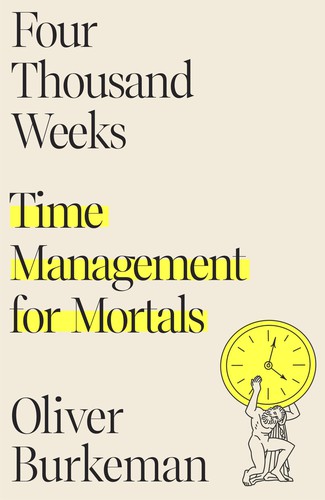
Four Thousand Weeks is Oliver Burkeman's philosophical attack on the entire project of time management as it is usually practiced.
Oliver Burkeman · 2021 · 5h 0m
Full summary and key takeaways →The 12 questions
- 1.
Burkeman argues that the fantasy of 'getting on top of everything' is structurally impossible. Does accepting that change how you feel about your current task list?
- 2.
What does the efficiency trap look like in your own life? Where has becoming faster or more organized generated more demand rather than more freedom?
- 3.
If you had only four thousand weeks from birth, and you've already spent some of them — how many remain? What does that number feel like?
- 4.
Burkeman makes a case for doing less and choosing more consciously. What would you give up, right now, if you took that seriously?
- 5.
He describes the 'when I finally' fantasy as a way of avoiding present decisions. Where in your own life are you waiting for conditions that will never arrive?
- 6.
Convenience culture has reduced friction in daily life. Where in your experience does friction — difficulty, effort, commitment — actually produce more satisfaction than convenience?
- 7.
Burkeman draws on Heidegger's concept of thrownness — finding yourself alive without choosing it. How does thinking of your life as thrown, rather than constructed, change what feels important?
- 8.
He argues that serialization produces better outcomes than parallel pursuit of multiple projects. What are you currently running in parallel that would benefit from finishing one before starting the next?
- 9.
What is the project or commitment you're most avoiding starting because the inevitable imperfection of beginning is uncomfortable?
- 10.
The book suggests that much of digital distraction is actually distraction from the anxiety of finitude — the fear of choosing poorly. Does that ring true for how you use your phone?
- 11.
Burkeman's prescriptions are anti-optimization: tolerate the anxiety, choose consciously, accept undone-ness. Is that genuinely satisfying advice, or does it feel like giving up?
- 12.
What would change about your daily schedule if you stopped pretending that you might eventually catch up and instead designed each day around what actually deserves your four thousand weeks?
How to run the discussion
- Pick six to eight, not all of them. An hour of real discussion covers fewer questions than anyone expects, and racing the list is what makes a book club feel like homework.
- Open with what people noticed, not what they concluded. Asking for a verdict first hardens opinions before anyone has heard each other.
- Let the disagreement run. The questions below that split a room are the ones worth the time; the ones everyone answers the same way can be skipped.
- Ask the quiet person a specific question. A direct, narrow question is far easier to answer than an open invitation to contribute.
Themes worth steering toward
If the conversation stalls, these are the threads that usually restart it.
Common questions
What are good book club questions for Four Thousand Weeks: Time Management for Mortals?
Here are 12 book club questions for Four Thousand Weeks: Time Management for Mortals by Oliver Burkeman, ordered to open easily and end somewhere worth arguing about. The strongest openers ask what each reader noticed rather than what they concluded, and the discussion usually turns on time management, mortality, productivity.
How long should a book club discussion of Four Thousand Weeks: Time Management for Mortals last?
Most groups run 60 to 90 minutes of actual discussion. That is roughly six to eight questions, not all of them, so pick the ones that suit your group rather than working down the list in order.
What are the main themes in Four Thousand Weeks: Time Management for Mortals?
Time management, Mortality, Productivity, Intentional living, Finitude. Those are the threads most likely to divide a room, which makes them the useful places to steer a discussion that has gone quiet.
Picking the next one? See books like Four Thousand Weeks: Time Management for Mortals or questions for other book club picks.
